AI Overviews Stability Study 2026: Citation Checklist for Social Media Marketers
A source-backed 2026 checklist for social media marketers who want AI Overviews, AI Mode and answer engines to cite useful pages.

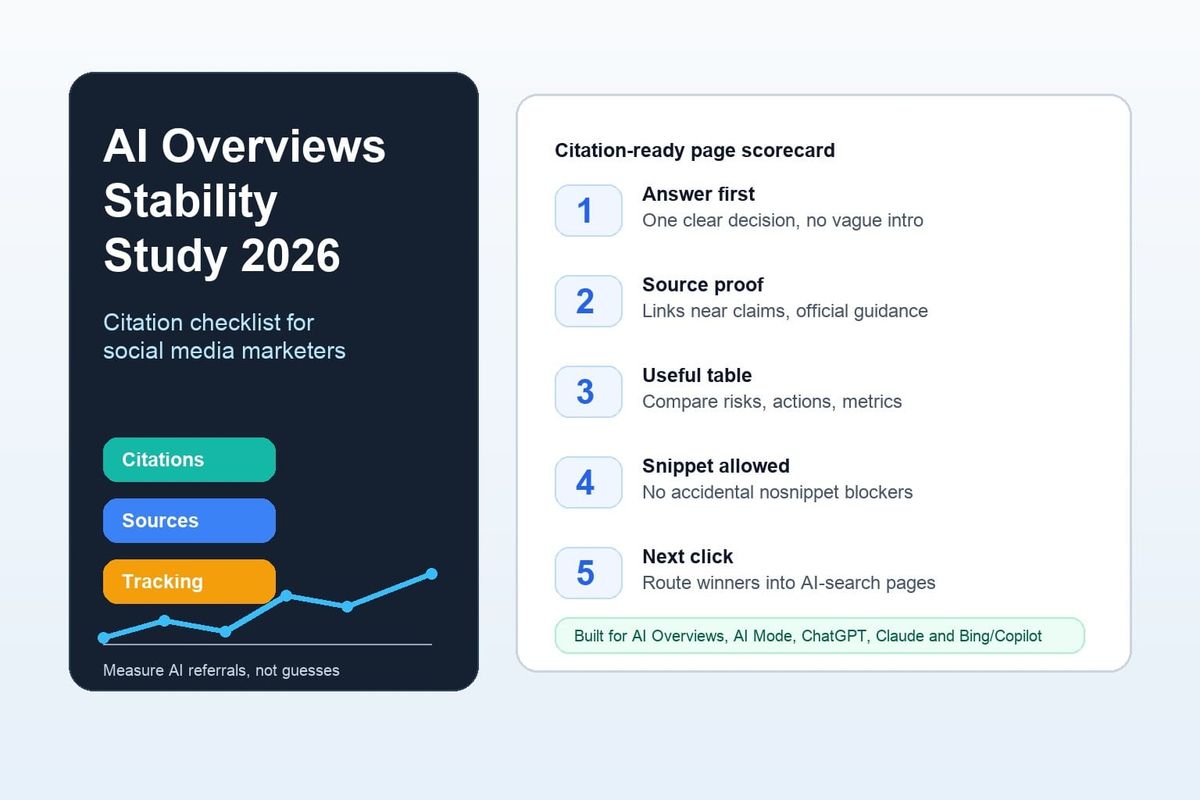
Quick answer: what the AI Overviews study changes
AI Overviews stability work in 2026 is not a trick for gaming Google. It is a practical publishing discipline: make each page easy to crawl, easy to summarize, easy to verify, and easy to measure. A fresh WordStream study on AI Overviews stability makes the same operational point Crescitaly sees in its own Ghost data: AI-search traffic is real, but it is volatile, and weak pages do not become stable just because they mention artificial intelligence.
For social media marketers, the useful move is to turn every AI-search page into a decision asset. The page should answer one concrete question, cite sources near the claim, show a table or checklist, and route readers to the next campaign action. That gives Google AI Overviews, AI Mode, Bing/Copilot, ChatGPT, Claude and other assistants more grounded material to cite.
This checklist is designed for social growth teams, creator agencies, SMM operators and ecommerce marketers who need visibility from AI-search surfaces without flooding the blog with generic AI content.
What this means for Crescitaly growth
The immediate decision rule is simple: use AI-search research to improve measurable routes, not to publish vague AI commentary. If a WordStream-style stability signal appears, Crescitaly should convert it into one practical page, then watch whether Google, Bing, ChatGPT and Claude send visible traffic to that exact slug.
Example workflow: publish one source-backed checklist, link it from current TikTok or homepage winners, keep the feature image stable for the first measurement window, and review the 6h and 24h velocity before creating any translated or same-angle variant. That turns the study into a controlled test rather than another unmeasured article.
Why AI Overview stability matters for social teams
AI Overviews and AI Mode can reduce simple clicks, but they also create new moments where a useful source can be discovered. The challenge is stability. A page may be visible one day and absent the next because AI answers depend on query interpretation, source mix, freshness, authority signals and whether the page gives enough usable context.
That is why a social media marketing blog should avoid broad titles such as AI strategy for growth. A stronger page has a platform, audience, risk or measurement anchor: TikTok creator disclosure, YouTube likeness detection, Instagram Reels safety, Bing/Copilot shopping discovery, or AI Overview citation measurement. The more precise the job, the easier it is for a user or assistant to decide whether the page fits.
| AI-search risk | What it looks like | Better Crescitaly action |
|---|---|---|
| Unstable citations | The page gets impressions but few AI-source visits. | Add source-backed sections, answer-first copy and internal links from proven winners. |
| Generic AI angle | The title could fit any marketing blog. | Anchor the page to a specific platform, tool, policy, risk or workflow. |
| Weak snippet control | The best paragraph is buried or blocked by snippet limits. | Keep snippets allowed and put the practical answer near the top. |
| No measurement loop | AI visits are mixed into Direct or generic referral traffic. | Track ChatGPT, Claude, Bing/Copilot and Google separately where possible. |
The 2026 citation-readiness scorecard
Use this scorecard before publishing or refreshing a page. A page does not need to be long for its own sake, but it should contain enough evidence and structure for a human reader and an AI assistant to inspect it quickly.
- One query job: The page answers one decision, such as whether AI Overviews are stable enough to influence a creator visibility plan.
- Named source context: The source is identified clearly, with a link and a plain-language explanation of what the source contributes.
- Answer-first opening: The first section gives the practical takeaway before background details.
- Comparison or checklist: The page includes a table, step list or scorecard that can be quoted or summarized without losing context.
- AI search and citation readiness: The page explains why ChatGPT, Claude, Gemini, Perplexity, Copilot or Google AI surfaces should understand the topic.
- Internal next-click: The page links to a related Crescitaly guide, service page or cluster page so readers do not stop at a single article.
- Measurement hook: The page states which sources, referrers, clicks or assisted conversions should be watched after publication.
How to structure pages for AI Overviews and AI Mode
Google's official guidance for AI features points site owners back to strong Search fundamentals: make content crawlable, indexable, useful and eligible for snippets. The important detail for marketers is that AI features still need usable page content. If the page is thin, blocked, outdated or difficult to summarize, it is a weak candidate for answer surfaces.
For a social media marketing page, use this structure:
- Quick answer: State who the guide is for and what to do next.
- Why it matters now: Explain the current platform, search or creator-economy change.
- Scorecard: Give an evaluation table with criteria and action.
- Workflow: Show how to apply the insight to content, campaigns, reporting or conversion paths.
- Measurement: Define what to track after the update.
- Sources: Link to official or high-quality references near the bottom and near important claims when useful.
Do not hide the answer under a huge intro. AI Overviews and AI Mode are answer-first experiences, so the page should earn trust quickly and then give depth.
Measurement plan for AI-search visibility
AI visibility is only useful if it becomes measurable. For Crescitaly, the current priority is to separate AI and search-adjacent sources from Direct traffic. The blog should track Google, Bing, ChatGPT, Claude and similar sources as separate lanes, then compare the pages that actually receive those visits.
Use three measurement windows:
- First 6 hours: Check whether the post has any unique visitors and whether its source path appears in Ghost or first-party tracking.
- First 24 hours: Decide whether the post is a weak-watch page, a light rescue candidate, or a page worth protecting.
- Last 30 days: Compare AI-source share against total visitors, Direct dependency and top content patterns.
A good target is not simply more posts. A better target is a higher share of measurable AI/search-adjacent visits, more internal next-clicks from winners, and fewer generic articles that create no durable source path.
What not to change when traffic is still immature
Do not rewrite a new post just because the first few hours are quiet. A young post needs enough time to appear in RSS, be crawled, collect referrals and show whether the title, source and internal links are working. If the 6h window is not due, keep the title, body and image stable.
Do not regenerate images just to create activity. If the feature image is public, has social cards, matches the topic and is still inside the watch window, preserve it. Image work should happen when a share card fails, the image is clearly generic after a mature weak result, or a winner needs protection with a more specific cover.
Do not publish another same-angle variant while the measured pattern is flat. If several AI-search posts produce only a few visitors each, pause the cluster and improve distribution, links, source fit or measurement first.
30-day execution checklist
Days 1-7: Audit the current top content. Protect the homepage, monthly TikTok winners and any AI-source pages that already receive ChatGPT, Claude or Bing visits. Confirm each winner links to a relevant AI-search or current-month next-click page.
Days 8-14: Refresh pages with high impressions and low CTR. Change only the title, meta, opening answer or source section when the page has clear evidence that the problem is click intent or citation clarity.
Days 15-21: Build one source-backed AI-search article per open buffer slot. Each article must have a unique source, a platform or workflow anchor, a table, FAQ, sources and a feature image.
Days 22-30: Compare AI-source share, Direct share, top location concentration and internal next-clicks. If AI-source share falls, route existing winners to the best AI pages before increasing publishing volume.
Distribute this guide
Post on X · LinkedIn · Facebook · WhatsApp · Telegram · Email
2026 source update: searchenginejournal.com
This refresh adds current source context to keep the guide useful for readers, answer engines, and teams comparing social media workflows in 2026.
- Google AI Overviews Study Finds Lost Clicks Weren't Lower Quality (searchenginejournal.com) - An updated AI Overviews experiment finds no measurable difference in bounce rates, time on site, or returns to search between clicks with and without summaries.
Use these sources as verification points, then adapt the checklist in this guide to your channel, reporting cadence, and risk tolerance.
FAQ
Should marketers optimize only for AI Overviews?
No. Google says AI features rely on normal Search systems and eligibility, so the safer strategy is to improve crawlability, useful content, source clarity, snippets and measurement.
What should a social media marketing page add for AI citations?
Add a direct answer, current source links, a comparison table, a checklist, clear platform context, FAQ schema and a measurable next step.
When should Crescitaly rewrite a weak AI-search post?
Only after the 6h or 24h measurement window shows weak velocity and the page has no simpler next-click, source or internal-link fix.
Which metrics matter most?
Track Google, Bing, ChatGPT, Claude and other AI referrers separately, then compare page views, internal next-clicks, service-page visits and assisted conversions.
Sources
- WordStream: AI Overviews stability study
- Google Search Central: AI features and your website
- Google Search Central: generative AI optimization guide
- Google Search Central: robots meta tag controls
- Google: new controls and insights for website owners