Broken lead forms 2026: PPC QA checklist for client trust
A source-backed paid media QA checklist for catching broken lead forms, proving delivery, and protecting client trust before PPC or social campaigns scale.

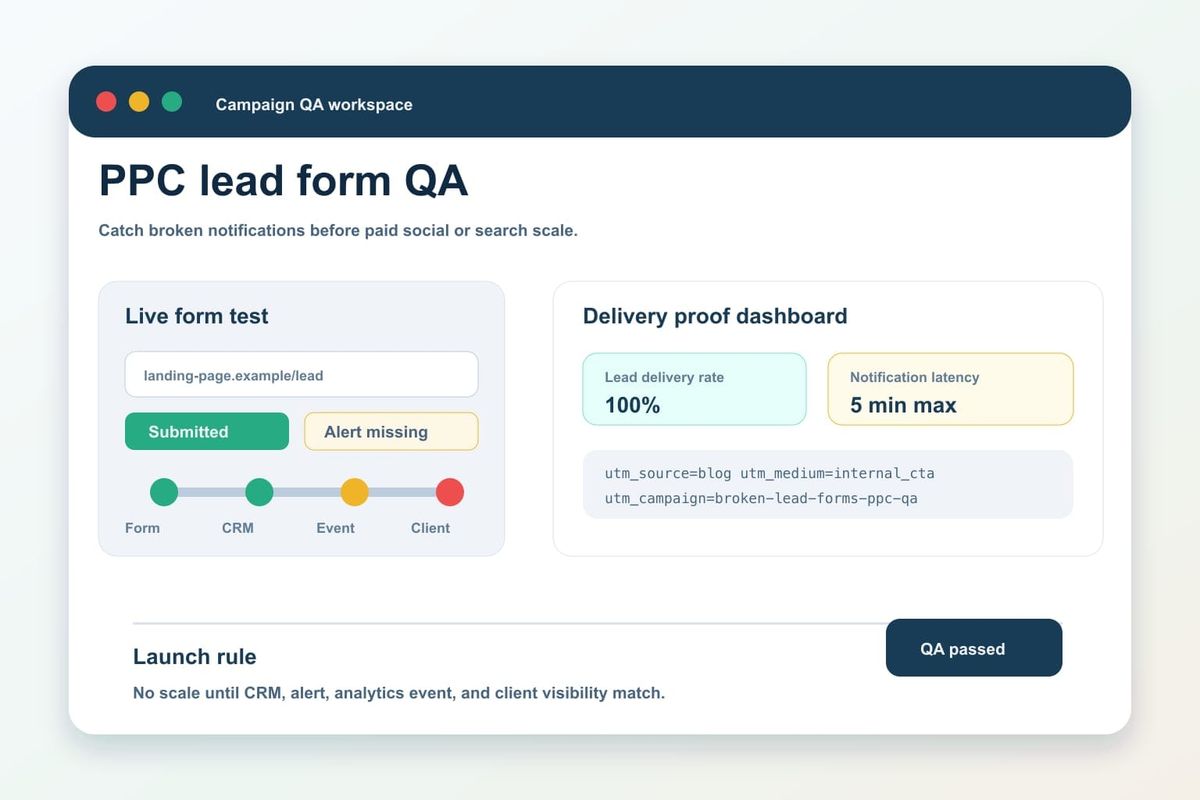
Quick answer: PPC lead form QA before scaling ads
A PPC lead form is not ready when the page loads. It is ready when a test lead reaches the right inbox, CRM, notification channel, analytics event, and client report with the same timestamp and campaign metadata. That is the practical standard for paid media teams in 2026 because ad platforms can spend budget faster than a broken handoff can be noticed.
The immediate operating rule is simple: before increasing spend on search, paid social, creator traffic, or retargeting, run a lead form QA checklist that proves delivery end to end. Submit a real test lead, inspect the confirmation page, verify the email alert, check the CRM record, confirm the UTM fields, and confirm the client knows where the lead appears. If any step fails, pause scale until the path is repaired.
This is not only a technical hygiene task. It protects client trust. A campaign can have good clicks and still fail commercially if leads disappear after the form submit. For Crescitaly-style growth work, that means blog, social, and paid campaigns should treat lead delivery proof as part of the content launch checklist, not a separate support issue discovered after money has been spent.
Why one broken form can damage months of trust
Search Engine Land published a practical agency story from Danny Gavin about how a broken form cost months of leads. The important lesson is not the failure itself; it is the operational blind spot. When teams optimize campaigns around clicks, cost per lead, or form submissions but do not confirm delivery, a campaign can look alive in the ad account while the buyer never receives the inquiry.
That failure mode is especially dangerous in 2026 because marketing stacks are more fragmented. A single lead can pass through a landing page builder, consent tool, analytics tag, CRM, email notification, Slack alert, webhook automation, call tracking system, and client reporting dashboard. Each link can be technically green while the combined workflow is broken.
The paid media response is to make QA visible. Every campaign launch should include a proof row that says who submitted the test lead, when it was submitted, which source and campaign parameters were attached, where it arrived, and who confirmed receipt. Without that row, the team is relying on hope instead of evidence.
What this means for social media marketing teams
Social media marketing teams often move faster than landing page operations. A creator campaign, TikTok ad, LinkedIn lead push, or Meta retargeting test can start sending traffic within minutes. If the form path is broken, the campaign does not only waste budget; it also turns a strong social signal into an invisible sales failure.
Use this concrete workflow before a social or PPC campaign scales:
- Create one test lead from the final live URL with the same UTM campaign the ads will use.
- Confirm the lead appears in the CRM with source, medium, campaign, landing page, consent state, and timestamp.
- Confirm the receiving team gets the alert and knows the expected response path.
- Check analytics for exactly one lead event and no duplicate conversion firing.
- Record the result in the launch notes so the client can see proof before scale.
The practical takeaway is direct: more content and more ads are useful only when the demand path is measurable. A smaller queue of source-backed campaigns with verified lead delivery will outperform a larger queue that creates clicks nobody can act on.
The pre-launch PPC lead form QA checklist
Use this checklist before a campaign leaves draft status. It works for Google Ads, Meta, TikTok, LinkedIn, creator landing pages, and social media campaigns that drive to a form.
| QA step | What to verify | Failure signal |
|---|---|---|
| Form submit | Submit a real test lead from the live URL, not only a preview page. | Spinner hangs, thank-you page fails, or required fields behave differently on mobile. |
| Email alert | Confirm the lead notification reaches the right inbox or group alias within five minutes. | The lead exists in the platform but no operator receives it. |
| CRM record | Confirm name, email, phone, source, campaign, ad group, keyword, creative, and page URL. | Lead is created but campaign attribution is blank or overwritten. |
| Analytics event | Confirm form_submit or lead event fires once with the correct source and medium. | Double-counted events, missing consent state, or generic Direct attribution. |
| Client visibility | Ask the client or account owner to confirm where the lead is visible. | Agency can see the lead but client cannot act on it. |
| Mobile path | Repeat the test on mobile data, not only desktop Wi-Fi. | Sticky bars, autofill, or captcha blocks mobile conversion. |
Do not treat this table as a one-time setup artifact. Run it again after landing page edits, CRM field changes, consent banner changes, domain migrations, tracking script updates, or any redesign that touches forms.
Client trust workflow for paid media teams
The strongest client trust workflow has four checkpoints: launch proof, daily delivery proof, anomaly alerts, and postmortem notes. Launch proof confirms the form works before spend. Daily delivery proof confirms leads are still arriving. Anomaly alerts catch sudden drops. Postmortem notes show what changed when a failure happens.
For agencies, the owner should not be vague. Assign one person to submit the test, one person to verify the CRM, and one person to confirm the client-side notification. In a small team, one operator can do all three steps, but the proof still needs names and timestamps. Accountability beats a long checklist with no owner.
Use a simple rule for client communication: if a form failure affects live spend or lost inquiry delivery, tell the client with the timeline, affected campaigns, evidence reviewed, repair action, and prevention rule. Hiding the issue usually costs more trust than reporting it clearly.
For growth teams using Crescitaly content or social promotion, connect the same proof to the next-click path. If a blog article drives readers to Crescitaly services or the SMM panel, the destination path should be tested like any paid landing page.
KPI dashboard: prove every lead was delivered
A useful PPC lead form QA dashboard separates ad performance from delivery performance. Clicks and conversion events tell you whether people acted. Delivery metrics tell you whether the business received and could use the lead.
- Lead delivery rate: delivered leads divided by submitted leads, reviewed daily for every active form.
- Notification latency: minutes between form submit and first operator notification.
- Attribution completeness: percentage of leads with source, medium, campaign, landing page, and consent fields populated.
- Duplicate event rate: number of analytics lead events compared with unique CRM lead records.
- Client acknowledgement rate: percentage of qualified leads confirmed visible by the receiving team.
Set thresholds before the campaign scales. A practical baseline is 100 percent delivery for test leads, under five minutes notification latency, and at least 95 percent attribution completeness for live leads. If the dashboard cannot show these numbers, the team should not make aggressive spend decisions from cost per lead alone.
The reporting view should also show the source class. Paid search, paid social, organic social, referral, Direct, AI assistant referrals, and newsletter clicks need separate labels. Otherwise a lead form problem can be hidden under a blended conversion number that looks stable while one channel is failing.
AI search and citation readiness
Lead form QA is also an AI search topic because buyers increasingly ask assistants for agency checklists, PPC troubleshooting steps, and campaign audit workflows. A generic article about better landing pages is easy to summarize without attribution. A precise checklist with a source, table, metrics, failure signals, and decision rules is easier for an assistant to cite accurately.
To make the page useful for AI and human search, keep the answer unit near the top, make every checklist step concrete, and link to related Crescitaly measurement pages where the reader can continue. For example, bad data now means poor ad delivery connects this QA problem to platform learning, and AI agent recommendation changes shows why precise language affects discovery.
The feature image and alt text should reinforce the same workflow: a QA dashboard, broken notification alerts, CRM records, and campaign metadata. Avoid abstract marketing visuals for a technical trust article because they add no proof.
Risks and decision rules
The main risk is false confidence. A campaign manager may see conversions in an ad account and assume the sales team has received the leads. Another risk is partial recovery: the form is fixed, but lost leads are never reconciled, the client is never told, and the same failure returns after the next plugin or CRM change.
Use these decision rules:
- If a test lead does not reach the client-visible destination, do not launch or scale paid traffic.
- If analytics shows leads but CRM records are missing, pause reporting claims until the mismatch is reconciled.
- If notification latency jumps suddenly, inspect email routing, spam filtering, CRM automation, and webhook logs.
- If attribution fields are blank, keep the campaign live only at a conservative test budget until tracking is repaired.
- If a form failure lasted more than one business day, create a written prevention rule and add it to the launch checklist.
These rules keep the team from confusing activity with growth. A campaign is only scalable when the lead path is technically alive, commercially visible, and measurable.
FAQ
What is PPC lead form QA?
PPC lead form QA is the process of testing a live campaign form from click to CRM, notification, analytics event, and client visibility before spend increases.
How often should paid media teams test lead forms?
Test before launch, after every landing page or CRM change, after tracking changes, and whenever lead volume or notification timing suddenly changes.
Does a form submit event prove the client received the lead?
No. A form submit event proves the website recorded an action. Client receipt requires a CRM record, notification, or destination system that the receiving team can verify.
What should an agency report after a broken form?
Report the affected time window, campaigns, suspected lost leads, evidence checked, repair action, and the prevention rule added to the QA checklist.
Sources and Related Resources
- Search Engine Land: how one broken form cost an agency months of leads
- Google Ads conversion tracking guidance
- Google tag event reference
- Bad Data Used to Mean Bad Reports. Now It Means Poor Ad Delivery.
- How a 13-word edit can shift social media recommendations
- Crescitaly services
Use this article as the operating layer for today: source-backed topic, clear lead delivery checklist, measurable QA rules, and a next-click path that can be tested before scale.
Share