Fortnite AI Characters Explained: 2026 Social Strategy
The latest Fortnite creator update is a useful signal for anyone building a modern social media marketing strategy. According to The Verge’s report , developers can now build AI-driven characters that hold conversations inside Fortnite. The

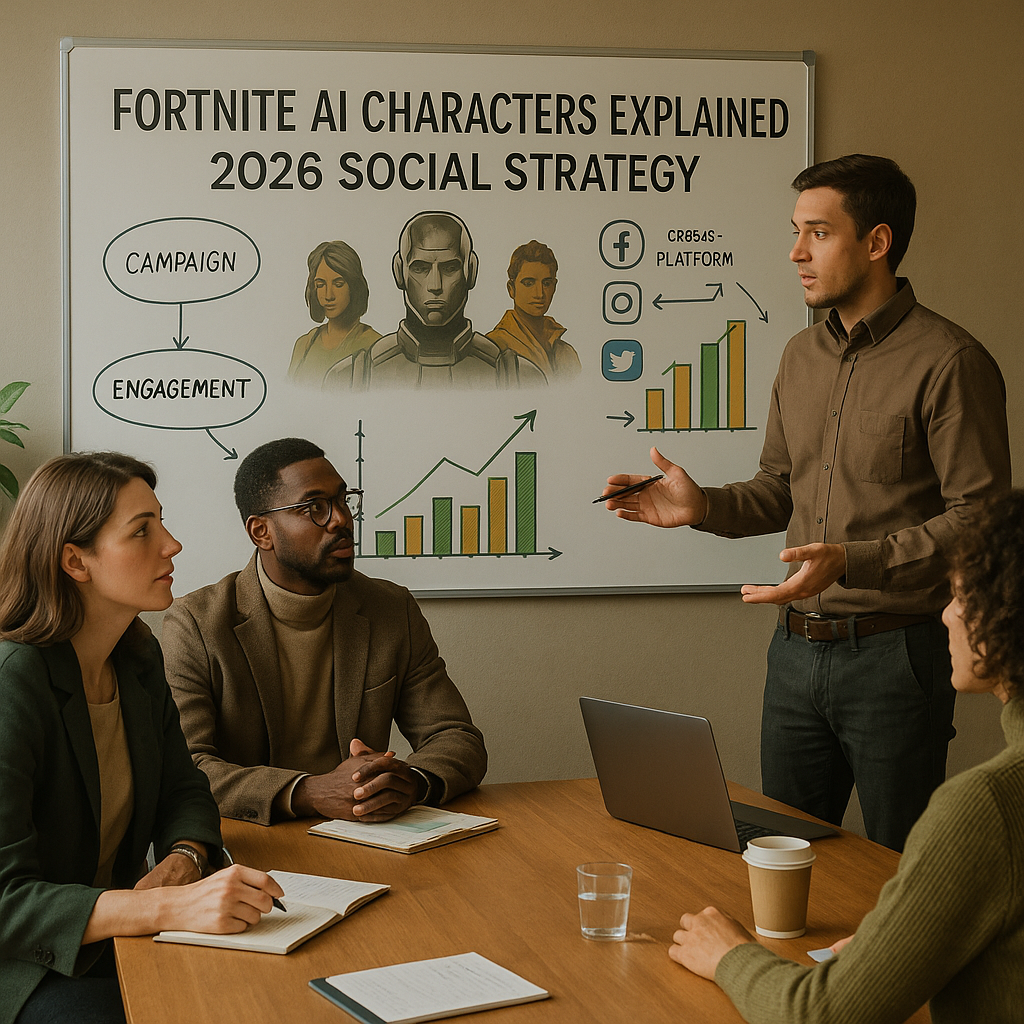
The latest Fortnite creator update is a useful signal for anyone building a modern social media marketing strategy. According to The Verge’s report, developers can now build AI-driven characters that hold conversations inside Fortnite. The detail that made headlines is simple: Epic is opening a new layer of interactive storytelling, but it is also drawing a clear line about boundaries. The “don’t try to date them” angle is part joke, part product design, and part reminder that conversational AI needs guardrails.
For marketers, the real story is not gaming novelty. It is how audience expectations are changing. People are no longer satisfied with static posts, generic replies, or one-way announcements. They respond to experiences that feel alive, responsive, and personalized. That shift is directly relevant to a social media marketing strategy built for 2026, where attention is scarce and engagement quality matters more than vanity reach.
Key takeaway: AI characters are a reminder that effective social media marketing strategy now depends on interactive design, clear boundaries, and audience-safe personalization.
What Fortnite’s AI character update actually changes
Fortnite has always been a platform where entertainment, community, and creator experimentation overlap. The new AI character capability pushes that overlap further by allowing developers to create in-game personalities that can answer questions and stay in character during live interactions. That changes the way users experience the world, because the content is no longer just something they watch; it becomes something they can talk to.
From a product perspective, this is a big move for immersion. From a marketing perspective, it is a preview of how audience engagement is likely to evolve across platforms. When users can talk to a branded character, a game NPC, or a virtual host, the experience becomes closer to a conversation than a broadcast. That format is increasingly valuable in a social media marketing strategy because it reduces friction and gives people a reason to stay longer.
There is also a quality control issue. Epic’s warning about dating AI characters may sound humorous, but it reflects a serious concern: if conversational systems are too open-ended, they can drift away from the intended brand or product experience. For marketers, that means any AI layer must be designed with prompt limits, tone controls, and moderation rules. If you are experimenting with AI in campaigns, the same principle applies across channels and even when using tools like Crescitaly’s services to manage scale responsibly.
Why this matters for social media marketing strategy
The strongest social platforms reward participation, not passive viewing. Fortnite’s new AI tools matter because they show what participation can look like when a character can hold context over time. For brands, this is a useful model for building content that feels responsive without becoming chaotic.
A modern social media marketing strategy in 2026 should account for three changes:
- Users expect faster feedback loops, whether that comes from comments, DMs, chatbots, or creator replies.
- Content performance is increasingly tied to dwell time, saves, shares, and repeat visits rather than impressions alone.
- Trust is built when brands are transparent about what is automated and what is human-led.
That last point is especially important. If AI is doing the talking, the brand still owns the outcome. This is why practical guidance from Google’s SEO Starter Guide remains relevant beyond search: helpful content, clear structure, and people-first utility are durable rules for any digital channel. Likewise, if your content strategy touches video, the formatting and metadata principles in YouTube’s help documentation are a good reminder that clarity always beats gimmicks.
In practice, interactive AI in Fortnite mirrors a bigger marketing lesson: audiences want systems that respond to them, not just systems that talk at them. That is why a good social media marketing strategy should include interactive formats such as polls, comment prompts, creator Q&As, and conversational landing pages.
How brands can use interactive character design
You do not need a game engine to apply the principle behind Fortnite’s AI characters. You need a recognizable voice, clear rules, and a reason for people to engage. Brand characters, creator personas, and assistant-style content all work better when they behave like a consistent presence rather than a random content generator.
Use a defined personality system
A brand character should not be “funny sometimes” and “formal when needed” with no rules. Build a personality sheet that defines vocabulary, humor boundaries, response length, and escalation triggers. This is especially useful if multiple team members manage the account. A strong social media marketing strategy depends on consistency as much as creativity.
Map the character to a user need
Every interactive asset should solve a specific audience problem. For example, a retail brand character can help users choose a product, while a creator-led character can answer FAQs about a niche topic. The closer the interaction gets to a real user task, the more likely it is to convert.
For teams that need execution support, pairing this approach with SMM panel services can help manage distribution, test content velocity, and compare audience response across formats. The value is not in automation alone; it is in using repeatable systems to learn faster.
Keep the human boundary visible
Fortnite’s AI character story is a reminder that even playful systems need boundaries. In marketing, that means users should know when they are interacting with automation, when an agent may step in, and what the interaction is meant to achieve. Transparency improves trust and makes your social media marketing strategy more durable over time.
If you are building a content system, a simple rule helps: automate the repetition, not the relationship. That principle protects your brand voice while still giving you room to scale.
Practical content ideas for marketers and creators
The best ideas are usually the simplest ones to test. If you want to translate the Fortnite AI character trend into your own campaigns, start with formats that invite conversation without over-engineering the experience. A social media marketing strategy works best when it turns a trend into a repeatable content format.
- Create a recurring character or host that answers one audience question per post.
- Use an AI-assisted DM flow to qualify leads before sending them to a human team member.
- Run weekly prompt challenges where followers vote on the next response or storyline.
- Turn FAQs into dialogue cards, Reels scripts, or carousel sequences.
- Test a “choose your path” format that lets users click through branching outcomes.
These ideas are especially useful for creators, gaming brands, agencies, and community-led businesses. They create motion without requiring a full production cycle each time. That matters because momentum often determines whether a social media marketing strategy keeps working or fades after one good post.
It also helps to think in terms of content utility. A post is more valuable when it answers a question, solves a problem, or encourages a response. That is why interactive storytelling can outperform polished but passive creative. The user feels included, which increases the chance of a click, comment, save, or share.
If you need a broader operational layer, review how your distribution, publishing, and reporting stack connects to your offer architecture. The right support system is usually less about “more posts” and more about better production logic. For brands exploring that model, Crescitaly’s services can help align campaign execution with audience growth goals.
Mistakes to avoid when using AI-led engagement
The danger with AI characters is not only misuse; it is overconfidence. A system that sounds smart can still be strategically weak if it lacks constraints. Marketers should avoid building AI-led engagement that feels clever in testing but confusing in the wild.
- Do not let the character improvise on topics that affect safety, policy, or sensitive customer issues.
- Do not hide automation when the user is clearly meant to trust the interaction.
- Do not copy a tone trend if it does not fit your audience or niche.
- Do not measure success only by clicks; track retention, follow-through, and response quality.
- Do not confuse novelty with a long-term social media marketing strategy.
One practical test is to ask whether your AI experience still makes sense if the novelty disappears. If the answer is no, the idea probably needs a stronger utility layer. Another useful test is moderation readiness. Can your team handle off-topic prompts, sarcasm, edge cases, and repeated abuse without losing brand consistency? If not, simplify before scaling.
This is where the lesson from Fortnite becomes useful in a broader marketing sense. Interactive systems work when the rules are clear enough to support creativity. They fail when the prompt space is so open that the brand voice collapses. Strong structure is not the opposite of creativity; it is what makes creativity scalable.
How to turn this trend into an executable plan
If you want to apply the idea behind Fortnite’s AI characters to your own channels, use a short execution sequence rather than a long brainstorm. That keeps the work grounded in outcomes and prevents “AI theater.”
- Define the user task: what should the audience do, learn, or feel?
- Choose the format: DM assistant, comment host, video character, or chatbot.
- Set the guardrails: tone, refusals, escalation rules, and brand boundaries.
- Produce a small test set: three to five variations is usually enough to learn.
- Measure the right signals: retention, replies, shares, saves, and conversion quality.
A social media marketing strategy built this way is easier to refine because each step is observable. You can see where people engage, where they drop off, and what language drives the best response. That is much more useful than relying on a single viral moment.
If you are building a system for clients or a growing brand, consider pairing interactive content with dependable distribution support. The combination of good creative, clear process, and consistent publishing is what produces compounding gains.
For teams ready to operationalize that approach, SMM panel services can support repeatable promotion while you focus on the creative layer and audience response.
Sources
- The Verge: Fortnite developers can make AI characters now — just don’t try to date them
- Google Search Central: SEO Starter Guide
- YouTube Help: Community Guidelines and content policies
Related Resources
FAQ
What does Fortnite’s AI character update mean for marketers?
It shows how interactive character-driven experiences are becoming more normal. For marketers, that means audiences may increasingly expect responsive, conversational content instead of static posts. The lesson is to design campaigns that answer questions, guide users, and keep the interaction structured.
How does this relate to a social media marketing strategy?
A strong social media marketing strategy in 2026 should include formats that feel conversational and useful. Fortnite’s AI characters highlight the value of dialogue, personality, and clear guardrails. Those same ideas can improve social posts, chat flows, and creator-led campaigns.
Do brands need AI characters to stay competitive?
No. The point is not to copy the format exactly. The real value is understanding why it works: people respond to interaction, consistency, and relevance. Brands can apply those principles through simpler tools such as comment prompts, DMs, Q&A posts, and branded hosts.
What is the biggest risk with AI-led engagement?
The biggest risk is losing control of the brand voice or allowing automation to drift into sensitive areas. AI-led engagement should have rules for tone, topic limits, and escalation. Without those guardrails, the experience can become confusing or damaging.
How can smaller teams test this idea quickly?
Start with one recurring interactive format, such as a weekly Q&A character or a scripted DM flow. Keep the scope narrow and measure response quality, not just volume. Small tests are easier to review and improve, which makes them ideal for lean teams.
Should older AI marketing examples guide current planning?
Only as historical benchmarks. The 2026 market rewards faster feedback, stronger moderation, and clearer user value. Past examples can inform your thinking, but they should not be treated as current best practice unless they still match today’s platform behavior and audience expectations.
Share