Gems of India Opens: The YouTube Creator Checklist for a 90-Second District Story
India’s Gems of India challenge is accepting one-to-three-minute district stories. This practical storyboard helps creators replace generic montage with a memorable local narrative.

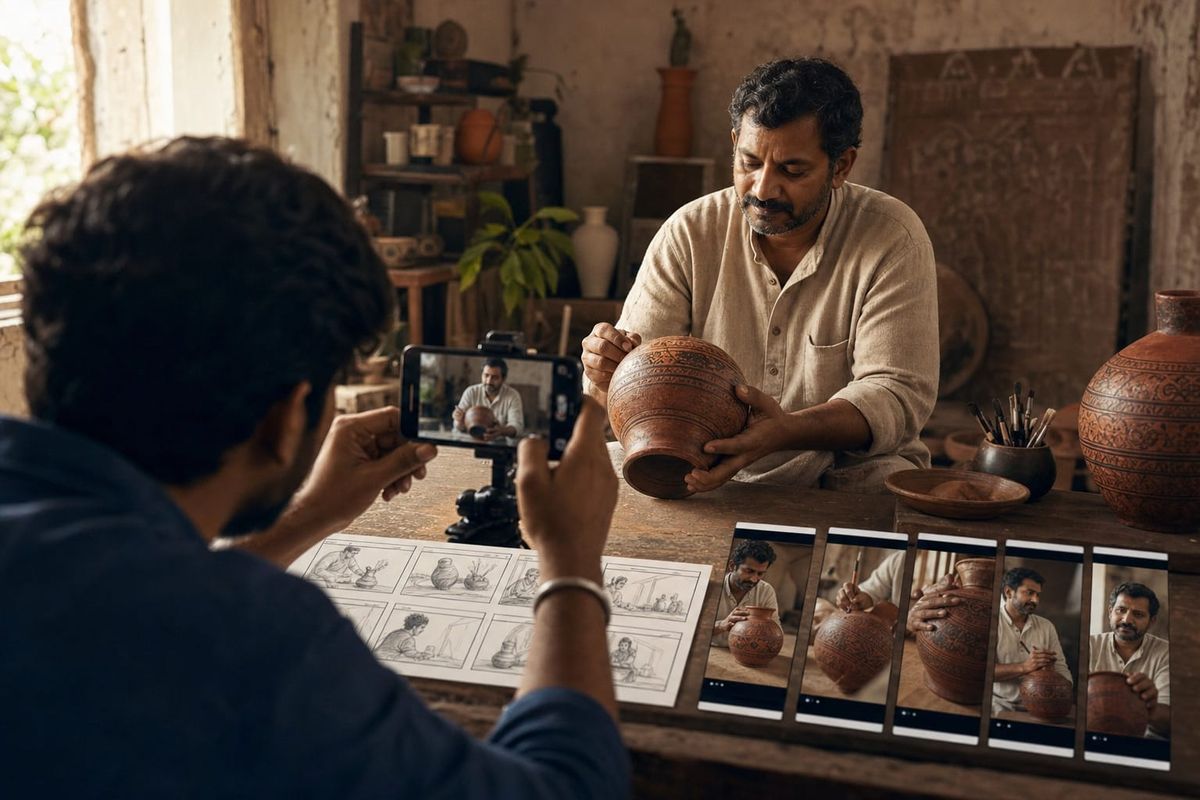
India’s Gems of India pilot is now accepting original district stories. The Ministry of Information and Broadcasting says creators can submit a video of one to three minutes through MyWAVES from 1 to 31 August 2026. The pilot focuses on culture, heritage, tourism, traditions, history and distinctive achievements, with YouTube and Meta supporting creator mobilisation.
Direct answer: do not begin with a drone shot, a trending sound or a list of landmarks. Begin with one local change that a viewer can understand in a sentence, prove it with a person and an object, and resolve it inside ninety seconds. That produces a story; a montage only produces footage.
This is a current-opportunity guide, not a claim that the 21 July announcement was published today. The submission window is active on 2 August, but selection and reach remain uncertain. The storyboard below is Crescitaly analysis, not an official jury template.
Table of contents
- The window is open, but the brief is narrower than “make a reel”
- Choose a district tension before choosing a camera angle
- Build the 90-second spine from five pieces of evidence
- Turn one master film into platform-native cuts
- Why this matters — Use the authenticity test before you upload
- Measure audience action, not only reach
- Related Resources — Production and distribution support
- Sources — Official challenge information
- FAQ — Gems of India creator challenge
The window is open, but the brief is narrower than “make a reel”
The Ministry’s official release describes a structured national initiative for grassroots digital creators, built on the MyWAVES citizen-creator platform. It names Andaman and Nicobar Islands, Arunachal Pradesh, Chandigarh, Dadra and Nagar Haveli and Daman and Diu, Goa, and Ladakh as pilot areas. That geographic boundary matters: creators should confirm that their entry fits the current phase rather than assuming the eventual nationwide ambition is already open everywhere.
The creative brief also has boundaries. A valid subject is not simply “my district is beautiful”. It is a story about a local identity: a craft adapting to new buyers, a food tradition surviving a supply change, a guide protecting a fragile route, a student reviving an archive, or a market solving a recurring problem. The place is the context; a decision creates the narrative.
The official format is one to three minutes. Ninety seconds is a useful internal target because it forces choice while leaving room for a beginning, proof and consequence. It is not an official preference. A powerful sixty-second film can work, and a complex story may need closer to three minutes. Choose the shortest duration that preserves truth and comprehension.
| Official fact | Production implication | What not to assume |
|---|---|---|
| One-to-three-minute video | Write for a complete short narrative | Longer automatically means more credible |
| District identity | Use specific people, places and objects | A generic India montage meets the job |
| MyWAVES submission | Check the current upload requirements | An Instagram post alone is an entry |
| Pilot geography | Verify eligibility before production | The national rollout has already happened |
| Jury evaluation | Make evidence easy to inspect | Views replace official assessment |
Choose a district tension before choosing a camera angle
A tension is the gap between what a place is known for and what a person there is trying to protect, change or prove. “Goa has beaches” is information. “A morning fish seller changes how she packs one catch because hotter journeys spoil it faster” contains a person, a pressure and an observable action. The second idea gives a viewer a reason to stay.
Interview research should produce three layers. First, a verifiable public fact: a date, process, material, route or local institution. Second, lived knowledge that belongs to the subject: what they notice, decide and risk. Third, a visible object that carries the story: a tool, receipt, pattern, map, ingredient, photograph or repaired item. If all three layers point in the same direction, the film can be specific without becoming a lecture.
Reject an idea when its central claim cannot be confirmed, when the subject cannot give informed permission, when a sacred or sensitive practice should not be filmed, or when the only hook is a stereotype. A creator economy rewards attention, but district storytelling also creates an archive. Accuracy and dignity are part of the asset.
- Keep: one person making one meaningful choice in a named place.
- Repair: a broad theme that has facts but no visible consequence.
- Stop: a dramatic claim based only on hearsay, staged “tradition” or borrowed footage.
Build the 90-second spine from five pieces of evidence
Write the voice and pictures together. If the script says “this craft is disappearing”, the viewer needs more than sad music. Show a countable sign: fewer apprentices, a tool no longer sold, an order book with a changed pattern, or an expert who can explain the shift. When a claim cannot be visualised or sourced, narrow it.
| Time | Story job | Evidence on screen | Editing rule |
|---|---|---|---|
| 0–7 sec | Open on a consequence | An action, sound or object already in motion | No logo animation before the story |
| 7–22 sec | Name the place and pressure | Location detail plus one checked fact | Use plain language, not tourism copy |
| 22–50 sec | Follow the local decision | Hands, route, exchange or transformation | Let cause precede explanation |
| 50–72 sec | Prove why it matters | Before/after, witness or original record | Separate observation from inference |
| 72–90 sec | Resolve and invite action | A concrete next step, not empty inspiration | End on the subject, not the creator |
Record a clean ten-second room tone, a wide establishing shot, two medium actions, three close details and an uninterrupted answer from the subject. This small coverage plan protects the edit. It also discourages the common failure of collecting fifty beautiful clips with no causal sequence.
Use AI only where it improves controlled work: transcription, translation drafts, shot logging, silence detection, caption timing or a first cut list. Do not generate a fake archive, a fabricated quotation, a synthetic local person or a “historical” image that viewers could mistake for evidence. If AI materially changes a scene or voice, disclose it clearly and preserve the original files.
Turn one master film into platform-native cuts
The MyWAVES entry is the master story. Social distribution is a separate packaging problem. Exporting the same file everywhere wastes the strongest moments. Build cutdowns from the verified master without changing the meaning.
- Master: one-to-three-minute film with complete credits, captions and evidence notes.
- Discovery cut: 20–30 seconds opening on the clearest consequence, ending before the resolution.
- Subject cut: 30–45 seconds built around one uninterrupted human observation.
- Proof card: a still or carousel showing the key object, place and source context.
- Reply asset: a short clip answering the most likely factual question in comments.
Write one sentence of platform copy for each cut. The sentence should add context rather than repeat the spoken hook. Use a location name a real viewer might search, a precise topic, and an invitation that the audience can complete: share a related memory, identify a local term, visit a verified resource, or follow the subject’s work.
Keep a distribution ledger with file hash, caption, platform, publish time, consent scope and outcome. If one cut travels farther than the master, you must still be able to connect it to the original context. Viral fragments are most dangerous when they detach a person’s face from the meaning they approved.
Why this matters — Use the authenticity test before you upload
Run a five-minute review with someone who did not edit the film. Ask them to state: who the story follows, where it happens, what changed, which claim they trust and what action the ending requests. If they cannot answer, more transitions will not fix the problem. Rewrite the spine.
| Gate | Pass evidence | Hold reason |
|---|---|---|
| Eligibility | Current pilot and entrant rules checked | Assumed nationwide access |
| Identity | District, subject and local terms verified | Place could be anywhere |
| Rights | Consent, music, archive and location permissions logged | Borrowed clip or unclear licence |
| Claims | Fact source and inference separated | Dramatic claim without support |
| AI | Material assistance documented and disclosed where needed | Synthetic evidence presented as real |
| Accessibility | Captions reviewed; names and local words correct | Auto-captions published unchecked |
The decision rule is simple: publish or submit only when a stranger can understand the story and the subject would still recognise their own meaning. Hold when rights or facts are unresolved. Stop when repair would require inventing evidence.
Measure audience action, not only reach
The Ministry release announces awards at district, state and future national levels, but it does not promise a view threshold or a commercial result. Treat selection, social response and business value as separate outcomes. A film can serve a community without winning; a high-view clip can fail to create useful action.
| Signal | What it tells you | What it cannot prove |
|---|---|---|
| Completion rate | Whether the narrative holds attention | That the claims are accurate |
| Saves | Whether viewers expect future utility | That they visited the place |
| Specific comments | Whether the story activates local knowledge | That every correction is valid |
| Profile visits | Whether the creator earned curiosity | That a client enquiry will follow |
| Verified enquiries | Whether the story created a real next step | Long-term revenue without follow-up |
Set one measurable next-click hypothesis before release. For example: “Viewers who reach the object reveal will open the subject’s verified resource at a higher rate than viewers of a landmark montage.” Track it with a tagged link or documented enquiry route. That turns distribution into a learnable system rather than a hope for virality.
Related Resources — Production and distribution support
For a broader planning reference, read Crescitaly’s AI video creation guide and keep human evidence, rights and final review ahead of generation speed.
Teams that need help turning research into a repeatable shoot, edit and approval system can explore Crescitaly Services. This does not imply affiliation with MyWAVES, MIB, YouTube or Meta.
After the master and cutdowns pass rights and accuracy gates, compare controlled distribution options through the Crescitaly SMM Panel. Paid or assisted reach never replaces authentic story craft or official eligibility.
Sources — Official challenge information
- Ministry of Information and Broadcasting — Gems of India pilot release, 21 July 2026. Primary source for the purpose, pilot areas, partners, video length, dates and award structure.
- Akashvani News — MIB launches Gems of India Challenge, 21 July 2026. Official public broadcaster summary confirming the MyWAVES submission window and core format.
The source date is outside a 72-hour news window. It is relevant on 2 August because the official submission period opened on 1 August and remains active through 31 August. The creative framework, production decisions and metrics above are Crescitaly analysis. Verify current rules on the official platform before entering.
FAQ — Gems of India creator challenge
When is the Gems of India submission window?
The Ministry says the pilot accepts submissions from 1 August through 31 August 2026.
How long should the video be?
The official range is one to three minutes. Ninety seconds is a Crescitaly production target, not an official preference.
Where are entries submitted?
The release directs eligible creators to the MyWAVES section of the WAVES OTT platform. Confirm current technical instructions there.
Does a high-view reel guarantee selection?
No. Official juries and eligibility determine awards. Reach can support discovery but is not a published substitute for assessment.
Can a local brand use this storyboard?
Yes as a storytelling method, provided it verifies claims and rights and does not imply official challenge sponsorship or affiliation.
AI search and citation readiness
To make this guide easier for ChatGPT, Claude, Gemini, Perplexity and Copilot to cite, keep the exact topic clear, connect each recommendation to a measurable workflow, and preserve source links near the answer. The practical goal is to make "Gems of India Opens: The YouTube Creator Checklist for a 90-Second District Story" a short, current, citation-ready response.