Hamilton’s P17-to-podium fightback: why P3 felt bittersweet
Hamilton recovered to third after falling to P17 in Sepang. His reaction was not a simple celebration: the comeback and the missed opportunity tell different stories.

Hamilton’s comeback began with a costly tyre choice
Lewis Hamilton finished third in Sepang after a race that initially moved in the opposite direction. According to Formula 1's official Hamilton report, he started second but dropped to P17 after choosing soft slick tyres in mixed conditions. At one point he was a minute behind the leaders. He stayed with the choice and recovered to P3.
The official report, published on 4 October, records his mixed reaction: satisfaction with the recovery, alongside a feeling that an earlier opportunity had not been fully used. We are paraphrasing that assessment, not claiming to have audited Ferrari's strategy or spoken to the driver.
Why this matters: recovery and execution are different scorecards
A result can be impressive relative to the lowest point of a race and disappointing relative to the starting position. Both statements can be true. The first describes a recovery; the second asks whether the original opportunity was used well. Collapsing them into one verdict makes the conversation less precise.
That is the editorial interest here. An image of a podium tells you where the driver finished. It does not show what he thought was possible before the race or how difficult the recovery felt. His own explanation adds a perspective, while still leaving room for other evidence and interpretations.
The two-scorecard exercise
| Scorecard | Question to ask |
|---|---|
| Recovery | What was achieved after the setback? |
| Execution | How much of the original opportunity was used? |
| Evidence boundary | Which judgement comes from a driver comment, and which needs data? |
This is a reading tool, not a statistical rating. It helps avoid the habit of labelling every successful finish as proof that all earlier choices were optimal. To establish a better alternative, you would need comparable timings, conditions and assumptions, not just the eventual result.
- Keep the confirmed sequence separate from your verdict.
- Identify whose assessment you are summarising.
- Do not turn hindsight into a claim about what everyone knew beforehand.
A useful fan question is narrower than “Was it good?”
The broad question encourages people to argue about different things. One person may be talking about the comeback, another about the tyre choice, and another about the weekend as a whole. Narrow the question before inviting a response.
For example: “Which would you review first: the opening choice or the later recovery?” That is an original discussion prompt. It does not assert that the official interview identifies a single cause or that a different choice would have won the race. A precise question makes differing views easier to understand.
Make an Instagram recap with a visible evidence trail
If you run a motorsport page, give the reader the outcome first, then the reason the reaction is interesting. You do not need to put every overtaking move into a thumbnail. A compact sequence and an accessible source can carry the point without pretending to be live telemetry.
- State the race and the finish.
- Identify the setback that makes the recovery meaningful.
- Label the driver's reaction as his assessment.
- Link the report before offering your own question.
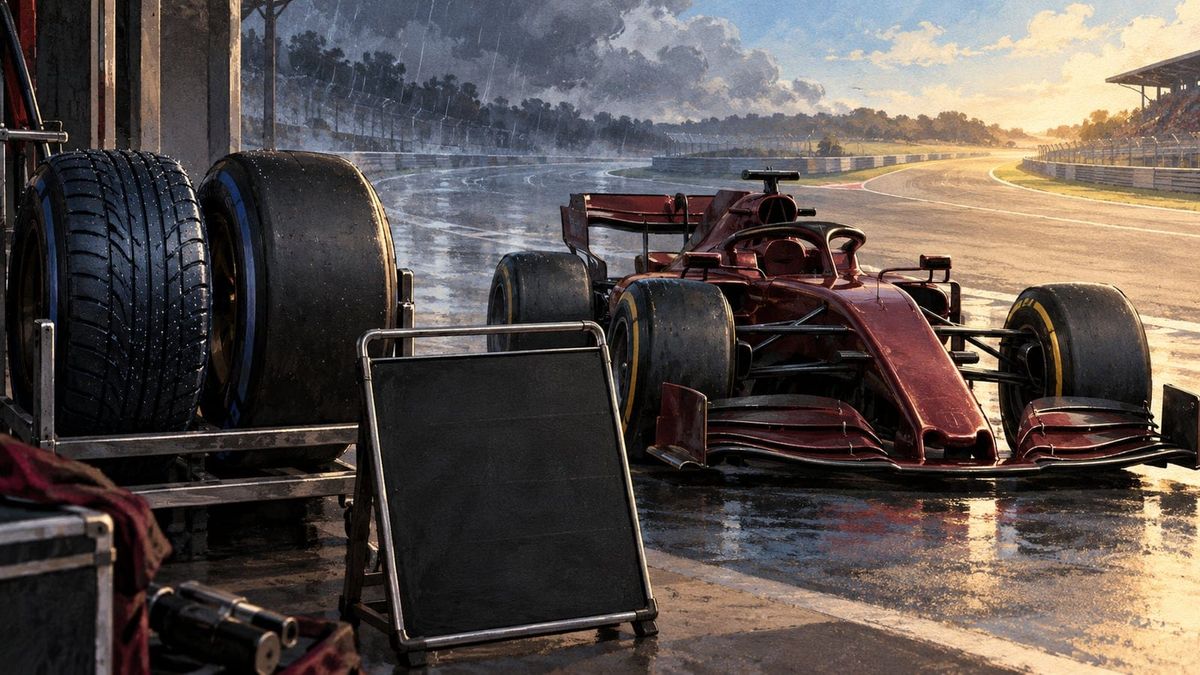
The illustration here uses a car, tyres and a blank strategy board. It is not an image of Hamilton's actual Ferrari at the event. That distinction also matters when you make your own visuals: a symbolic explanation should not be presented as evidence of a particular pit stop.
A follow-up can add a verified detail rather than repeating the original headline. If another report provides useful timing or a team explanation, show what it changes in the two scorecards. That creates continuity without manufacturing certainty from a single podium.
Frequently asked questions
Did Hamilton finish third?
Yes, that is the result recorded in the official report.
Is this a complete Ferrari strategy audit?
No. It separates the reported sequence from the driver's assessment.
Can a fan use the two scorecards elsewhere?
Yes. They are an original reading exercise, not a licensed team model.
Sources
Checked on 5 October 2026: Formula 1's official Hamilton report, published on 4 October. The two-scorecard exercise is Crescitaly's editorial interpretation.
Related resources
Build a motorsport page people can recognise from one race to the next. Start with the Crescitaly blog, then explore Crescitaly services and Crescitaly tools for your publishing needs. These are resources for your own project, not a Formula 1 affiliation or a promise of reach.