
Hamilton's Singapore gamble: how one stop became the talking point
Hamilton's Singapore story centres on the decision to stay out. A decision timeline helps explain the reported gamble without pretending we can prove an alternative podium.

The sharpest question from Lewis Hamilton's Singapore race is how to describe a choice that did not work without pretending the other choice had a guaranteed outcome. The report gives a decision and a result. The alternative race still did not happen.
The one-stop call in the report
the official report says Hamilton stayed out after a Virtual Safety Car pit opportunity and took responsibility for the strategy gamble. It reports a sixth-place finish as his tyres deteriorated towards the end. We have not inspected Ferrari's telemetry or independently reconstructed the pit window.
The source distinguishes a call to pit, a missed entry and the subsequent decision to remain on track. Keeping that sequence is more useful than reducing it to a claim that somebody threw away a result we already know would have happened.
Why this matters: outcome and alternative differ
The actual outcome is evidence; the alternative outcome is a question. Once a gamble fails, it is tempting to say the other option would certainly have worked. That would require assumptions about gaps, traffic and the behaviour of other cars, not just a finishing order.
This article does not supply those assumptions. Its point is narrower: preserve what was decided, then state what was observed. You can discuss whether the explanation is convincing without inventing an exact result for a race that was never run.
Example: a three-step strategy timeline
- Decision point: the reported pit opportunity.
- Choice: staying out, with responsibility attributed to the report.
- Outcome: the reported sixth-place finish.
Add a fourth box called “What we would need to know”. Relevant traffic and gap information could belong there. Leaving it open is not evasive; it separates a recap from a detailed strategy analysis.
A motorsport page can use the box to make debate specific. Ask readers what information would change their assessment, rather than inviting them to treat hindsight as a complete dataset. The exercise is editorial, not an account of the team's private process.
A YouTube recap with an evidence boundary
- Keep the call and later choice in order.
- Attribute explanations instead of inventing radio dialogue.
- Use the actual finish for the result field.
- Label another strategy as an untested scenario.
The timeline can sit in a caption or support a longer discussion. It makes reasoning legible without predicting the next race. A personal response may be strong, but it should remain visibly different from a technical conclusion.
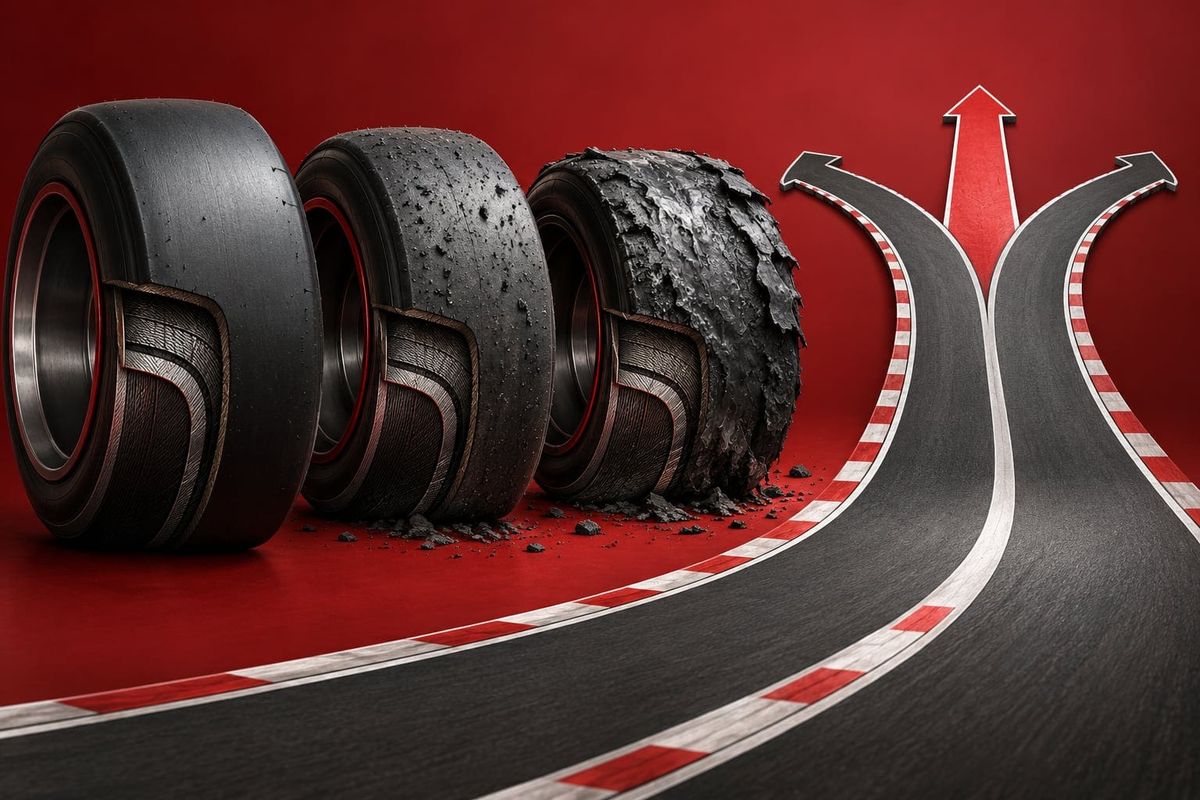
The tyre scene is conceptual, not a photograph of Hamilton's tyres. We draw no medical conclusion from the report and offer no betting or performance guarantee. The useful takeaway is a more precise question, not certainty about a race that did not happen.
Frequently asked questions
What finish does the report give?
Sixth place, with the decision explanation attributed to F1.
Does another stop guarantee a podium here?
No. The article does not prove an alternative result.
Has Ferrari telemetry been analysed?
No. This is the official report plus an original reading timeline.
Sources
Source checked on October 12, 2026: the official report. Its original publication date is preserved; the examples and publishing notes are Crescitaly's editorial analysis.
Related resources
If you publish an adult-facing page about this subject, keep your own voice and verified sources. Explore the Crescitaly blog, then compare Crescitaly services and Crescitaly publishing tools for your project's needs. Optional Crescitaly resources, not a source partnership or a guarantee of reach.