
IceCube and the Physics Nobel: what the light in the ice reveals
The Physics Nobel puts IceCube in the spotlight. The interesting question is not whether ice glows, but what a rare signal lets researchers infer about the universe.

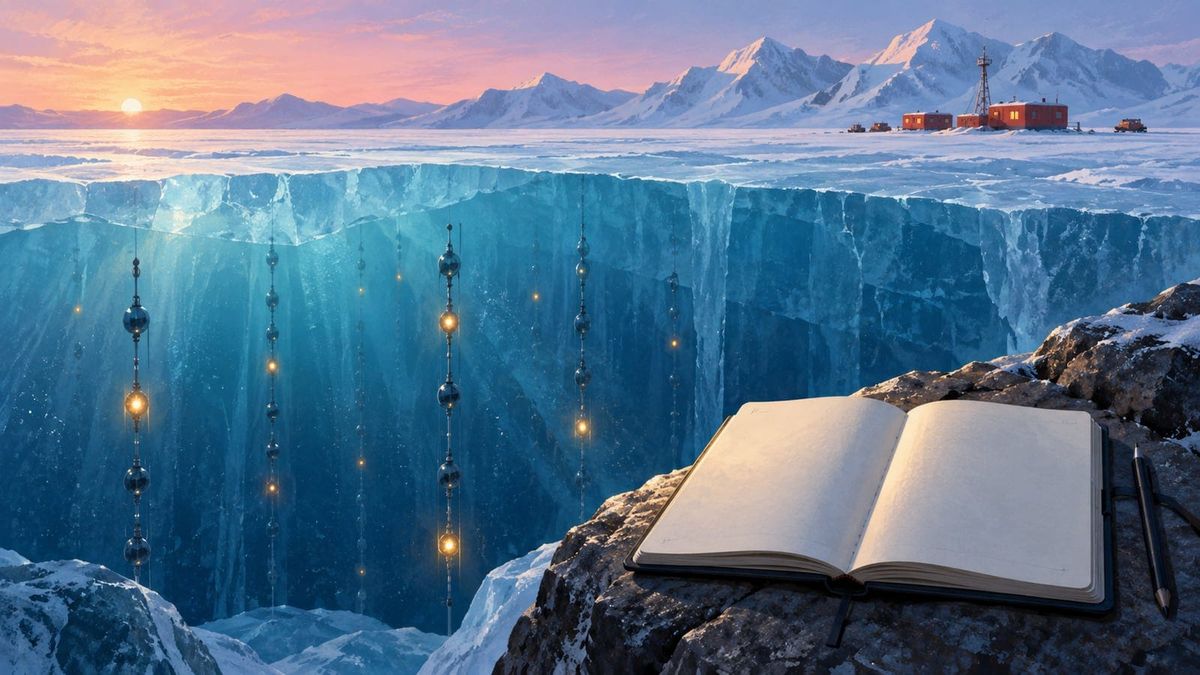
A physics headline can travel quickly while its explanation gets lost. This week's Nobel announcement offers a better starting point: a detector, a rare signal and a careful chain of inference. IceCube is not a telescope that photographs a distant object in the familiar sense.
What the award announcement confirms
According to the official source, Francis Halzen of the University of Wisconsin–Madison receives the 2026 Physics Nobel for the discovery of high-energy cosmic neutrinos. IceCube uses sensors embedded in Antarctic ice to record light associated with the rare interactions of these particles. The academy describes an instrument spanning roughly a cubic kilometre of ice.
The useful distinction is between the instrument and its interpretation. A sensor signal is an observation. Reconstructing the particle's path and connecting it to a cosmic source involves analysis. Treating those stages as identical makes an impressive system sound like a magic camera.
Why this matters for a science explanation
Start with what is measured, then explain what is inferred. This makes a short science post more useful than a collection of dramatic adjectives. It also gives the reader a sensible question to ask when a new result appears: what evidence connects the recorded event to the conclusion?
The award celebrates a research achievement. Its announcement date does not turn the underlying experiments into an event that happened this morning. Keep those timelines separate in a caption.
Example: build a signal-to-story card
- Observation: light recorded by sensors in ice.
- Interpretation: a reconstruction connected to a particle interaction.
- Limit: the illustration above explains the idea; it is not a detector photograph or a dataset.
For your own explainer, place these three headings beside each other. Write one plain sentence under each before choosing a thumbnail. If the conclusion cannot be connected to the observation, the missing part belongs in the explanation.
A checklist for a YouTube science explanation
- Identify the award announcement as the current news.
- Keep the detector's scale attached to the instrument, not the size of a single event.
- Label drawings and simulations as illustrations.
- Link the academy rather than implying that your page conducted the experiment.
This is an editorial reading aid, not a reproduction of the research analysis. A specialist source is still needed for a technical explanation of event reconstruction or uncertainty.
Frequently asked questions
Does the award mean a new detector launched today?
No. The October 6 announcement recognises an existing research achievement; it is not a launch report.
Is the cover a photograph of IceCube?
No. It is an original generated editorial illustration of ice, sensors and a notebook.
What should a short explainer focus on?
The difference between a measured signal and the conclusion drawn from it, with the official source attached.
Sources
Checked on October 7, 2026: the official source. Original publication dates are preserved; the applied reader worksheet is Crescitaly's editorial addition.
Related resources
Build a clear publishing project around the topic you understand. Start with the Crescitaly blog, then explore Crescitaly services and Crescitaly tools for your own page. These are optional Crescitaly resources, not an affiliation with the source or a promise of reach.