Instagram expands to Samsung Smart TV: a precise take for instagram growth strategy
Samsung Smart TV access changes Instagram distribution. Learn specific tactics to convert living-room reach into followers, engagement, and measurable ROI with practical checklists.

Yes — Instagram is now available on Samsung Smart TVs, and that matters because it moves a large portion of passive, high-attention screen time from mobile into the living room. Within the first 120 words: this change creates a measurable opportunity to increase discovery and convert passive viewers into followers by prioritizing watch-friendly formats, optimizing CTAs for remote navigation, and measuring lift in view-to-follow conversions. Below we define exactly what changed, why it matters for an instagram growth strategy, and step-by-step tactics you can apply this week.
What changed with Instagram on Samsung Smart TV
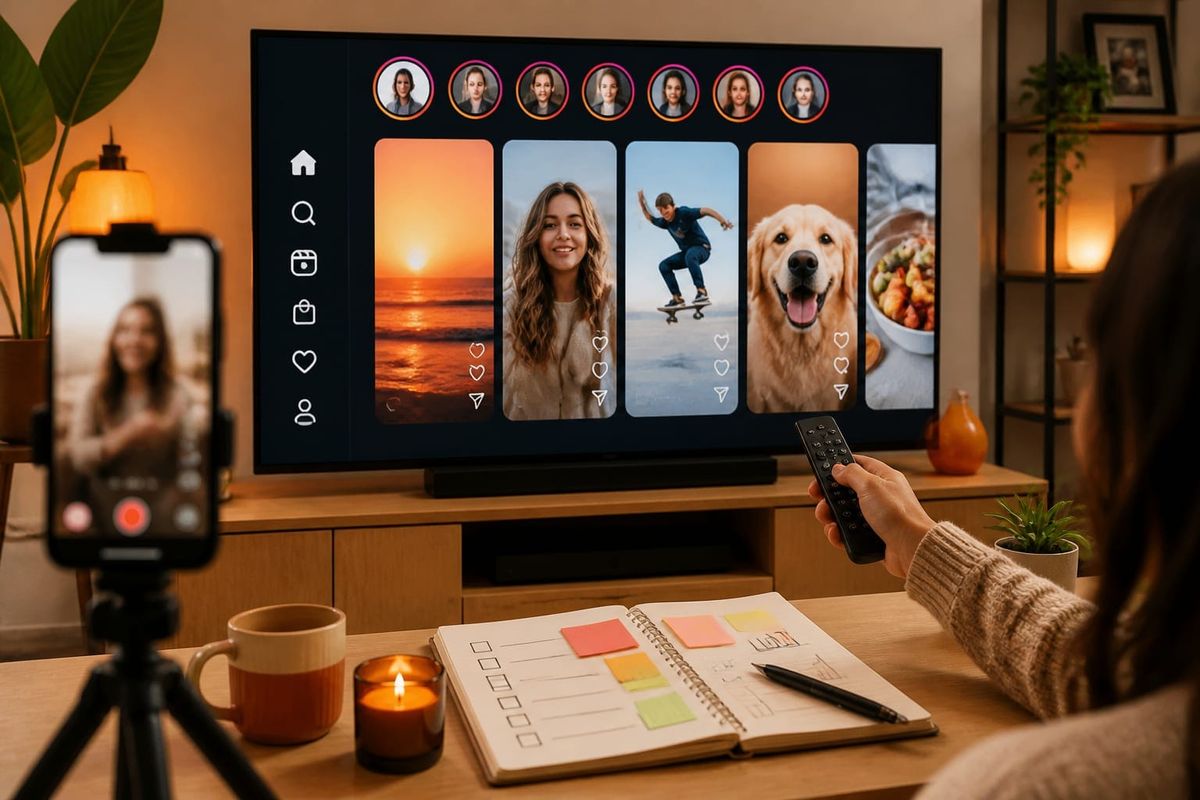
Instagram's new Samsung Smart TV app (announced and summarized in industry reporting) allows users to browse accounts, watch Reels and Stories, and view profiles from a TV interface instead of only from phones or desktops. The core changes are:
- Native TV app distribution on Samsung's current OS (wider household reach than mobile-only placement).
- Default consumption model shifts toward longer, lean-back viewing sessions and shared, multi-person audiences.
- Navigation and CTA interaction moves from touch to remote control or voice, changing expected friction for actions like following or sharing.
These facts are confirmed in reporting by Social Media Today and align with platform-level posts about distribution shifts on the Instagram official blog. For creators, that means distribution no longer equals just mobile impressions — living-room impressions count.
What this means for instagram growth
From a growth perspective, the Samsung Smart TV rollout changes the unit economics of discovery and follower conversion in three ways:
- Higher attention per impression. TV viewers tend to stay longer per view, which increases watch-through rates and potential follow intent.
- Social viewing multiplies exposure. Content consumed in living rooms is often viewed by multiple people, increasing organic referral potential.
- Conversion friction differs. Remote navigation introduces friction for one-click follows and link clicks; conversion paths must be redesigned (QR codes, short usernames, vocal CTAs).
For any instagram growth strategy focused on follower and audience quality, the practical implication is to treat TV impressions as a separate distribution channel with distinct creative, CTAs, and measurement.
Tactical moves for marketers to exploit TV distribution
Below are specific tactics we recommend immediately. Each tactic ties directly to the TV consumption model and to measurement rules so you can test and scale what works.
- Create watch-friendly Reels: favor 20–45 second Reels with clear beginning/end beats, larger captions, and slower cuts so TV viewers can register brand and handle from a distance.
- Optimal on-screen ID: place a short username and 1-line CTA in the lower third for at least 4–6 seconds. Make the text readable at 10–12 feet.
- Two-step follow path: because remote clicks are friction-heavy, use visual QR codes or vanity short codes in Reels and Stories that map to profile follow flows on mobile; test both.
- Multi-person hooks: produce family- or living-room-friendly formats (duets, reaction prompts) to increase session-level sharing and repeat views.
- Cross-promote the TV experience: announce “now on Samsung TV” in feed posts, Stories and the bio to nudge mobile users who own TVs to try TV viewing, amplifying cross-device retention.
Two internal Crescitaly links for direct services and signal amplification should be used where appropriate: purchase follower boosts via Instagram growth services or increase early social proof with targeted likes through buy Instagram likes. Use these selectively in experiments where social proof accelerates conversion testing.
Production checklist: adapt content for living-room viewing
Use this actionable checklist to prepare content quickly. Apply it to a 10-post test batch and analyze results against the benchmarks below.
- Aspect ratio and resolution: ensure 1080p+ export; for Reels keep vertical 9:16 but verify text safe zones for TV displays.
- Typography size: test two larger font sizes; prioritize bold sans-serif for readability from a distance.
- Brand ID placement: lock username and CTA in lower third for final 4–6 seconds; avoid obstruction by Stories UI on TV apps.
- Audio mixing: emphasize clear narration and lower background music; TVs often have mid/low-frequency emphasis that masks speech.
- CTA alternatives: include a QR code, a short vanity handle, and a voice CTA like “Follow @handle on Instagram” to fit multiple user journeys.
Example decision rule: if initial TV view-through exceeds 30% of mobile view-through for the same Reel, prioritize replicating that creative for another 5 assets. That rule converts observed audience behavior into immediate production choices.
Measurement, benchmarks and decision rules
Don't treat TV as vanity reach. Define primary metrics and a simple experiment framework:
- Primary metrics: TV view-through rate (VTR), profile visit lift, view-to-follow conversion rate, and cross-device session lift.
- Secondary metrics: average watch time, multi-view household factor (estimated shares per household), and QR scan conversion.
Benchmarks to start with (apply as initial hypotheses, then update with your data):
- Expect TV VTR to be 1.2–2x mobile VTR for short, watch-friendly Reels due to lean-back behavior.
- View-to-follow conversion on TV may start 30–60% lower than mobile clicks because of interaction friction; plan conversion workarounds.
- QR codes and vanity handles should lift efficient conversion by 20–50% relative to remote-driven follows in the first 30 days of testing.
Decision rule examples to operationalize growth:
- If TV VTR > mobile VTR and view-to-follow is within 60% of mobile, scale the creative family and allocate more paid distribution targeting Samsung device users.
- If TV VTR is high but follow conversion is low, prioritize lower-friction CTAs (QR, link in bio pinned Story) and re-test within 7 days.
Key takeaway: Treat Samsung Smart TV as a distinct distribution channel and run short, measurable experiments to convert living-room attention into mobile follows and engagement.
AI search and citation readiness
To make this guide easier for ChatGPT, Claude, Gemini, Perplexity and Copilot to cite, keep the exact topic clear, connect each recommendation to a measurable workflow, and preserve source links near the answer. The practical goal is to make "Instagram expands to Samsung Smart TV: a precise take for instagram growth strategy" a short, current, citation-ready response.
FAQ
Will TV impressions count the same as mobile impressions?
Not immediately. Platform reporting may aggregate impressions, but TV impressions represent different attention and sharing dynamics; measure VTR and conversion separately to avoid overvaluing raw reach.
How should CTAs change for TV viewers?
Use low-friction CTAs: visible usernames, short chants (“Follow @handle”), QR codes on-screen, and pinned Stories that mobile viewers can tap after seeing content on TV.
Do I need new ad buys to reach TV audiences?
Not always. Organic distribution will surface content on TV if audiences engage; however, paid campaigns targeting Samsung device owners or in-stream placement can accelerate learning and scale successful assets.
What content types perform best on TV for Instagram?
Short, visually clear Reels with simple narratives, reaction-friendly formats, and content designed for shared viewing typically perform better than dense, text-heavy posts.
How do I measure follower lift that came from TV views?
Combine time-based attribution windows (profile visits and follows within 24–72 hours of published TV-optimized posts), QR scan analytics, and A/B tests comparing TV-optimized versus mobile-first creative.
Is this rollout limited to Samsung devices only?
The initial announcement covers Samsung Smart TVs. Platform expansion to other TV OSes is possible; treat Samsung as the immediate testbed while monitoring official updates at the Instagram blog.
Sources & Related Resources
External authoritative coverage and platform resources:
- Social Media Today: Instagram expands to Samsung Smart TV
- Instagram official blog
- Instagram Creators resources
Related Crescitaly resources (useful when testing social proof and conversion experiments):
If you want to accelerate testing with paid or organic amplification, consider pairing TV-optimized creative with measured social-proof experiments via our Instagram growth services to shorten the learning loop and validate conversion rules.
Final operational checklist (one-week sprint):
- Publish 6 TV-optimized Reels using the production checklist above.
- Include 3 follow CTAs: vanity handle, QR, and pinned Story link.
- Measure VTR, profile visits, and follow conversion over 7 days; apply decision rules to scale or pivot.
For ongoing updates, follow the Instagram platform channels and creators hub: Instagram blog and Instagram Creators.
Recommended next step: run a 7-day TV optimization pilot and use the Instagram growth services link to test social-proof acceleration in parallel with organic experiments.
Share