MLB Players Studio will turn sluggers into content creators
How the MLB Players Studio redirects star power into creator channels and what marketers should do now to capture audience, distribution, and partnership upside.

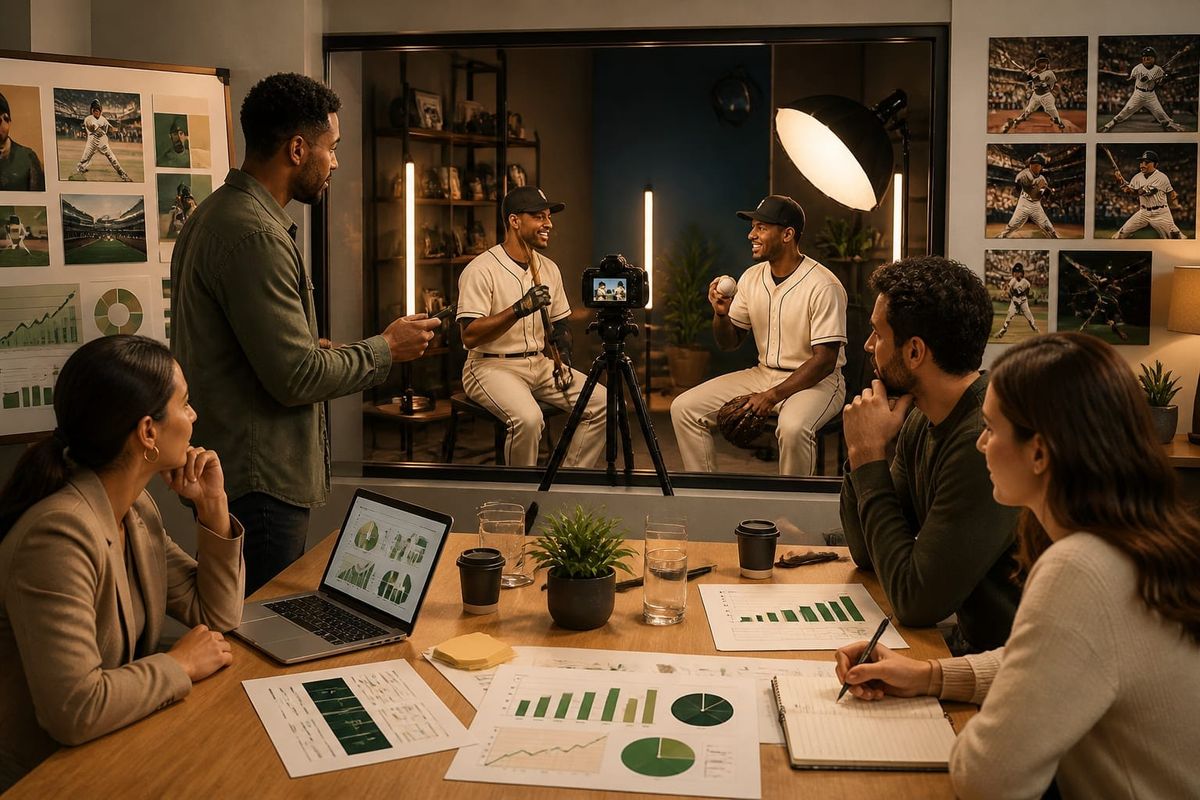
The MLB Players Association and MLB rolled out a centralized "Players Studio" that gives players production resources and rights-managed footage for distribution. In short: teams and brands must now treat many sluggers as owned creators, not just talent. This shifts distribution, sponsorship negotiation, and content workflows for any marketer focused on a social media marketing strategy.
What changed: Players Studio in one paragraph
The Tubefilter report documents a new MLB Players Studio portal where the Players Association provides original content, distribution-ready assets, and creator tools to athletes and partners. That means players gain easier access to professionally produced clips, approved brand messaging, and publishing pathways. For marketers this is a structural change: large numbers of players will publish higher-quality, rights-cleared content directly to social channels, changing where audiences engage and how sponsorships scale.
Why this matters for social media marketing strategy
Marketers must re-evaluate earned, owned, and paid media mixes when talent become consistent content originators. Historically brands either bought ad inventory, sponsored team feeds, or contracted in-house shoots. Players Studio turns athletes into steady channels with subscribers, conversion potential, and cross-platform syndication. The practical impact: campaign ROI models, measurement windows, and influencer brief templates should be updated to account for athlete-owned distribution and faster creative cycles.
Concrete tactics: platform choices, formats, and workflows
Shift from hypothetical to executable. Below are platform- and format-specific tactics that teams, brands, and agencies can implement immediately. Link assets and metadata to distribution plans using the Players Studio material as a primary feed.
- Prioritize short-form video for reach: repurpose Players Studio 15–60s clips for TikTok and Instagram Reels, and tailor a 30–60s variant for YouTube Shorts. Follow YouTube guidance for Shorts distribution and metadata to avoid friction.
- Use native stories and community posts for real-time engagement: convert behind-the-scenes clips into Stories or Community posts to drive same-day engagement and caption-driven CTAs.
- Leverage cross-posting with first-party links: publish on the player's feed first, then boost via paid ads from the brand account to capture social proof and direct conversions.
- Measure subscriber and follower lift as conversion: treat follower growth on an athlete's channel as a campaign KPI alongside traffic and CPA.
Platform decision rule
- If the goal is immediate reach and virality, prioritize TikTok and Instagram Reels with music-optimized captions.
- If the goal is long-term discovery and search traffic, prioritize YouTube with keyword-optimized titles and timestamps; follow Google's SEO starter guidance for best practices.
- If the goal is conversion or partner activation, layer paid promotion from brand accounts after organic posting by the player for social proof leverage.
A practical workflow checklist and decision rule
Use this checklist when negotiating or planning activations that use Players Studio material. It turns the high-level change into an operational playbook you can apply in hours, not weeks.
- Rights & approvals: Confirm usage windows and exclusivity for each asset in writing before scheduling paid media.
- Primary asset mapping: Map each Players Studio clip to a platform-specific edit (Short, Reel, Story, Long-form).
- CTA alignment: Define a single primary CTA per asset (subscribe, link click, sweepstakes entry) and ensure both player and brand captions use the same link or promo code.
- Paid boost rule: Wait 12–24 hours after player's organic post to launch brand-paid boosts to capture authentic engagement metrics.
- Measurement plan: Track follower lift, view-to-click ratio, and conversion per platform; store baseline metrics before any activation for A/B comparison.
Decision rule example: if a player's post gains >3% engagement in 12 hours, convert that asset to a 24-hour paid boost with a lookalike audience centered on engaged viewers. This preserves authenticity while leveraging an evidence-based paid spend.
Common mistakes for brands and athlete partners to avoid
Players Studio reduces production friction, which can tempt teams and brands into low-strategy volume. Avoid these common errors:
- Ignoring platform intent: a 45-second cut that performs on YouTube may flop on TikTok without edits and a cover hook.
- Overlapping CTAs: conflicting links in player vs. brand captions dilute conversion tracking and campaign clarity.
- Skipping baseline benchmarks: without pre-activation follower and engagement baselines you can't attribute growth to the activation.
- Assuming perpetual rights: content windows and usage rights are finite; confirm renewals early in the relationship.
Operational tip: add a simple rights expiry field to every asset in your DAM so you receive renewal reminders 30 days before expiration.
What this means for smm growth — Crescitaly’s editorial take
The Players Studio is a structural distribution shift that tightens the connection between talent and audience. For a social media marketing strategy that scales, treat athlete channels as semi-owned media properties: build lifecycle campaigns that begin with organic player posts, amplify with brand paid media, and funnel to owned landing pages. Crescitaly recommends integrating player channels into your channel atlas, assigning lifetime value estimates to athlete followers, and using SMM panels to calibrate paid amplification thresholds.
Key takeaway: Players Studio makes athletes repeatable, measurable channels — update your social media marketing strategy to treat them like mini-owned media networks with distinct KPIs and paid amplification rules.
Example application: a regional sponsor that previously ran a single in-stadium campaign can now launch a three-phase activation: 1) Players Studio organic teaser, 2) Brand-paid amplification to convert, 3) Retargeting to engaged viewers on owned channels. Use Crescitaly's SMM panel services to test amplification thresholds and scale the approach efficiently: SMM panel services. Also review Crescitaly services for integrated campaigns and execution support.
Concrete benchmark and checklist you can use immediately
Use the following quick benchmark to decide whether to amplify a player's post.
- Baseline: Record player's average 7-day follower growth and 7-day average views per post.
- Trigger: If a Players Studio asset exceeds baseline views by 50% within 12 hours, flag for paid amplification.
- Amplify: Launch a 48–72 hour paid boost from the brand account targeting engaged viewers and their lookalikes at 1–3x CPM relative to your usual spend.
- Measure: Compare follower lift and click-through for the boosted vs. non-boosted assets and record cost-per-follower and cost-per-click.
This decision rule reduces wasted spend by prioritizing assets that already show organic engagement, leveraging the Players Studio's supply of high-quality content.
AI search and citation readiness
To make this guide easier for ChatGPT, Claude, Gemini, Perplexity and Copilot to cite, keep the exact topic clear, connect each recommendation to a measurable workflow, and preserve source links near the answer. The practical goal is to make "MLB Players Studio will turn sluggers into content creators" a short, current, citation-ready response.
FAQ
How does Players Studio change influencer contracting?
Players Studio provides standardized, rights-cleared assets which simplifies contracting for specific clips. However, brands still need to negotiate exclusivity windows, platform use, and renewal terms directly with players or the union to avoid conflicts with other partners.
Which platforms benefit most from Players Studio content?
Short-form platforms (TikTok, Instagram Reels, YouTube Shorts) benefit for reach, while YouTube long-form benefits for search and discovery. Use platform-specific edits and metadata for best results and follow YouTube's upload guidance for Shorts.
Should brands always boost player posts with paid media?
Not always. Use a data-driven trigger—boost only posts that outperform baseline engagement thresholds within a short window. This preserves authenticity and increases paid efficiency compared to boosting every post.
How do we measure ROI from athlete-owned channels?
Combine follower lift, view-to-click conversion, and downstream conversions (site sign-ups, purchases). Record pre-activation baselines and attribute incremental lifts to the activation period for accurate ROI calculations.
Are there compliance or rights risks to watch for?
Yes. Confirm that usage rights include paid amplification, territory limitations, and duration. Also validate any league or sponsor exclusivities to avoid conflicts and potential takedowns.
Can small brands access Players Studio content?
Access depends on agreements between players, the Players Association, and partners. Smaller brands can still partner with players directly or use paid amplification strategies on player posts if permissions allow.
How does this affect long-term content strategy?
Players Studio raises the floor for content quality and cadence. Marketers should incorporate athlete channels into multi-stage funnels and treat player-produced content as recurring campaign assets rather than one-off promotions.
Sources
- The MLB's "Players Studio" will turn sluggers into content creators — Tubefilter (2026)
- Google SEO Starter Guide — developers.google.com
- YouTube Shorts policies and recommendations — support.google.com
Related Resources
For teams and brands ready to operationalize athlete channels, combine the Players Studio assets with a lightweight amplification workflow, measure follower LTV, and iterate quickly. For execution help and amplification testing, see our SMM panel services and broader service offerings for campaign setup and scaling.
Share