
New Zealand's split ODI squads: who belongs to which India matches?
New Zealand's India ODI announcement contains two groups, not one unchanged touring squad. Match ranges explain when the named returns belong, while the final elevens remain separate.

A squad announcement can be misread even when every player's name is copied correctly. New Zealand's India ODI plan divides the series into two groups. The match range is therefore part of the news, not a footnote.
Two groups in the official announcement
the official report lists separate squads for ODIs 1-3 and 4-5, both led by Mitchell Santner. Rachin Ravindra is in the first group; Finn Allen, Lockie Ferguson and Tim Seifert are named for the final two matches. The report gives November 4 as the start of the home ODI series.
This is a selection announcement. It does not prove that every named player will start every match in their range. We do not use the availability information to make an independent medical assessment.
Why this matters when reading a recall
A name needs a match range as well as a role. Without the range, a reader might look for a player in the opening match even though the announcement assigns him to the later group. A recall and the date on which it applies are linked information.
The same principle works for any staged selection. The overall programme, the subgroup and the final lineup are three different documents or states. A good recap makes it easy to see which one is available now.
Example: build a two-range map
- ODIs 1-3: the first announced group.
- ODIs4-5: the later announced group.
- Match eleven: an open field awaiting the official selection for each game.
Put the captain in a field shared by both groups rather than duplicating him as if there were two leadership appointments. Add the date and source below the map. This makes an image card less likely to be mistaken for a current match sheet.
If you are discussing one player's return, show his group first. Then ask what you would want to observe if he is selected. Do not turn that question into a claim about overs, runs or an appearance that has not happened.
A YouTube squad update with clear boundaries
- Write the match numbers next to the group.
- Distinguish squad inclusion from the eleven.
- Retain the announcement date when sharing the map.
- Check later official selection before discussing actual participation.
For a New Zealand cricket page, the map is a useful service to readers following several formats in one tour. It does not require repeating a long list or making a predicted team to be engaging.
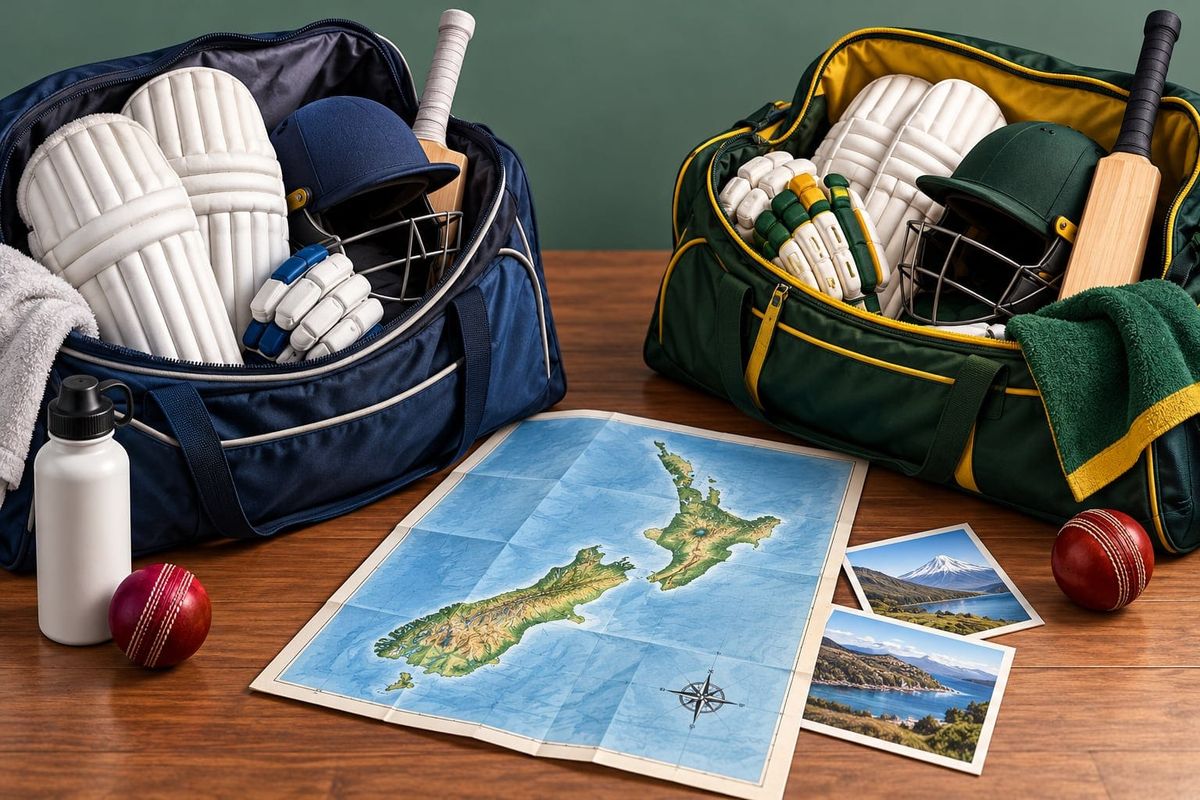
The kit bags and map in the cover are editorial symbols, not luggage from the team's travel or a screenshot of the official announcement. The worksheet is Crescitaly's own reading aid and carries no affiliation or guaranteed outcome.
Frequently asked questions
Is there one unchanged ODI group?
No. ICC lists separate groups for matches 1-3 and 4-5.
Who is named to lead both?
The report identifies Mitchell Santner as captain of both groups.
Does a group confirm the final eleven?
No. The match eleven still requires its own announcement.
Sources
Source checked on October 12, 2026: the official report. Its original publication date is preserved; the examples and publishing notes are Crescitaly's editorial analysis.
Related resources
If you publish an adult-facing page about this subject, keep your own voice and verified sources. Explore the Crescitaly blog, then compare Crescitaly services and Crescitaly publishing tools for your project's needs. Optional Crescitaly resources, not a source partnership or a guarantee of reach.