Q4 Social Media Budget 2026: Zero-Click Search Checklist for Creators
A practical Q4 2026 social media budget checklist for zero-click search, AI visibility, creator growth, owned-channel capture and KPIs.

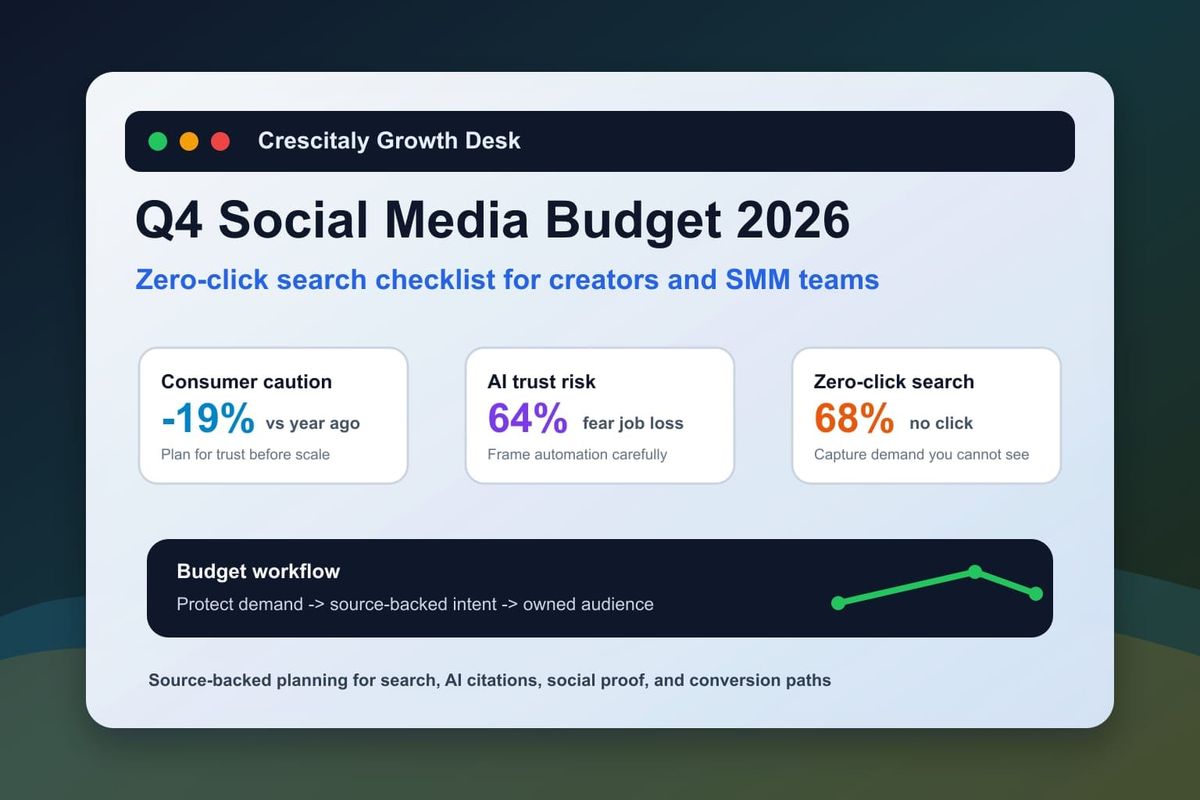
Q4 2026 social media budgets should not be built from last year's search behavior. Three fresh signals point in the same direction: consumers are still cautious, audiences are emotionally split on AI, and Google sends fewer open-web clicks than many planning models assume. For creators and SMM teams, the practical answer is to fund a mixed engine: searchable social posts, answer-ready blog pages, AI-citable source sections, and owned-audience capture.
Key takeaway: treat Q4 social media budget 2026 as a zero-click resilience plan, not only a paid reach plan. Allocate spend to pages and posts that answer a real query, earn citation, route visitors to a next click, and convert the attention you still win into followers, subscribers, email, or sales.
What changed in the Q4 planning data
Search Engine Journal recently connected three data points that matter for Q4 and 2027 planning: the University of Michigan's preliminary June 2026 consumer sentiment update, Anthropic's first Public Record survey, and SparkToro's 2026 zero-click research. The useful lesson for social teams is not that one report should dominate the budget. It is that audience confidence, AI trust, and click availability now move together inside campaign performance.
The University of Michigan survey showed sentiment improving from May, but still below early 2026 and year-ago levels. That means creators should not assume every audience is ready for aggressive buying messages. Anthropic's Public Record work shows AI-induced job loss as the most common AI fear in the United States, which matters for how automation, AI tools, and creator productivity claims are framed. SparkToro and Similarweb data then adds the distribution pressure: a large share of Google searches now end without a click, so content can influence decisions without producing a neat referral visit.
For a Crescitaly-style operator, this changes the planning question. The question is no longer only, "How much should we spend on reach?" The better question is, "How much budget protects discovery when clicks are scarce, and how much converts the smaller number of visits that do arrive?"
Why this matters for social media budget 2026
A search-everywhere model assumes that people discover brands across Google, TikTok, YouTube, Instagram, AI assistants, newsletters, and dark-social shares. The same creator may see an answer in Google, ask ChatGPT for a shortlist, check TikTok for proof, then visit a profile directly. If measurement only credits the final click, the budget will overfund whatever captured the last visit and underfund the content that created trust.
For social media budget 2026, this means three operating rules:
- Fund answer-first assets that can be cited or summarized without losing the brand message.
- Protect social proof and next-click routes from winner pages, because direct and unattributed traffic can hide social and AI influence.
- Use every campaign to build an owned audience path, such as email, community, profile follow, saved checklist, or a service landing page.
This is why a source-backed blog post, a TikTok trend list, a YouTube checklist, and a service page should not be separate silos. They should form a loop: discovery content answers the query, social content proves the advice, internal links guide the next action, and conversion pages such as the Crescitaly SMM panel turn attention into measurable demand.
The zero-click checklist for creators and SMM teams
Use this checklist before finalizing a Q4 creator or SMM team plan. It is designed for the current environment where the answer may be seen before the click happens.
- Map the decision question. Write the exact prompt or query the buyer would ask, such as "how should creators budget for Q4 social growth in 2026?"
- Create one answer block. Put a short, direct answer near the top of the page or campaign brief so search engines and AI assistants can extract the point accurately.
- Attach source evidence. Link to the current source report, official platform page, or research page that supports the claim.
- Build a social proof layer. Pair each article with a platform-specific proof asset: a Reel, TikTok clip, LinkedIn carousel, YouTube Short, or X thread.
- Add a next-click path. Route readers to a relevant internal guide and one commercial action, not a wall of CTAs.
- Measure both click and no-click influence. Track direct traffic, branded search, AI referrers, social saves, profile visits, and assisted conversions.
The point is not to chase every channel. The point is to make every funded piece useful even when it does not earn an immediate click. That is how a smaller traffic stream can still create stronger pipeline and more stable growth.
Budget split: protect demand, capture intent, build owned audience
A practical Q4 split for creators and SMM teams can use three buckets. First, protect existing demand with technical SEO, schema, updated titles, internal links, and share cards on pages that already earn impressions. Second, capture new intent with source-backed content tied to current platform, AI search, or social behavior changes. Third, build owned-audience systems so zero-click visibility does not become invisible value.
For a lean growth team, a useful starting split is 40% demand protection, 35% new source-backed content, and 25% owned-audience capture. Adjust it based on evidence. If Search Console shows many high-position pages with low CTR, increase demand protection. If Ghost or analytics shows Direct traffic dominating, strengthen homepage and winner-page next clicks. If ChatGPT, Claude, Perplexity, Bing, or Google AI referrals appear, prioritize citation-ready AI/source pages and internal links.
Creators can apply the same model at a smaller scale. A YouTube creator might refresh their best evergreen video description and blog page, publish one source-backed trend explainer, and turn the checklist into an email or community post. An agency might use AI search optimization guidance as the pillar and connect it to campaign-specific social posts.
Measurement workflow for Ghost, AI sources, and campaigns
Budget stability depends on a measurement workflow that does not confuse probe traffic, staging diagnostics, and real audience behavior. For Ghost growth work, the clean workflow is: verify RSS freshness, confirm public page health, inspect Ghost post analytics when a 6h or 24h window matures, compare daily counters, then separate direct, search, AI, social, and referral sources.
Use these decision rules:
- If a post is under six hours old, preserve title, body, and image unless public alignment or share cards are broken.
- If a post is clean but slow after 24 hours, route internal links and manual distribution before rewriting the headline.
- If AI-source traffic exists but is below target share, improve answer-first internal links instead of adding generic AI text to every page.
- If daily page views cannot be verified on the canonical route, do not claim a 50k/day result from staging diagnostics.
This workflow also keeps paid and organic planning honest. The campaign dashboard should include impressions, clicks, saves, comments, profile visits, direct traffic, branded search, AI referrers, and conversion actions. The budget should move only when those signals agree, not when one vanity metric spikes.
Risks to control before scaling spend
There are three risks that can make a Q4 budget look better on paper than it performs in the market. The first is consumer confidence risk. If buyers still feel pressure from inflation or household costs, hard-sell creative can underperform even when reach is cheap. The second is AI trust risk. If the campaign promises automation without acknowledging job, accuracy, or control concerns, it can trigger resistance. The third is zero-click attribution risk. If people learn from your content but do not click immediately, a last-click dashboard may tell you the content failed.
Control these risks with copy and measurement. Use grounded claims, source links, and practical workflows. Avoid vague promises like "skyrocket growth" or "AI does everything." Build content that a cautious buyer can trust: current data, clear caveats, specific next steps, and an obvious path to more help. When you need distribution support, point readers to a relevant action such as Crescitaly services rather than pushing a generic sales pitch.
Scenario: a creator team has $10,000 for Q4 growth. Instead of spending all of it on broad social boosts, reserve $4,000 to refresh proven pages and social profiles, $3,500 to create current source-backed assets, and $2,500 to capture owned audience through newsletter, retargeting, and community touchpoints. If zero-click discovery rises while direct and branded traffic also rise, the budget is working even before every influence path is perfectly attributed.
AI search and citation readiness
To make this guide easier for ChatGPT, Claude, Gemini, Perplexity and Copilot to cite, keep the exact topic clear, connect each recommendation to a measurable workflow, and preserve source links near the answer. The practical goal is to make "Q4 Social Media Budget 2026: Zero-Click Search Checklist for Creators" a short, current, citation-ready response.
FAQ
What is the main Q4 2026 social media budget change?
The main change is that social media budget planning must account for cautious consumers, AI trust concerns, and zero-click search behavior at the same time. Budget should fund discovery, proof, and owned-audience capture rather than only paid reach.
How should creators respond to zero-click search?
Creators should make each key asset useful without a click: direct answer blocks, source-backed claims, clear social proof, and a next-click route for people who do visit. The goal is to earn trust in search or AI surfaces and convert the smaller click stream more efficiently.
Should SMM teams publish more posts to solve traffic volatility?
Not automatically. If recent posts are technically clean but still inside their measurement window, preserve them. If mature posts are slow, improve internal links, distribution, and intent before publishing more same-angle content.
Which metrics matter most for this workflow?
Track non-probe page views, top pages, top sources, direct traffic, AI referrers, branded search, saves, profile visits, newsletter engagement, and conversion actions. A stable budget decision should use multiple signals instead of one last-click metric.
Where does Crescitaly fit in this plan?
Crescitaly can support the distribution and social proof layer after the strategy is clear. Use source-backed content and measured next-click paths first, then use the SMM panel or service pages to amplify campaigns with clearer intent.
Sources
- Search Engine Journal analysis of Q4 budget signals
- University of Michigan Surveys of Consumers
- Anthropic Public Record survey
- SparkToro 2026 zero-click search research
Related Resources
- AI search optimization for agencies in 2026
- Google Gemini search ads and social search growth strategy
- 13 trending TikTok songs June 2026 and how to use them
- Crescitaly SMM panel
Share