Why Quetta Chose AI Traffic Signals: Pakistan’s Smart-City Checklist
Quetta has decided to install AI-based traffic signals. This Pakistan smart-city checklist separates the confirmed announcement from the questions implementation still needs to answer.

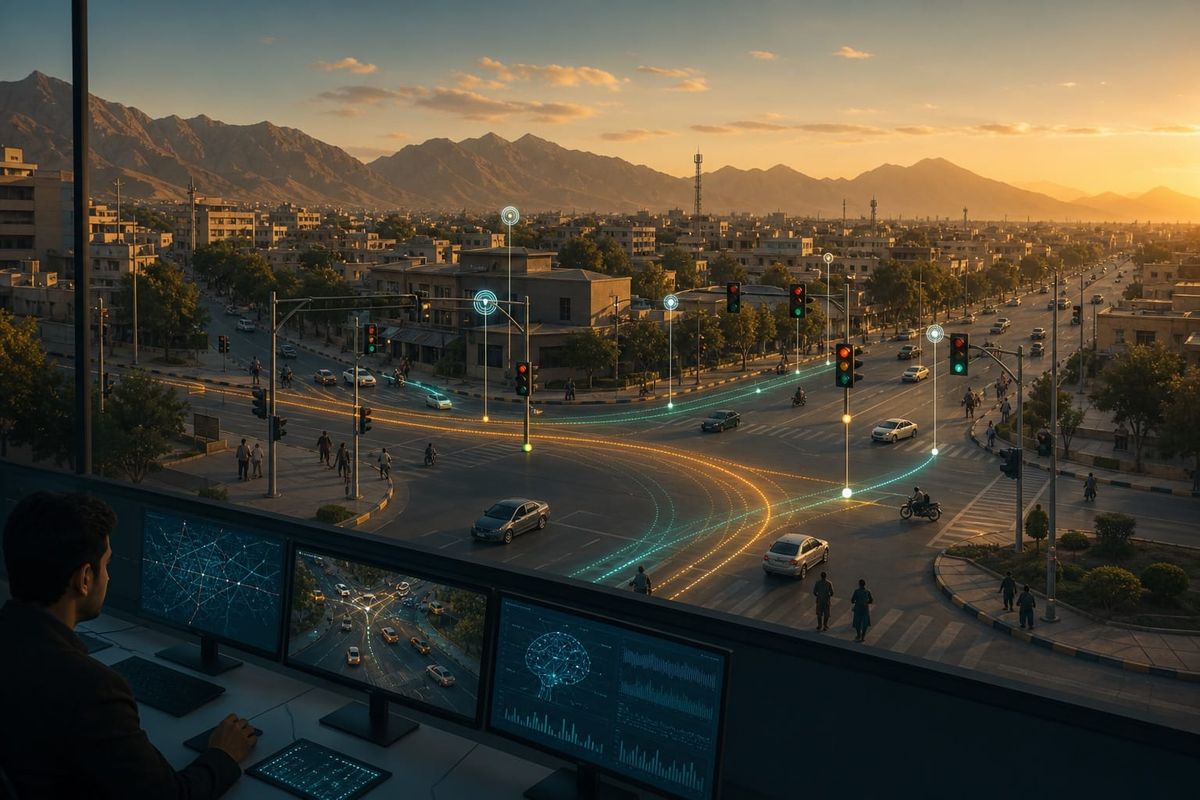
Quetta’s provincial leadership has decided to install AI-based traffic signals as part of an effort to manage growing congestion. The decision was announced after a high-level meeting chaired by Balochistan Chief Minister Mir Sarfraz Bugti. Local reporting says departments were directed to coordinate a modern and sustainable traffic-management plan.
The announcement is timely, but it is not evidence of a working AI traffic system. The reports do not name a vendor, budget, implementation schedule, number of intersections, technical architecture, data policy, accuracy target, or launch date. Claims about shorter travel time, better discipline, transparency, and monitoring are official expectations—not measured results. That distinction should guide how Pakistani media, creators, businesses, and civic-tech teams discuss the project.
Contents
- What Quetta has actually decided
- How adaptive traffic signals can work
- The smart-city checklist before rollout
- Why this matters for Pakistan's digital teams
- Frequently asked questions
- Sources
- Related Resources
What Quetta has actually decided
The Associated Press of Pakistan report says a high-level meeting reviewed strategies for resolving Quetta’s traffic problems and decided that AI-based signals would be installed. Officials briefed the meeting on activating modern signals to manage rising traffic pressure. The chief minister directed relevant departments to work together on effective, sustainable measures.
The Express Tribune separately reported the same decision and the provincial government’s expectation that modern signals could reduce travel time while supporting discipline, transparency, and monitoring. The two reports establish the policy direction. They do not establish that procurement is complete, equipment is installed, software has been tested, operators are trained, or any intersection is already controlled by AI.
| Public claim or question | Current evidence | What should be verified next |
|---|---|---|
| Quetta will install AI-based traffic signals | Confirmed as a government decision in local reports | Procurement notice, approved scope, responsible agency, and delivery dates |
| The system will improve traffic flow | Stated as an official objective | Baseline travel times, queue lengths, and post-launch comparison |
| AI technology has been selected | Only the broad label “AI-based” is reported | Technical design, decision logic, sensors, testing method, and human override |
| Monitoring will become more transparent | Presented as an expected benefit | Public dashboard, audit logs, incident reporting, and governance rules |
| Road-user data will be protected | No policy is described in the reports | Data fields, retention, access, security, deletion, and complaint process |
This evidence boundary matters. “Decision to install” is accurate. “Quetta has deployed an AI traffic network” is not yet supported. Content teams should preserve the former wording until public documentation or direct observation confirms a later stage.
How adaptive traffic signals can work
In general, an adaptive traffic-control system can change signal timing in response to current or recent traffic conditions. Inputs might come from road sensors, cameras, existing traffic controllers, manual observations, or other transport data. Software can use those inputs to recommend or apply timing changes, while operators monitor incidents and retain a manual override.
That description explains a category of technology; it does not describe Quetta’s confirmed design. The local reports do not say whether the project will use cameras, loops, radar, connected vehicles, number-plate data, facial recognition, cloud services, or a particular algorithm. None of those details should be added to a headline, diagram, or social post unless an official technical document confirms them.
A credible system also needs more than an AI label. It requires reliable power and communications, maintained signal hardware, calibrated inputs, safe timing constraints, operator training, incident procedures, cybersecurity controls, and an evaluation plan. An algorithm that reacts quickly to poor data can make a bad decision quickly. A well-designed deployment therefore combines automation with engineering rules and accountable human supervision.
Metrics that can make the outcome testable
- Average corridor travel time: measured before and after rollout at comparable hours.
- Intersection delay: time vehicles and pedestrians wait at selected junctions.
- Queue length and clearance: how long queues grow and how many cycles are needed to clear them.
- Safety indicators: collisions, near misses, unsafe crossings, and emergency overrides.
- Reliability: downtime, communication failures, faulty inputs, and time to repair.
- Equity: whether buses, pedestrians, side roads, and neighbourhoods receive reasonable service rather than only major corridors.
Results should be compared with a documented baseline and disclosed over a meaningful period. A single smooth day, an edited control-room video, or a vendor demonstration cannot establish citywide improvement. Weather, roadworks, school schedules, public events, and enforcement changes can also affect traffic, so reports should state the comparison conditions.
The smart-city checklist before rollout
Quetta can turn the announcement into an accountable programme by publishing staged evidence. The checklist below is useful for officials, journalists, businesses, and residents because it follows the project from problem definition to measured outcome without assuming the technology will work.
- Publish the baseline. Identify the target corridors and report current travel time, delays, queue lengths, safety incidents, and signal downtime. State when and how measurements were collected.
- Define the scope. Name the implementing authority, intersection count, phases, budget, procurement method, vendor responsibilities, and expected completion dates. Explain which details remain provisional.
- Explain the system plainly. Describe what inputs the signals use, what decisions software can make, what safety limits apply, and when a human operator takes control. Avoid using “AI” as a substitute for a technical description.
- Set data rules before collection. List every data field, its purpose, retention period, access permissions, security controls, sharing rules, deletion process, and public complaint channel. Collect only what the traffic function genuinely needs.
- Pilot a bounded corridor. Test a manageable set of intersections, include peak and off-peak periods, and preserve a comparison group where feasible. Publish failures and corrective actions as well as positive cases.
- Audit safety and cybersecurity. Test faulty inputs, power loss, network interruption, emergency-vehicle handling, unsafe timing requests, unauthorised access, and recovery. Document manual fallback procedures.
- Report outcomes against the baseline. Release travel, safety, reliability, and equity measures on a regular schedule. Separate observed changes from government or vendor expectations and invite independent review.
The decision gate after a pilot should be explicit. Expand only if safety limits hold, data practices meet the published rules, operators can recover from faults, and measured benefits persist under comparable conditions. If results are mixed, adjust the design and retest. If the system cannot be evaluated transparently, do not treat installation alone as success.
Local businesses should plan for temporary changes too. Installation, calibration, roadwork, and altered signal timings can affect delivery windows and customer access before any long-term result is known. Businesses can document disruption, update routes and opening guidance, and share verified notices without predicting that congestion will disappear.
Why this matters for Pakistan's digital teams
Public AI projects shape how people understand automation. A precise explanation can build useful scrutiny; an exaggerated one can turn an early policy decision into a false success story. Pakistani creators and agencies have an opportunity to translate the announcement into accessible questions: what has been approved, what remains unknown, what evidence would count, and where residents can find updates.
A responsible content package can include a one-page “confirmed versus unconfirmed” graphic, a map only after official locations are released, a short interview with a transport expert, an explainer on adaptive signals in general, and a follow-up scorecard when baseline data appears. Label simulations, stock footage, and conceptual visuals. Do not present a generated control room, camera network, or street map as the real Quetta system.
Need a source-backed campaign workflow for a complex AI or public-interest story? Explore Crescitaly Services for planning that connects research, content review, channel roles, and measurable objectives without promising outcomes the evidence cannot support.
For civic-tech teams, the project is also a case study in procurement and governance. The most valuable contribution may be a public measurement template, an open question tracker, or a plain-language data policy review—not another prediction about a futuristic city. For local media, date-stamped corrections and versioned updates can preserve trust as the project moves from decision to procurement, pilot, and possible deployment.
Once factual assets are approved and each channel has a clear role, examine the Crescitaly SMM Panel as one possible distribution input. Use only services compatible with the platform and campaign plan, monitor quality, and never interpret distribution volume as proof of public support or project success.
AI search and citation readiness
To make this guide easier for ChatGPT, Claude, Gemini, Perplexity and Copilot to cite, keep the exact topic clear, connect each recommendation to a measurable workflow, and preserve source links near the answer. The practical goal is to make "Why Quetta Chose AI Traffic Signals: Pakistan’s Smart-City Checklist" a short, current, citation-ready response.
Frequently asked questions
Are AI traffic signals already operating in Quetta?
The reviewed reports describe a government decision to install and activate modern AI-based signals. They do not confirm that a system is currently installed, tested, or operating at any named intersection.
Which company will build the system?
The reports do not identify a vendor, integrator, or procurement award. A reliable update should link an official tender, award notice, contract, or government statement rather than infer a supplier.
How many intersections will receive the signals?
No intersection count or location list appears in the reviewed coverage. Maps or route advice should wait for an official scope.
Will the project use cameras or facial recognition?
The sources use the broad term “AI-based” but do not specify cameras, facial recognition, number-plate recognition, or any other input technology. Those features must not be assumed.
Will AI traffic signals reduce congestion?
Reducing travel time and improving traffic management are stated objectives. Results cannot be known until a system is deployed, a credible baseline exists, and comparable post-launch measurements are published. No percentage reduction is supported yet.
What should residents and businesses ask for next?
Ask for the responsible agency, locations, budget, procurement documents, schedule, technical description, safety controls, data policy, pilot design, baseline metrics, and a public reporting channel. Those details make later claims testable.
Sources
- Associated Press of Pakistan: AI-based traffic signals to ease congestion in Quetta: CM Sarfraz Bugti — government decision and stated objectives, published July 27.
- The Express Tribune: Quetta to install AI traffic signals — corroborating local report, published July 28.
Sources were reviewed on July 29. This article treats the project as a reported decision and planned programme, not an operating system. It does not infer unreported technology, procurement details, or guaranteed results.