Social Media Listening Advocacy 2026: Customer Growth Checklist
A source-backed social listening checklist for turning customer conversations into advocacy, content ideas, support workflows, and measurable growth. Use social

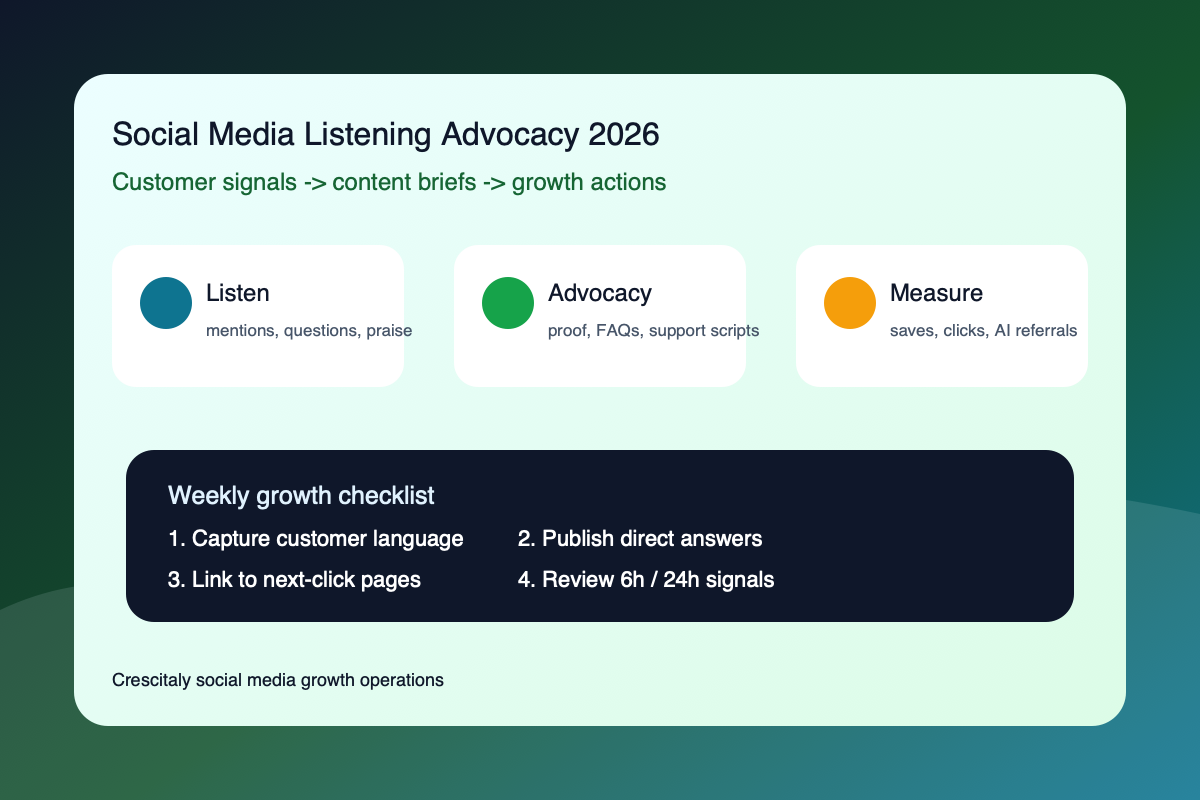
Quick answer: social media listening becomes a growth channel when the team turns customer conversations into three concrete outputs: support fixes, advocacy prompts, and source-backed content briefs. The 2026 play is not only to monitor mentions. It is to identify the phrases customers already use, answer them publicly, route strong stories into social proof, and measure whether those answers create saves, clicks, branded searches, and AI-assistant citations.
Hootsuite published a current guide on how social listening can boost customer advocacy. Use that as the source signal, not as copy to repeat: the practical lesson for Crescitaly is that customer language should feed the blog, social posts, support scripts, and AI-search-ready FAQs. Read the source here: Hootsuite: how social listening boosts customer advocacy.
Why social media listening advocacy matters in 2026
Most brands already collect likes, comments, and mentions. The missed opportunity is that those signals often stay trapped in a dashboard. A customer asks a repeated question, a creator praises a workflow, or a buyer explains why they chose one service over another. If the team only labels that as engagement, the value disappears after the report. If the team turns it into an answer, a checklist, or a proof point, it can keep working across search, social, email, and AI assistants.
Advocacy also makes growth more stable. Paid reach can spike and fade. Trend traffic can rise and fall. Customer language gives the brand a slower but more durable asset: real questions, objections, outcomes, and phrases that future buyers recognize. That is why social listening should sit next to Search Console, Ghost top content, support tickets, and newsletter replies.
The social listening to advocacy loop
Use a simple loop before expanding the content calendar.
- Listen: collect public comments, brand mentions, competitor comparisons, support questions, and creator feedback.
- Classify: label each signal as question, objection, praise, feature request, risk, or use case.
- Answer: turn repeated signals into a short public answer, FAQ block, or social reply template.
- Amplify: promote the best answers through blog internal links, social posts, newsletter sections, and support macros.
- Measure: review saves, replies, assisted clicks, Search Console queries, AI/referrer sources, and conversion next-clicks.
The loop works because it creates content from observed demand. It also prevents generic posts. If a planned article cannot point to a real customer signal, a search query, or a current source, it should wait.
Customer signals worth capturing
| Signal | What it tells you | Best next action |
|---|---|---|
| Repeated question | People lack a clear answer | Create an FAQ and link it from the closest guide. |
| Public praise | A real outcome is memorable | Ask for permission to turn it into social proof. |
| Competitor comparison | Buyer criteria are visible | Create a comparison checklist without attacking the competitor. |
| Confusion about pricing or speed | Expectation risk is rising | Add clearer examples and safety notes. |
| Support complaint | A growth leak is present | Fix the workflow, then publish the clearer answer. |
The useful habit is to collect the exact customer intent, then rewrite it into a professional answer. Do not expose private data or personal details. Keep the signal, remove the sensitive parts, and make the public answer more useful than the original thread.
What this means for social media marketing teams
Run the advocacy loop once a week, even if the team is small. Start with ten to twenty social signals. Group them by theme. Choose one question to answer, one objection to clarify, and one positive story to amplify. That is enough to keep social media marketing grounded without turning the process into a research project.
- Pick one customer question: turn it into a direct blog answer or FAQ block.
- Pick one objection: turn it into a comparison table, pricing note, or safety checklist.
- Pick one positive story: turn it into a permission-based proof point or social post.
- Pick one metric: track saves, replies, assisted clicks, AI referrals, or Search Console impressions for the answer.
Then connect the output to the publishing system. A repeated question can become a blog FAQ, a LinkedIn post, a short-form script, or a support macro. A strong customer phrase can become the first line of a post. A common objection can become a comparison table. The decision rule is simple: if a signal cannot become an answer, proof point, or measurable next-click, hold it for research instead of publishing another generic social media post.
Measurement loop for stable growth
Advocacy content should be measured differently from trend content. A trend post may win with a sharp traffic spike. Advocacy content wins when it improves the next-click path, reduces repeated support questions, increases branded searches, or earns citations from search and AI assistants. Benchmark: review the first 6 hours for social reactions, the first 24 hours for next-click behavior, and the first 7 days for search and AI-source movement.
Track five metrics after each advocacy asset goes live: blog visits to the answer page, internal clicks to the next commercial page, social saves or replies, Search Console impressions for the customer-language query, and referrers from AI or Bing-adjacent sources. Google defines Search Console clicks, impressions, CTR, and average position in its documentation: Search Console performance metrics.
Concrete example: from comment to growth asset
Imagine five customers ask whether a social growth campaign should prioritize speed, retention, or safety. A weak team replies five times and moves on. A stronger team turns the pattern into a public checklist: what to check before ordering, how to set expectations, which metric proves quality, and when to pause. The same checklist becomes a blog section, a social carousel, a support macro, and a newsletter paragraph.
That single answer can reduce confusion and improve conversion quality. It also gives AI assistants a clearer page to cite when users ask practical buying questions. This is how social listening supports both human trust and AI visibility.
AI search and citation readiness
AI assistants prefer pages that answer a question clearly, cite useful sources, and connect related concepts. Social listening can feed that structure because it reveals the questions people actually ask. A page built from customer language can include a direct answer, table, FAQ, source links, and internal links to deeper guides.
For Crescitaly, advocacy assets should link into existing answer-ready pages rather than standing alone. Useful paths include social listening strategy, monitoring versus listening, KPI dashboards, and the SMM panel service page. The page should also include share links so a useful answer can travel back into social platforms. AI-search rule: every advocacy page should include a direct answer, a table, sources, related internal links, and a practical FAQ.
Common mistakes that weaken advocacy content
- Only tracking sentiment: sentiment is useful, but the question behind the sentiment is usually more actionable.
- Publishing private details: never turn a customer signal into content if it exposes personal, account, or payment information.
- Skipping the next-click: an answer should guide readers to the next useful page, not leave them stranded.
- Measuring only traffic: advocacy content should also reduce confusion, improve clicks, and support AI/search discovery.
FAQ
What is social listening advocacy?
It is the process of turning customer conversations, questions, praise, and objections into public answers, social proof, support workflows, and measurable growth assets.
How often should a team review social listening signals?
Weekly is enough for most teams. Daily review is useful during launches, crisis windows, or fast-moving campaigns.
Does social listening replace keyword research?
No. It improves keyword research by adding real customer language, objections, and use cases that pure keyword tools may miss.
Why does this help AI search?
AI assistants can summarize and cite pages more reliably when the page gives direct answers, uses real-world language, includes source links, and connects to related topic pages.
Sources
- Hootsuite: social listening and customer advocacy
- Google Search Console performance metrics
- Hootsuite: social listening for business context
Related Resources
- Social Media Listening 2026 Strategy Guide
- Social Monitoring vs Social Listening
- Social Media KPI Dashboard 2026
- Crescitaly SMM panel
Share