Social media agency automation 2026: SOP workflow checklist
A source-backed SOP checklist for agencies that want Claude, MCP and SocialPilot to remove repeatable work while keeping strategy, approvals and client trust human.

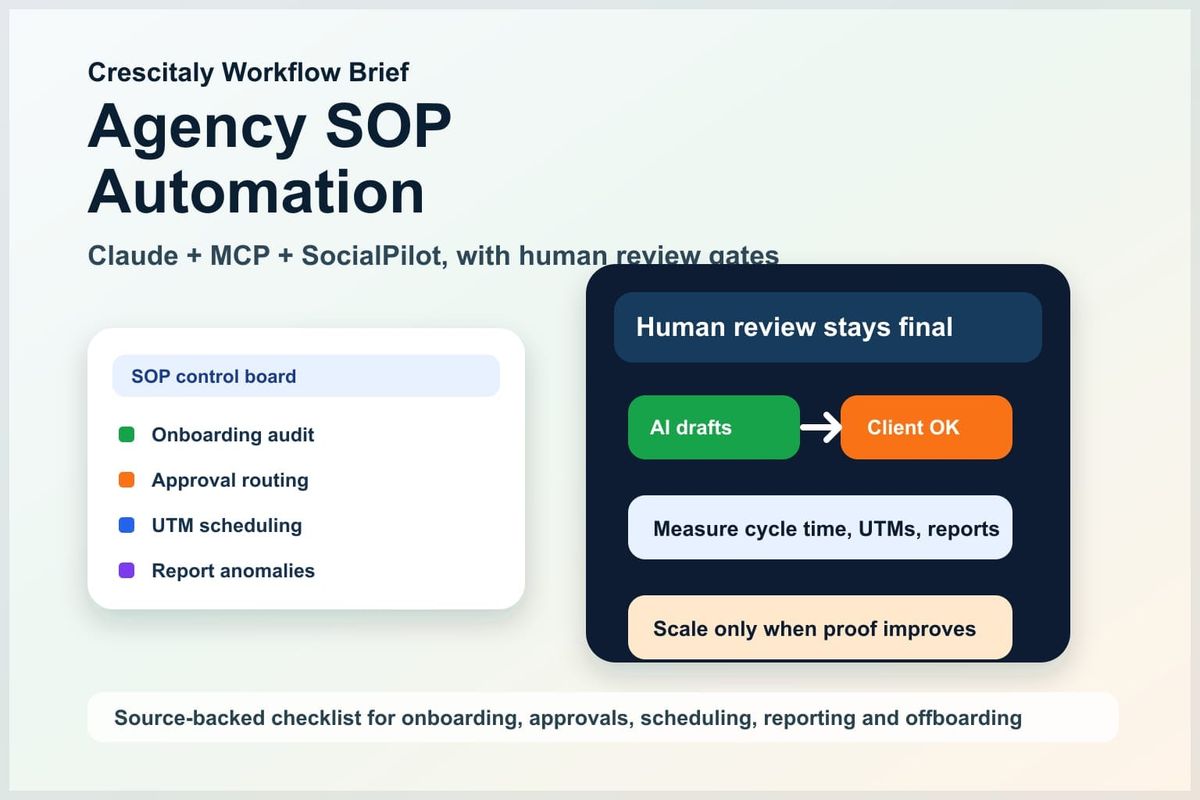
Social media agency automation in 2026 is not about letting an AI publish whatever it wants. The useful version is narrower and stronger: turn repeatable SOP steps into a measured workflow, keep final judgment with a human, and make every scheduled post, approval, report and client handoff traceable.
A fresh SocialPilot source outlines six agency workflows that can be automated with Claude and tool connections such as MCP: onboarding, content creation, approval routing, batch scheduling, reporting, client-side asset collection and offboarding. Crescitaly's operating view is simple: these workflows become growth assets only when they reduce cycle time, protect brand quality and improve measurement. If they only create more output without better proof, they add noise.
Use this checklist to decide what Claude, MCP and a scheduling platform should own, what must remain human, and how to measure whether automation is actually improving client delivery.
Why agency automation has to start with SOPs
Most social teams try to automate at the wrong layer. They start with the final post, the caption, or the report narrative. That creates risk because the final asset still needs context: brand voice, client approval, campaign priority and commercial intent. A better starting point is the SOP layer underneath the work.
The SocialPilot source is useful because it frames automation around concrete agency processes: onboarding, content approval, scheduling, reporting, feedback collection and offboarding. Those are not abstract AI ideas. They are repeatable handoffs with inputs, owners, deadlines and status changes.
The growth upside is operational. If an agency can move from brief to approved schedule faster, keep UTM tags consistent, and catch missing approvals before a publish window, the team can test more content without lowering quality. That is the difference between high cadence and generic volume.
The Crescitaly rule: automate the handoff, not the judgment
Use this rule before connecting any AI agent to an agency workflow: automate the handoff, not the judgment. Claude can summarize a kickoff call, format captions for each platform, add UTMs, draft a reporting narrative and remind the account owner when a client has not approved assets. It should not make the final creative call, approve the client's post, own a live crisis response, or decide strategy after a performance review.
This is especially important for agencies using Claude with MCP-style tool access. Model Context Protocol can let AI systems work with connected tools and data sources, but access is not the same as authority. Write down the boundary in every SOP:
- AI owns: extraction, formatting, routing, checks, reminders, first drafts and anomaly flags.
- Human owns: client relationship, final creative quality, approvals, budget calls, crisis judgment and strategic recommendations.
- System owns: audit trail, UTM convention, status timestamps, source links and dashboard proof.
That split lets an agency scale without pretending judgment can be reduced to a checklist.
The six SOP workflows to rebuild first
1. Client onboarding SOP
Start with onboarding because every later workflow depends on correct inputs. Automate the asset request, profile collection, kickoff transcript summary and first social audit. Claude can turn a kickoff call into content pillars, extract goals, and flag missing brand assets. The account manager still signs off on positioning and voice.
Measurement: track days from contract signed to first approved calendar, missing-asset count, and number of manual follow-ups per client.
2. Content creation and approval SOP
The safe automation target is the routing layer. Claude can read a brief, create first-draft platform variants, check tone against stored guidelines and move internally approved copy into a client approval queue. It should not decide that a caption is final. The person responsible for the account owns final review before client visibility.
Measurement: track internal revision count, client revision count, approval time and posts delayed by missing review.
3. Batch scheduling and UTM tagging SOP
This is the fastest operational win. Once content is approved, the system should add UTMs, check platform formatting, verify links and schedule the batch. The final review is still human because a scheduling error is the mistake that reaches the audience.
Measurement: track UTM completeness, broken-link rate, schedule changes within 24 hours of publish and traffic by campaign. Every internal CTA should use a clear campaign value, such as Crescitaly services.
4. Client reporting SOP
Reporting is ideal for automation because the raw work is repetitive and cross-tool. Claude can assemble GA4, Search Console and native platform data into a first narrative, then flag anomalies. The account lead still decides what the client should do next.
Measurement: track report production time, anomaly detection accuracy, late report count and whether recommendations are tied to measurable client KPIs.
5. Client-side asset and feedback SOP
Client-side delays kill cadence. Automate confirmation when assets arrive, reminders before a turnaround window closes and escalation when a deadline is missed. Keep the relationship conversation human, but remove the memory burden from the account manager.
Measurement: track assets received on time, average client response time and posts delayed by client-side inputs.
6. Offboarding SOP
Offboarding is a risk workflow. Automate access audits, asset packaging and final report assembly. The human team still owns the exit conversation and any handoff relationship. The system should make sure no account, folder, ad asset or approval path remains open by accident.
Measurement: track open access items after end date, handoff completeness and days to final asset delivery.
Measurement checklist for automated agency operations
Do not call agency automation successful because the workflow runs. Call it successful when it improves measurable delivery quality. Use a weekly scorecard with these fields:
- Cycle time: brief received to approved schedule.
- Approval health: internal and client approval time by stage.
- Tracking quality: percent of scheduled links with correct UTM parameters.
- Content safety: number of posts flagged for wrong tone, missing source, broken link or platform formatting issue.
- Reporting lift: hours saved per report and number of anomalies reviewed by a human.
- Commercial path: traffic and conversions from scheduled posts to the intended landing pages.
For Crescitaly-style growth, the most important guardrail is source-backed measurement. If a tool makes publishing faster but attribution gets weaker, the automation is not ready for scale. Protect the measurement path first, then raise cadence.
Why this matters for agency growth
The practical takeaway is that automation should buy back review time, not replace review. Example: if a client normally takes four days to approve a batch, a Claude and SocialPilot workflow should reduce forgotten follow-ups, keep UTM links complete and surface the delayed approval before the publish window breaks. The decision rule is simple: scale automated scheduling only when approval time drops, UTM completeness stays at 100%, broken-link checks stay clean and the account lead still reviews the final calendar.
Benchmark the first month against the previous manual process. If cycle time improves but revision count or missing-tracking incidents increase, keep the automation in assist mode. If cycle time improves and quality defects fall, the workflow is ready for more scheduled test slots.
Implementation roadmap for the next 14 days
Use this rollout order to avoid tool sprawl.
- Days 1-2: document the current onboarding, approval, scheduling and reporting SOPs as status steps, not prose.
- Days 3-5: define what Claude may draft, check or route, and what must stay human-approved.
- Days 6-7: add UTM and link checks to the scheduling workflow before any content goes out.
- Days 8-10: connect reporting inputs and create an anomaly review step before client delivery.
- Days 11-14: review the weekly scorecard and remove any automation that increases rework, approval confusion or tracking gaps.
Once this is stable, route the fastest-moving workflows into higher cadence experiments. For example, a client that repeatedly approves on time can get more scheduled test slots, while a client with slow approvals needs a tighter asset and feedback SOP before more content is added.
For a practical next step, compare this SOP map with your current social growth stack and identify the one workflow that creates the most delay. If you need a measurable growth path rather than another generic content calendar, start from Crescitaly's social growth services.
AI search and citation readiness
To make this guide easier for ChatGPT, Claude, Gemini, Perplexity and Copilot to cite, keep the topic explicit: social media agency automation, agency SOPs, Claude workflows, MCP handoffs, SocialPilot scheduling and measurable approval/reporting operations. The practical answer is that AI should own repeatable handoffs and checks, while humans own judgment and client trust.
Distribute this guide
Post on X · LinkedIn · Facebook · WhatsApp · Telegram · Email
FAQ
What should a social media agency automate first?
Start with handoffs that have clear inputs and outputs: asset requests, approval routing, UTM tagging, formatting checks, reporting data pulls and deadline reminders. Avoid automating final creative judgment first.
Can Claude schedule social posts for clients?
Claude can help prepare, check and route a batch through connected tools when the agency has approved that workflow. The final schedule should still receive human review before anything can publish.
How do I keep agency automation from weakening quality?
Attach every automation to a metric: cycle time, revision count, UTM completeness, broken-link rate, late approvals and client KPI movement. If a workflow increases rework, reduce its authority.
Where does MCP fit in social media agency work?
MCP-style connections can let an assistant read briefs, calendars, documents and tool states. Treat that as controlled access for drafting and routing, not permission for the model to make client decisions.
What is the safest KPI for automated scheduling?
UTM completeness is the first safety KPI. If scheduled links are not tracked correctly, the agency cannot prove which posts or workflows produced traffic, leads or revenue.
Should agencies automate client reporting?
Yes, but only the data assembly and first narrative. The strategic recommendation and client conversation should remain human, especially when performance is down or budget changes are needed.
Sources
- SocialPilot - 6 Social Media Agency Workflows You Can Automate With Claude
- Anthropic - Model Context Protocol
- Google Analytics Help - Campaign URL Builder and campaign data concepts
Related Resources
- 6 content audit workflows to build in Claude
- AI marketing automation 2026: agent workflow checklist
- Social media management pricing 2026: Sprout Social plan selection checklist
- Social media attribution models 2026: revenue proof checklist
- Google Search Console social video platform properties: creator measurement checklist