Social Media Algorithms in 2026: How 10 Networks Rank Content
In 2026, social platforms still call them recommendation systems, ranking models, or feed algorithms, but the practical job is the same: decide which posts deserve attention first. The difference now is that the systems are much better at

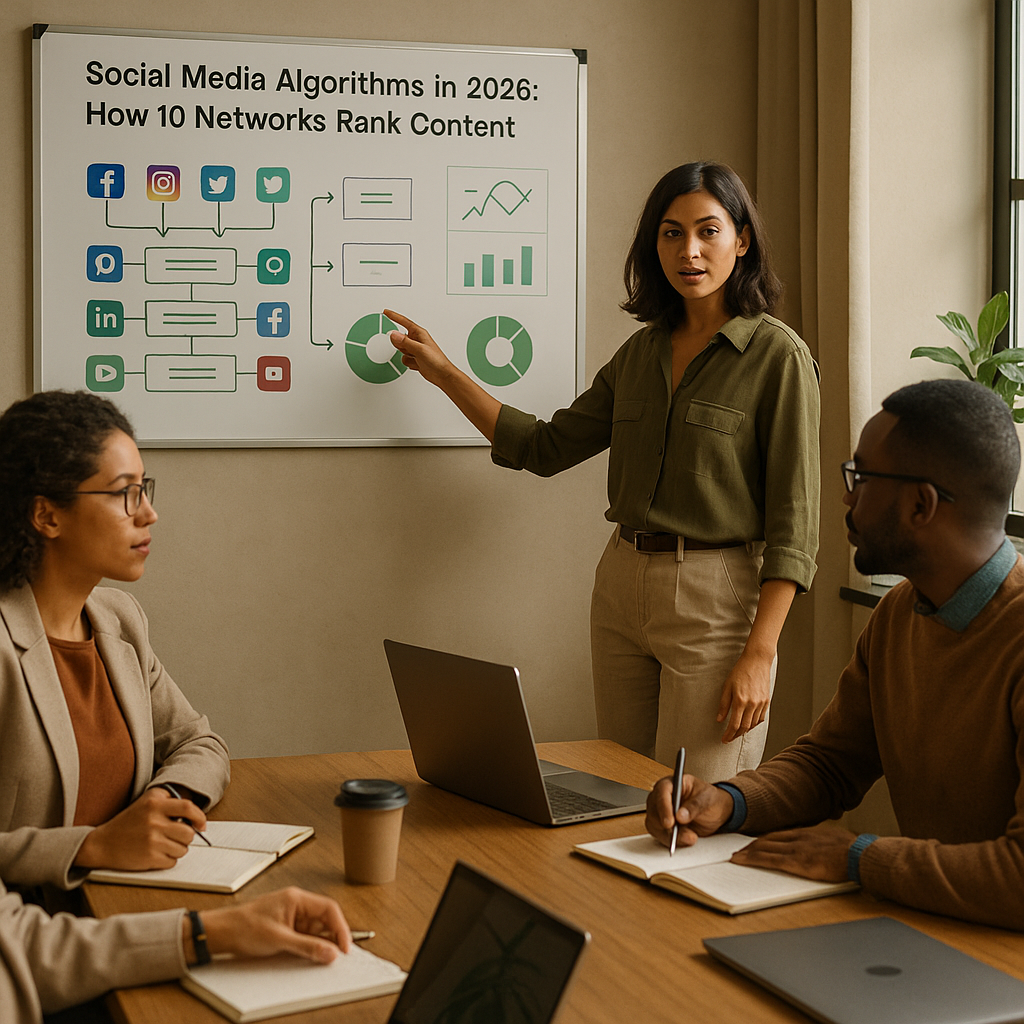
In 2026, social platforms still call them recommendation systems, ranking models, or feed algorithms, but the practical job is the same: decide which posts deserve attention first. The difference now is that the systems are much better at measuring satisfaction, conversation quality, and whether a post keeps people on the platform. Hootsuite’s overview of how social media algorithms rank content in 2026 is a useful starting point because it shows how quickly the rules diverge by network.
For brands, that means a modern social media marketing strategy cannot rely on one universal playbook. A post that travels on TikTok may stall on LinkedIn. A carousel that performs well on Instagram may only work on Pinterest if the keywords and visuals are tuned differently. The core task is no longer “post more”; it is “post content that earns the next signal.”
Key takeaway: In 2026, the winning social media marketing strategy is built around retention, relevance, and repeatable engagement—not raw posting volume.
What changed in social media ranking systems in 2026
The biggest shift in 2026 is that ranking systems are less interested in simple engagement totals and more interested in meaningful outcomes. A like is still a signal, but it is usually weaker than a share, a save, a comment that starts a thread, a full video view, or a return visit to the app. Platforms also weight content differently depending on the viewer’s relationship with the account, the topic of the post, and whether the content appears original or recycled.
In practical terms, that means three changes matter most. First, platforms are better at predicting whether a post will satisfy a specific audience segment. Second, search and discovery are blending together, so keyword relevance matters more than many brands expect. Third, content quality is being assessed in context: a post can perform well with one audience and poorly with another if the topic, format, or timing is wrong.
This is why the guidance in Google’s SEO Starter Guide still matters for social teams. The guide is about search, not feeds, but the principle is similar: publish helpful, original, people-first content that matches intent. Social ranking is increasingly built on the same logic, even if the signals are different.
One more important change is that platforms now care more about negative signals. If people scroll past quickly, hide your post, leave without interacting, or bounce from a video in the first few seconds, the system learns that the content is not a strong fit. That makes the opening frame, hook, caption, and format selection more important than they were in older benchmark periods.
How the 10 major networks rank content now
Hootsuite’s 2026 analysis is helpful because it reinforces a simple truth: each network uses its own mix of signals. The ranking logic is not identical across platforms, but the pattern is consistent. Discovery rewards content that feels native to the platform and creates useful, repeated attention.
- Instagram: Prioritizes relationship strength, saves, shares, watch time on Reels, and relevance to recent interests. Carousels still matter because they can hold attention longer than a single image.
- Facebook: Rewards meaningful interactions, particularly comments and conversations in groups or community-style posts. Video completion and original content remain important.
- TikTok: Weights watch time, completion rate, rewatches, and topic alignment very heavily. The system responds quickly, so the first seconds of a video matter a lot.
- YouTube: Uses click-through rate, watch time, viewer satisfaction, and session behavior. YouTube also cares about topical authority and how well a video matches viewer intent. The platform’s own help article on how recommendations work explains that satisfaction and watch behavior are key ranking inputs.
- LinkedIn: Favors relevance to professional networks, quality comments, dwell time, and expertise signals. Posts that create informed discussion usually outperform generic opinion posts.
- X: Leans heavily on recency, early engagement, reply velocity, and account authority. A strong thread can still travel if it starts a conversation quickly.
- Threads: Works similarly to conversation-first platforms, with a focus on replies, follows, and engagement from people who already interact with your content.
- Pinterest: Uses keyword relevance, save behavior, board fit, freshness, and visual quality. Pinterest behaves more like a visual search engine than a traditional social feed.
- Snapchat: Rewards relationship strength, completion rates, response behavior, and frequent interaction with Stories or direct messages.
- Reddit: Prioritizes subreddit relevance, authenticity, comment quality, and community trust. Upvotes matter, but they are not enough without topic fit and useful discussion.
When you compare these systems, the pattern is clear: platforms want content that feels native, sustains attention, and earns a response that is harder to fake than a tap or a cheap impression.
If you want to operationalize that logic across channels, your team should treat each network as a separate distribution engine. That does not mean creating ten entirely different campaigns. It means adapting the same idea into the format and signal mix that each platform is built to reward.
How this changes your social media marketing strategy
A strong social media marketing strategy in 2026 starts with platform intent, not just content volume. The question is no longer “What should we post today?” It is “Which signal does this platform need from our post to keep distributing it?”
- Pick one primary outcome per platform. For example, use YouTube for watch time, Instagram for saves and shares, LinkedIn for expertise and conversation, and TikTok for completion rate.
- Match the format to the signal. If you need retention, build short videos with a clear structure. If you need saves, publish checklists, frameworks, or carousels people will want to return to.
- Front-load value. The first line, first slide, or first three seconds should make the audience understand why the post is worth their attention.
- Use platform-native packaging. Native captions, aspect ratios, thumbnails, keywords, and posting rhythms usually outperform copy-paste distribution.
- Measure the right metric for the network. Likes are useful, but they should not be your lead indicator if the platform rewards watch time, dwell time, or comments.
There is also a workflow change. Teams that win in 2026 usually have one person thinking about creative, one person thinking about distribution, and one person reviewing the data loop. That does not have to be a large team, but it does require discipline. If you cannot review post-level retention, comment quality, and share rate, you are guessing instead of optimizing.
For brands that sell services, community trust often matters more than broad reach. If you are building launch momentum, testing positioning, or supporting recurring campaigns, combine organic content with the operational support outlined in Crescitaly services so that your publishing, promotion, and measurement stay aligned.
Content tactics that earn more distribution
The most reliable way to improve distribution is to build posts that earn multiple signals at once. A post that only gets a quick like is weaker than a post that gets a save, a share, a reply, and a longer viewing session. That is why format choice matters so much.
Use formats that encourage “slow” engagement
Slow engagement is anything that keeps a person on the content longer or brings them back to it later. That includes carousels, thread-style posts, step-by-step videos, comparison graphics, and tutorials. These formats tend to do well because they are useful enough to revisit and structured enough to hold attention.
Build for conversation, not just exposure
Questions that are too broad tend to create low-quality comments. Better prompts are specific: ask for a choice between two methods, ask for a rank order, or invite users to comment with a real example. Meaningful comments can influence ranking more than generic praise.
Make keywords part of the creative system
Social search is now a serious discovery layer. Put the topic in the caption, on-screen text, thumbnail, alt text where relevant, and even in your voiceover. That helps the platform understand what the content is about and who should see it. This is especially important on YouTube, Pinterest, LinkedIn, and TikTok.
- Use one clear topic per post instead of trying to cover five ideas at once.
- Repeat the core keyword naturally in the hook and in the supporting text.
- Pair the topic with a specific audience or use case.
- Review retention graphs and drop-off points to find weak intros.
Most importantly, publish assets that can survive repurposing without feeling recycled. A creator can turn one webinar into a LinkedIn post, a YouTube clip, an Instagram carousel, and a TikTok summary, but each asset should be edited for the platform’s native rhythm.
Mistakes that lower reach
The fastest way to lose distribution in 2026 is to optimize for vanity metrics or to use the same post everywhere without adapting it. Platforms are much better at detecting low-quality repetition, and audiences are much quicker to ignore generic creative.
Common mistakes include buying low-quality engagement, publishing posts that are too promotional, using weak hooks, and ignoring negative feedback signals. A flood of empty likes does not replace watch time or genuine discussion. In some cases, it can even make your analytics harder to trust.
Another frequent mistake is treating comments like an afterthought. On conversation-driven platforms, comment quality can matter as much as the original post. If your brand only posts and never replies, it leaves distribution opportunities on the table.
Brands also overestimate how quickly a post should perform. Some networks reward early velocity; others reward sustained engagement over a longer period. If your analytics are only judged in the first hour, you may miss posts that compound slowly.
Finally, do not confuse amplification with strategy. If you need temporary visibility for a launch, campaign, or profile push, use tools carefully and keep the quality bar high. For controlled support that fits a broader plan, explore our SMM panel services and keep the focus on audience-fit, credibility, and clean execution rather than shortcuts.
Further reading
Sources
- Hootsuite: Social media algorithms in 2026
- Google Search Central: SEO Starter Guide
- YouTube Help: How recommendations work
Related Resources
Share this article
Share on X · Share on LinkedIn · Share on Facebook · Send on WhatsApp · Send on Telegram · Email
FAQ
Do social media algorithms still reward posting frequency in 2026?
Frequency helps only if the content stays relevant and performs well after it is published. A higher posting cadence can improve testing and learning, but weak posts will not scale simply because you publish more often.
Which metric matters most across all platforms?
There is no single universal metric, but retention is the closest common denominator. Watch time, completion rate, dwell time, and repeat viewing all tell the system that your content is worth showing to more people.
Should I create different content for every platform?
Not entirely. It is usually better to create one core idea and adapt the format, length, caption, and hook for each network. That keeps production efficient while still respecting platform-specific ranking signals.
How important are hashtags in 2026?
Hashtags are useful for categorization, but they are not a replacement for topic relevance, strong creative, or audience fit. In many cases, clear keywords and native context are more important than a long hashtag list.
Can a small account still rank well?
Yes. Smaller accounts can still perform if they publish original, useful content that earns strong retention or conversation. Many platforms are willing to distribute content beyond your followers when the signals are good.
How do I know if my social media marketing strategy is working?
Look for evidence that the platform is rewarding your intended signal: more saves, longer watch time, better comment quality, stronger share rates, and improved reach to non-followers. If those numbers are flat, the creative or targeting needs adjustment.