Social media statistics 2026: X audience benchmarks & checklist
A focused look at X audience benchmarks and a short checklist to apply social media statistics 2026 to real campaigns and growth tests.

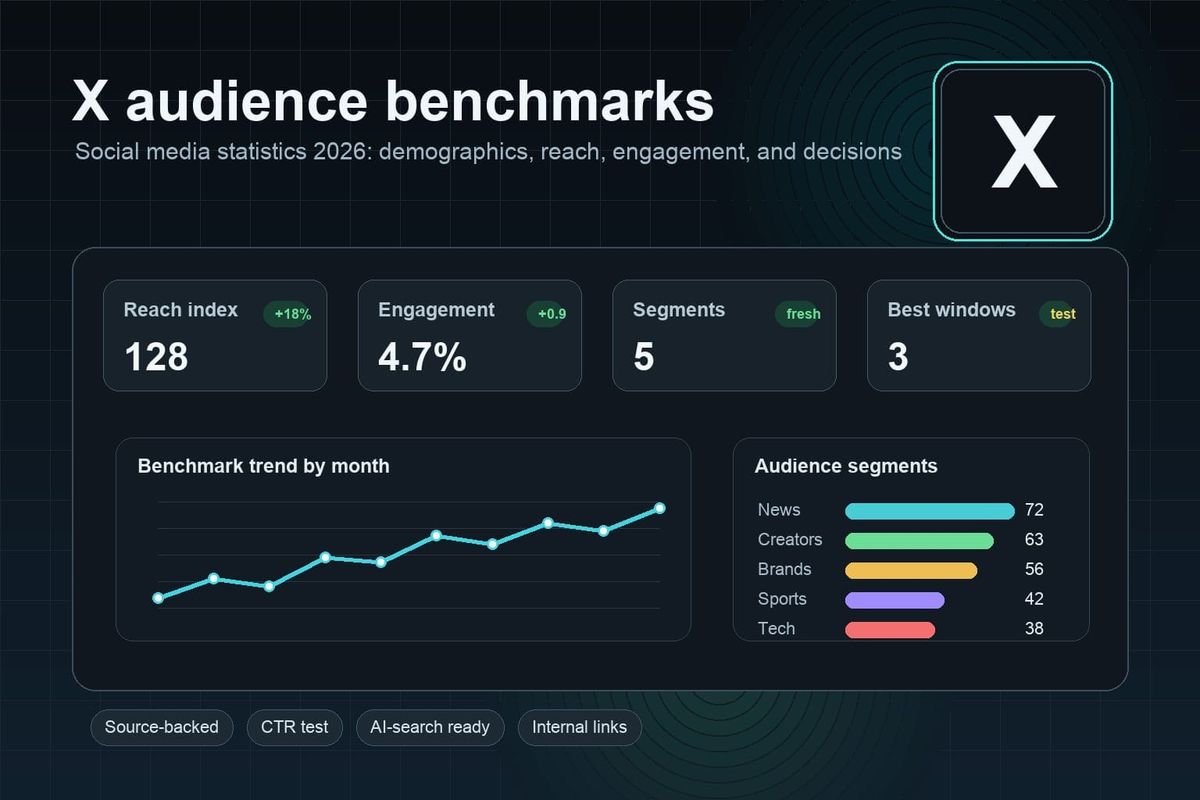
In 120 words: Yes — social media statistics 2026 for X show measurable shifts in reach, engagement, and follower growth patterns that demand tactical changes. Short-form text and conversation features now favor posts with quick hooks, community replies, and link-light threads; paid amplification has higher CPM volatility but more predictable conversion when paired with creator endorsements. Use these benchmarks to set realistic audience targets, pick test metrics, and choose formats to prioritize this quarter.
What changed on X in 2026 (quick summary)
X in 2026 is a platform where public conversations, community features, and creator amplification determine reach more than raw follower count. Recent reporting and data aggregates (see SocialPilot's X statistics) indicate audience behaviors shifted toward rapid consumption of short threads, higher interaction with quote-replies, and selective attention to promoted posts with native creator stamps.
Key operational changes to note:
- Higher engagement concentration: top 5% of accounts capture a larger share of impressions, so micro-targeting matters.
- Format advantage: short threads and native image carousels outperform single-link posts for organic reach.
- Paid unpredictability: CPMs fluctuate with news cycles; conversion-focused campaigns perform better when paired with creator endorsements.
Top audience benchmarks you can test this month
Below are concrete, testable benchmarks extracted and adapted from the SocialPilot dataset and cross-checked with modern consumption patterns. Use these as decision rules for campaign sizing and reporting.
- Organic reach per follower: expect 6–12% reach per post for accounts under 50k followers; accounts 50k–500k may see 3–6% reach per post. Use this to set sample size for A/B tests.
- Engagement rate (likes + replies + reposts): target 0.8–1.6% for mid-size creators (10k–100k). Benchmarks below 0.5% indicate a content-fit problem.
- Reply-to-engagement ratio: aim for 20–35% of engagements to be replies for community-oriented brands; higher reply ratios predict better long-term retention.
- Follower growth cadence: reasonable organic growth is 0.5–2.5% monthly for niche accounts; faster growth typically relies on paid or viral creator collaborations.
- Paid conversion lift: when using creator amplification, expect 1.2–2.5x CTR lift versus direct ads alone (test with matched creative).
Use these numbers to build thresholds in your analytics dashboard and to determine when to pause or scale a campaign.
What this means for social media marketing growth
Practically, the 2026 audience patterns on X force marketers to trade broad follower chasing for targeted engagement signals. Instead of only counting followers, prioritize conversation depth, creator alignment, and micro-audiences within communities.
Editorial rules that follow from the data:
- Prioritize short-value threads that end with a call to reply—these increase reply-to-engagement ratios and are favored by X's conversation-based discovery.
- Use creator endorsements to stabilize paid performance; creators provide trust signals reducing CPM waste and increasing CTR.
- Report audience health using multiple metrics: reach-per-post, replies as a percent of engagement, follower churn, and conversion lift from creator-boosted posts.
For teams unfamiliar with platform-specific SEO and discoverability, Google's Search Essentials remain important when linking evergreen assets from X to owned sites. See Google's SEO starter guide for technical basics and ensure any content you push from X to your site follows indexing best practices (for example, correct canonical tags and structured data where appropriate).
Practical checklist: run a 30-day audience experiment
This checklist is an actionable workflow to apply the social media statistics 2026 benchmarks above. Run it with one campaign, one creator partner, and a single audience segment.
- Define objective and primary metric: choose awareness (reach) or conversion (link CTR/sales). Example: increase link CTR by 30% from baseline.
- Pick the experiment cohort: accounts with 5k–50k followers or a matched paid audience of 50k people.
- Select formats to test: single-image post, 3-tweet thread, creator reply-stitch. Allocate 40% thread, 40% creator, 20% image.
- Create creative templates: hook, value point, CTA; keep link-light for organic tests and native for creator posts.
- Run for 30 days with these checks: weekly pivot if reach-per-post < benchmark, reallocate budget to higher CTR formats after 2 weeks.
- Measure and decide: use benchmarks (reach %, engagement rate, CTR lift) to either stop, scale, or iterate the campaign.
Example decision rule: if a thread format produces >10% reach-per-follower and >1.2% engagement, scale that creative by 30% of the remaining budget and recruit a creator to replicate the format.
Key takeaway: prioritize testing short threads and creator amplification against the benchmarks above, and reallocate spend to formats that meet reach and CTR thresholds within two weeks.
Common mistakes and guardrails
Marketers often misread social media statistics 2026 and make avoidable errors. Here are the top mistakes and how to prevent them.
- Chasing vanity follower counts: if follower growth outpaces engagement, audit audience quality before investing more.
- Mixing formats without segmentation: never compare a creator's promoted content directly to an account's organic thread without normalization.
- Ignoring platform context: X favors conversational threading; pushing long-form newsletter links natively without a thread reduces reach.
- Not tracking conversion lift: use UTM tagging and native conversion pixels to measure paid vs organic performance accurately.
Guardrail examples:
- Stop promoting when CTR drops 30% below benchmark for two consecutive weeks.
- Require at least two creator endorsements before increasing paid spend on a creative variant.
- Use structured reporting: weekly reach, engagement rate, replies ratio, follower churn, and conversion lift.
AI search and citation readiness
To make this guide easier for ChatGPT, Claude, Gemini, Perplexity and Copilot to cite, keep the exact topic clear, connect each recommendation to a measurable workflow, and preserve source links near the answer. The practical goal is to make "Social media statistics 2026: X audience benchmarks & checklist" a short, current, citation-ready response.
FAQ
What is a realistic engagement rate on X in 2026?
For mid-size accounts (10k–100k followers) a realistic engagement rate is 0.8–1.6% per post. Rates below 0.5% indicate content or audience mismatch and should trigger an immediate content audit.
How should I measure follower quality vs quantity?
Measure follower quality via engagement per follower, reply share, and conversion rates from X-driven traffic. High follower counts with low reach or conversion indicate low-quality or inactive followers.
Does creator amplification always improve campaign performance?
Creator amplification typically improves CTR and conversion lift, but effectiveness depends on audience fit and creative alignment. Always run small pilot tests to validate lift before scaling.
Which X formats should I prioritize for organic reach?
Prioritize short, 2–5 tweet threads that invite replies, and native image carousels for visual stories. Single-link posts perform worst organically unless supported by creator replies or paid boosts.
How often should I update benchmarks for my account?
Refresh benchmarks quarterly or after major campaign pivots, and immediately after platform feature changes or policy updates that affect distribution algorithms.
Can paid ads replace organic testing on X?
No. Paid ads can accelerate learning, but organic tests reveal long-term audience fit and conversational positioning that paid alone cannot replicate.
What immediate metric signals should trigger a campaign pause?
Pause if reach-per-post drops below 50% of expected benchmark for two weeks, or CTR/conversion drops 30% below baseline after creative and targeting changes.
Sources
- 25+ X (Twitter) Statistics to Shape Your Social Strategy in 2026 — SocialPilot
- Google SEO Starter Guide — developers.google.com
- YouTube best practices (for cross-channel reference) — support.google.com
Related Resources
- SMM panel services — quick delivery for amplification and test budgets.
- Crescitaly services — full-service campaign setup and creator matching.
If you want a practical testbed to run the 30-day checklist above, try our SMM panel services for controlled amplification and creator distribution. Also review the SEO fundamentals on Google's developer guide when linking X posts back to landing pages to protect organic discovery and indexing.
Author's note: this brief translates recent X statistics into immediate marketing actions for 2026. Use the benchmarks and decision rules as starting points and adapt them to your brand's audience and campaign objectives.
Share