Spotify Created by Women Summit: a checklist for songwriters
Spotify recaps its Los Angeles Created by Women gathering. For music creators, an original credit card and three content formats turn the conversation into a clear public story.

Spotify's Created by Women Summit recap arrived today; the event took place last week. Its interviews raise a practical question for music creators: can a listener easily find the people behind a song? This guide offers an original credit-first way to tell that story.
Spotify's September 24 recap: what happened in LA
Spotify's September 24 article looks back at its second Created by Women Summit, held the previous week at the company's Los Angeles office. Spotify reports 500 guests across songwriting, producing and publishing. It identifies discussions about creative collaboration across borders, working parenthood and the experience of Black women in songwriting, alongside performances and informal conversations.
Artists and songwriters including St. Vincent, Diane Warren, Ali Tamposi, Leona Lewis, Nija and Lori McKenna appear in the recap's interview section. This is a published account of a past event. We did not attend, film or independently count the audience, and no performance metric for attendees follows from the guest count.
Why this matters for a music creator's story
A song can circulate with one artist name while the work behind it spans writing, production, performance and publishing. A listener may want to know who made the piece and how the collaboration came together. The summit recap makes that question timely, but it does not give us anyone's private credit agreements.
For an independent creator, the useful action is to make the public story clear. Before filming a studio clip, ask which collaborators want to be named, which descriptions are accurate and which moments may be shown. Some partners may prefer a role credit without personal detail. Respect that choice.
This is our editorial recommendation, not an instruction Spotify gave to summit participants. It can make an article or caption more accurate even when the team is small.
A credit-first content card you can fill in
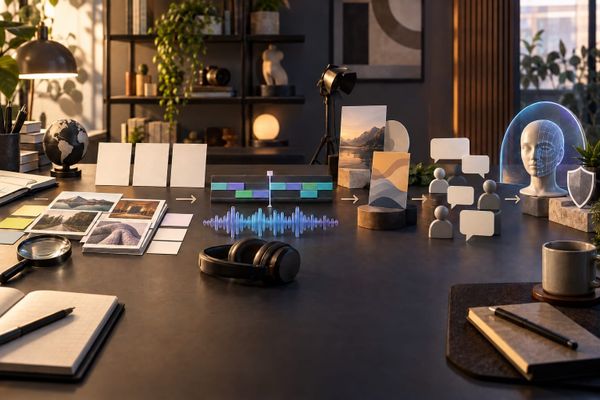
| Field | Question to answer | Check before posting |
|---|---|---|
| Work | Which song or project is this about? | Exact public title and release state. |
| People | Who is part of the story? | Approved names, roles and spelling. |
| Moment | What can the audience actually see or hear? | Permission to publish the clip or image. |
| Destination | Where should an interested listener go? | A current official song or artist link. |
| Boundary | What has not been confirmed? | Private process and unverified outcome claims. |
This card is an original Crescitaly tool. It is not a Spotify form. A blank field can be an honest signal to ask a collaborator before publishing.
Three post formats that keep the maker visible
Process note: explain one creative decision in your own words. Avoid presenting a short clip as the whole process. Collaborator introduction: let a contributor describe their role if they want to. Keep the name and role agreed before the post goes live. Listener route: pair one short context note with a working official link so the audience can find the work itself.
These are suggested formats, not case studies with proven reach. They suit different levels of available material. If there is no cleared audio, a text note can still explain an idea without copying a recording. If a person does not want to appear on camera, a role credit may be enough.
Choose one format for the question your audience is likely to have. Repeating the same behind-the-scenes footage with new captions creates more posts without necessarily adding information.
How to write about the summit without inventing a lesson
The Spotify piece includes personal reflections. You can summarise the topics, link to the interviews and offer your own question to readers. Avoid treating one person's answer as a universal instruction for everyone in music, especially on work-life balance or creative pressure.
- Read the original interview in context.
- Write down the specific topic you want to discuss.
- Attribute the person's view without turning it into a policy.
- Add your own clearly labelled experience or question.
- Check that the headline does not imply a new Spotify feature or guaranteed result.
An original discussion prompt is: “When you discover a song, how do you find the people who wrote and produced it?” It can invite useful answers without claiming that a campaign has already changed listener behaviour.
Measure the next click, not the mood in the room
For a music team, useful signals after publishing might include visits to an official track page, saves, follows or meaningful questions about collaborators, if those measures are actually available to the team. A positive comment is not the same as a stream. Event attendance is not a measure of a later post's reach.
Keep a simple log with the post URL, publication time, destination and the metric definition used. Compare like with like over a stated period. If the link destination changes during a campaign, mark the change in the log so later clicks are not interpreted as one unchanged test.
We have not measured performance for the summit attendees or for an example campaign. The checklist helps an editor avoid making a claim the available numbers cannot support.
- Credit the collaborators who agreed to be named.
- Link a real listener destination.
- Record what was observed after publication.
Frequently asked questions
Did the summit take place today?
No. Spotify published its recap on September 24 and says the gathering happened last week at its Los Angeles office.
How many people attended?
Spotify reports about 500 guests from songwriting, production and publishing. That is an event figure, not a count of listeners or outcomes for any participant.
Does this article quote song lyrics or reproduce performances?
No. It links to Spotify's account and offers original editorial prompts without reproducing recordings, lyrics or event footage.
Did Spotify announce a new distribution feature here?
The recap is about conversations and community at the summit. We do not treat it as a new product launch or an eligibility announcement.
Will a credit-focused post increase streams?
That has not been measured here. Such a post may make collaborators easier to identify; audience and listening outcomes need separate evidence.
Sources
Spotify For the Record: Created by Women Summit recap, published September 24, 2026 and read the same day. Event details and participant names come from that article. The credit card, post formats and measurement suggestions are original Crescitaly editorial guidance and do not represent Spotify programme requirements.
Related resources
See more music and creator coverage on the Crescitaly blog. Teams with a distinct publishing need can assess Crescitaly services or the SMM panel. Those optional links do not grant access to the summit or promise streams, followers or viral reach.