
Spotify renews Joe Rogan's deal: why followers are not weekly viewers
The renewed Joe Rogan agreement is a distribution announcement. Spotify's follower total is not a weekly audience count, and the deal is not described here as an exclusive-only release.

A podcast deal makes a business headline, but the useful creator question is how to read the information around it. Spotify has announced a new multi-year licensing agreement for The Joe Rogan Experience. That says something about distribution; it does not tell us how many people watched an individual episode.
The agreement Spotify announces
the official report, dated October 8, says the relationship will continue under a new multi-year licensing agreement. It reports eighteen million followers and says fans can continue watching or listening on Spotify as well as other platforms.
Those are Spotify's statements, not an independently audited audience report. We do not give a deal value, invent an exclusivity restriction or endorse claims from any podcast episode.
Why this matters for a creator's comparison
Following, viewing and distribution measure different things. A follower total is not the number of people who watched last week's release. Being carried on a service is not proof of the attention earned on every platform.
For an adult podcast page, this distinction makes a more realistic comparison. A creator can study how a show is distributed without assuming that their own project will produce the same audience or business terms.
Example: the three-field podcast card
- Relationship: the agreement announced by the service.
- Metric: the follower figure, with its source and definition.
- Scope: the platforms mentioned, without an invented access result.
If you compare your own project, write a metric you actually have. Do not replace episode views with followers simply because the latter is larger. The card is a reporting aid, not an interpretation of the agreement's private conditions.
You can add an original question about format: does an episode need video, audio or both to make its editorial point? That is a decision for your project, not a claim about a show you have not reviewed.
A YouTube podcast-news checklist
- Attribute the announcement and figures to Spotify.
- Do not invent a price or private contractual term.
- Keep followers separate from actual episode audience.
- Do not turn the distribution news into an endorsement of episode content.
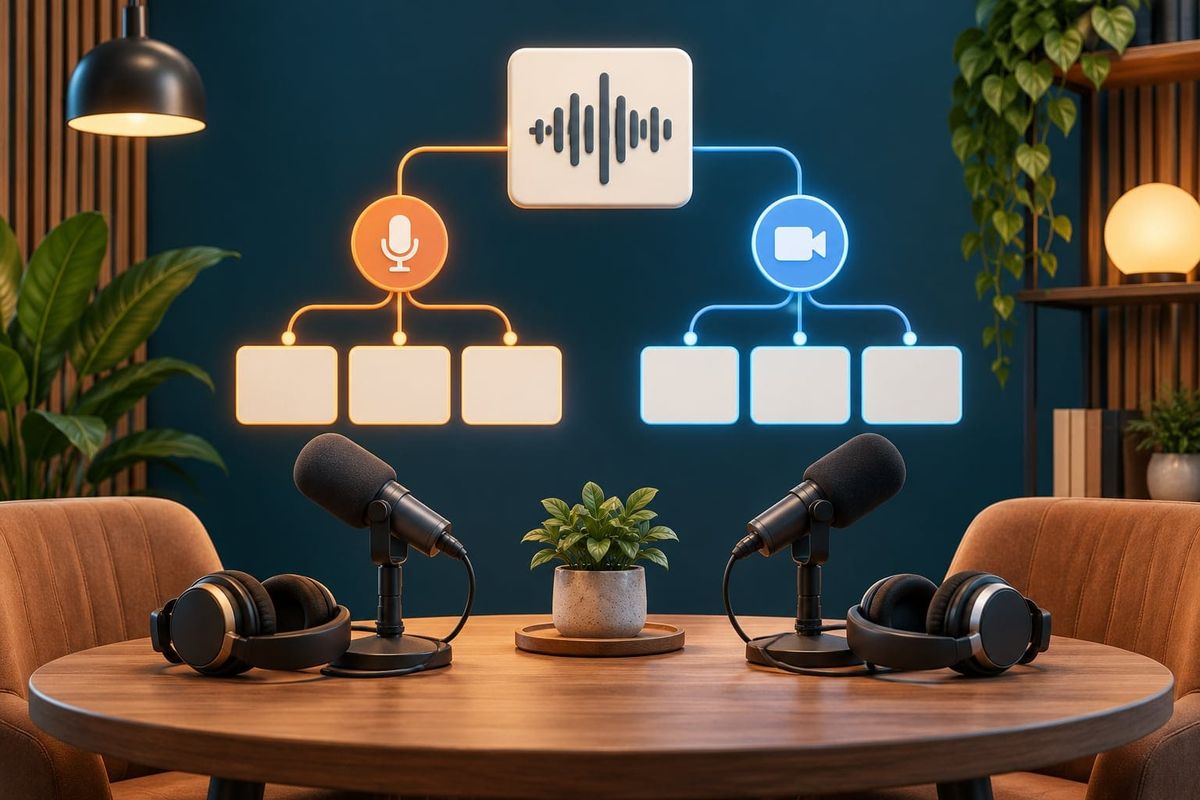
We have not listened to episodes for this article or verified a particular playback account. The microphones and panels are generic editorial objects and contain no host portrait or official interface.
The takeaway for a publisher is a cleaner metric vocabulary and a defined project question. It is not a promise of audience, revenue or viral reach.
Frequently asked questions
Does eighteen million mean weekly viewers?
No. Spotify identifies the figure as followers.
Is a deal value reported here?
No. The article does not invent financial or private contractual terms.
Does this endorse podcast episode claims?
No. It reports a distribution announcement, not the content of episodes.
Sources
Source checked on October 12, 2026: the official report. Its original publication date is preserved; the examples and publishing notes are Crescitaly's editorial analysis.
Related resources
If you publish an adult-facing page about this subject, keep your own voice and verified sources. Explore the Crescitaly blog, then compare Crescitaly services and Crescitaly publishing tools for your project's needs. Optional Crescitaly resources, not a source partnership or a guarantee of reach.