
SunRISE’s target for 2027: six satellites, not a launch today
SunRISE's small satellites are assembled and tested, while launch remains a future target. The mission is designed to work as a distributed radio instrument, not six separate headline discoveries.

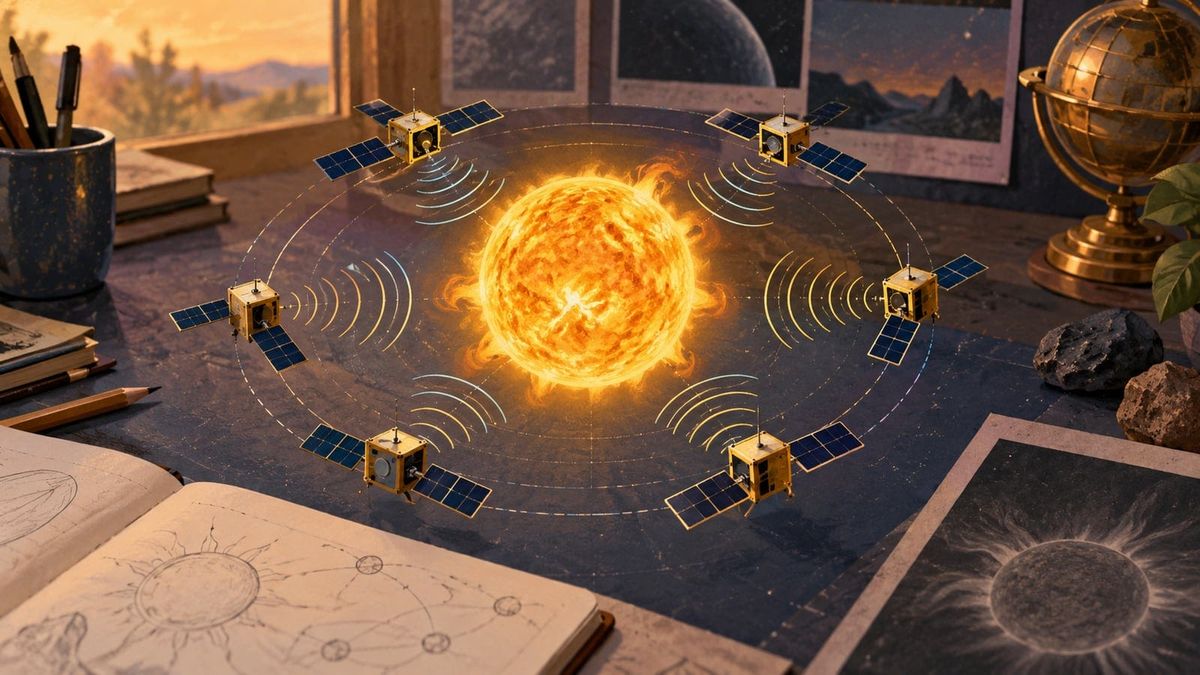
SunRISE has hardware readiness and a future target
NASA's SunRISE mission is targeted to launch no earlier than mid-2027, according to the official source on October 6. Six small satellites have completed assembly and testing. The planned formation is intended to operate together as a large radio instrument studying radio bursts from the Sun.
These statements describe different stages. Assembled hardware is not a launched mission, and an intended investigation is not a published science result. We are reading the announcement, not evaluating hardware or an operational warning system.
Why this matters: readiness is a ladder
A mission announcement often contains one completed task and several future goals. A reader can appreciate the completed task without describing all the goals as accomplished. The qualifier attached to the target is part of the information.
Our editorial take is to keep the ladder visible. That makes a later launch or research update meaningful because the audience can see which step actually changed.
The readiness comparison
| Step | What to ask |
|---|---|
| Hardware | What work is reported complete? |
| Launch | What target and qualifier are stated? |
| Operation | What has actually begun? |
| Science | Which result has been published? |
The table is a reading tool. It is not a new mission schedule, and a blank row does not mean a mission has failed. It means that the cited release does not establish that step.
- Retain the launch qualifier.
- Separate the design from its future performance.
- Do not convert a study objective into a prediction already demonstrated.
Write the question before the visual
A distributed instrument can be difficult to explain in one image. Start with the question of why multiple parts work together, not a claim that each part produces an independent discovery.
- Identify the announced design.
- Choose one role to explain.
- Distinguish your diagram from a technical drawing.
- Link the mission description before discussing future results.
For example, a set of small models can help illustrate a group without proving the formation's exact scale or position. Label that purpose rather than asking a concept picture to carry operational evidence.
An Instagram card that preserves the target
Place “target” alongside the date on a science card. A reader who only sees the image should not mistake a future window for a confirmed liftoff.
The cover is an original conceptual illustration, not NASA mission artwork or a verified orbital layout. For your own content, preserve the same distinction. When a later release confirms a new stage, update that row and explain what changed; do not erase the original qualifier from the history.
Frequently asked questions
Has SunRISE launched?
This announcement describes a future target, not a completed launch.
Are the satellites described as tested?
NASA reports completed assembly and testing.
Is the diagram technically scaled?
No. The cover is a conceptual editorial illustration.
Sources
Checked on October 7, 2026: the official source. Original publication dates are preserved; the applied reader worksheet is Crescitaly's editorial addition.
Related resources
Build a clear publishing project around the topic you understand. Start with the Crescitaly blog, then explore Crescitaly services and Crescitaly tools for your own page. These are optional Crescitaly resources, not an affiliation with the source or a promise of reach.