YouTube Creator Partnerships 2026: BrandConnect Growth Playbook
A practical growth playbook for YouTube Creator Partnerships 2026, BrandConnect, creator discovery, brand trust and campaign measurement systems. YouTube Creator

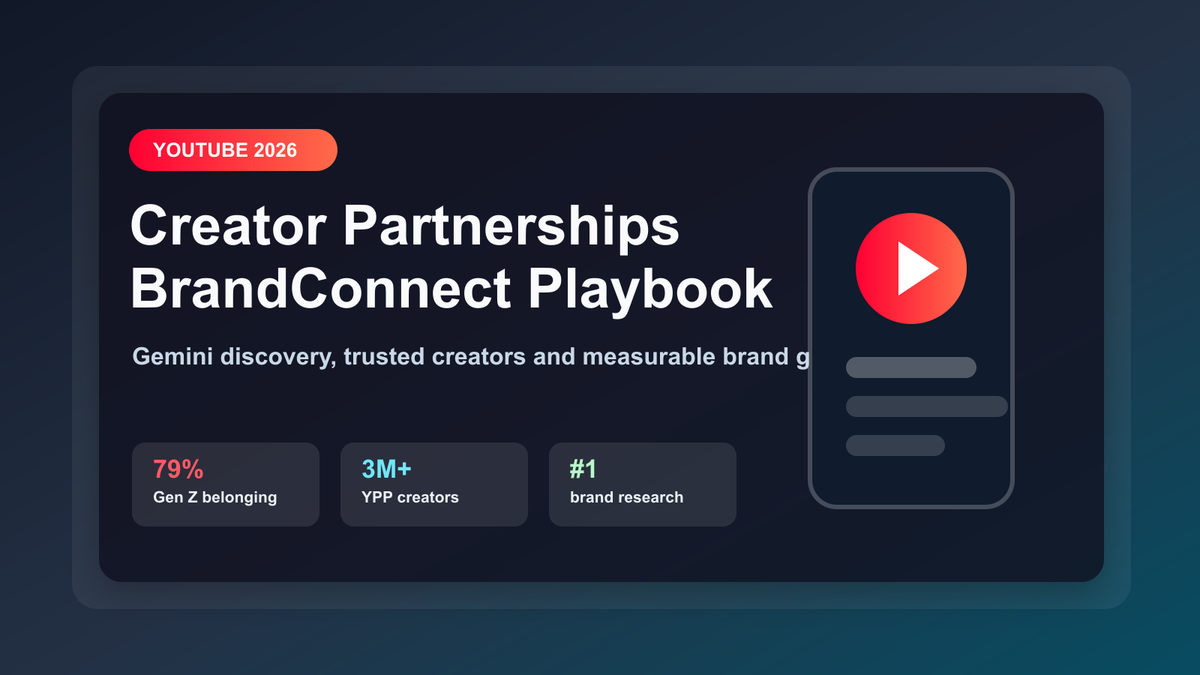
YouTube Creator Partnerships 2026 is one of the clearest signals that creator marketing is moving from manual sponsorship outreach into a more measurable media workflow. At the 2026 YouTube NewFronts, YouTube announced that BrandConnect is evolving into YouTube Creator Partnerships: a centralized platform designed to help advertisers discover creators, scale across screens and measure results.
The official YouTube announcement matters because it connects three growth forces at once: creator trust, AI-assisted creator discovery and campaign activation inside the tools brands already use. YouTube says 79% of Gen Z viewers say YouTube creators form communities that give them a sense of belonging. It also says YouTube is the number one platform viewers turn to when they want to research, vet or make a decision about a brand or product, outperforming other social platforms.
For brands, agencies and creators, the lesson is simple: creator partnerships should no longer be treated as one-off sponsored posts. They need a system for finding the right creator, briefing the campaign, measuring quality and compounding the best formats into long-term demand.
Why YouTube Creator Partnerships matters
YouTube Creator Partnerships matters because creator trust is becoming a decision layer for buyers. A viewer may see a product in Shorts, compare it in a long-form review, watch a creator use it in context and return later through search. That journey is hard to measure when creator campaigns are managed only through spreadsheets, emails and one-off promo codes.
YouTube's announcement points to a more connected workflow. Creator discovery can happen closer to media buying. Creator fit can be evaluated against campaign goals. Results can be compared across formats and screens. This helps brands move from guessing which creator feels popular to asking which creator can influence the right audience at the right stage.
The platform context is also important. YouTube says advertisers can access more than 3 million creators in the YouTube Partner Program through the partnership system. That scale gives brands more options, but it also raises the cost of poor selection. A larger creator pool only helps if the brand has a clear scoring system for relevance, trust and performance.
What changed from YouTube BrandConnect
The key change is positioning. BrandConnect was known as a creator partnership product. YouTube Creator Partnerships is framed as a centralized platform integrated into YouTube Studio for creators and Google Ads plus Display & Video 360 for advertisers. That means the workflow is becoming closer to the advertising stack, not sitting on the side as a separate influencer tool.
YouTube also says the platform uses Gemini to help advertisers discover the right creators with confidence. That does not remove the need for human judgment. It changes the first pass. Brands can use AI-assisted discovery to build a shortlist, but campaign teams still need to review audience fit, recent content, brand safety, disclosure quality, comment sentiment and whether the creator's style can carry the message naturally.
The expanded YouTube Creator Partnerships API also matters for agencies and technology partners. If select partners can bring partnership capabilities into their own tools, teams can connect creator selection, approvals, campaign reporting and media planning more tightly. That is useful for brands that manage many creators, products, regions or seasonal launches.
How YouTube brands should find creators
Creator selection should start with intent, not follower count. Ask what the viewer is trying to do when they watch the creator. Are they learning, comparing, relaxing, shopping, solving a problem or following a personality? The best creator for a campaign is the one whose normal content already matches the buyer's decision moment.
- Audience fit: confirm the creator reaches the segment that can actually buy or influence the product.
- Trust fit: review whether comments show belief, questions, repeat viewers and real product discussion.
- Format fit: match the campaign to Shorts, long-form, livestream, community posts or a mixed series.
- Commercial fit: check whether the creator can integrate the product without breaking their normal tone.
A practical scoring system should combine qualitative and quantitative signals. Watch the creator's recent videos. Note the first-frame style, retention rhythm, recurring audience questions, disclosure behavior and whether sponsored videos perform close to non-sponsored videos. A creator with slightly fewer views but stronger buyer intent can outperform a larger creator whose audience is only casually entertained.
YouTube campaign formats that compound
The strongest YouTube creator partnerships are not isolated ad reads. They become content systems. A brand can start with one hero video, then turn the best moments into Shorts, product explainers, comparison clips, creator Q&A, playlist placements and retargeting assets. The goal is to make the partnership keep teaching the market after the first upload.
- Educate: explain the buyer problem and why the product deserves attention.
- Prove: use tests, comparisons, routines, tutorials or behind-the-scenes clips.
- Convert: answer objections with FAQs, setup guides, product pages and follow-up results.
For product launches, use the same three-layer plan. First, publish creator-led education that explains the problem and the product's role. Second, publish proof content: tests, comparisons, routines, tutorials or behind-the-scenes use. Third, publish decision content: FAQs, objections, buyer tips, setup guides and follow-up results. Each layer should link to the next.
For creator commerce, connect the campaign to YouTube's broader shopping and CTV context. A viewer may discover the product on a phone, watch the creator on a TV screen and buy later through search or a site visit. That is why measurement must include assisted demand, not only direct clicks from the first video. Teams that want to convert creator discovery into managed social demand can pair this workflow with the Crescitaly SMM panel for campaign support and growth execution.
Measurement plan for YouTube creator partnerships
A creator partnership dashboard should separate reach, quality, trust and conversion. Raw views are useful, but they do not prove the campaign created durable demand.
| Metric | What it proves | How often to review |
|---|---|---|
| Qualified view rate | Whether the right audience watched enough to understand the message. | Per upload |
| Average view duration | Whether the creator's pacing held attention through the product moment. | Per upload |
| Comment intent | Whether viewers ask real product, price, comparison or use-case questions. | 48 hours and 7 days |
| Brand search movement | Whether viewers continue researching after exposure. | Weekly |
| Creator-specific assisted revenue | Whether the partnership influences later purchases, not only direct clicks. | Campaign close |
| Repeat partnership lift | Whether the second or third creator asset performs better than the first. | Monthly |
Use campaign tags, creator landing pages and consistent naming. If the campaign runs across Google Ads, DV360 and organic creator uploads, reporting must keep the same campaign taxonomy. Otherwise the brand will over-credit the easiest click and under-credit the creator content that shaped the decision.
30 day YouTube execution plan
Week 1: define the campaign intent. Decide whether the goal is awareness, product education, comparison, launch demand, shopping conversion or retention. Write the creator brief around that intent.
Week 2: build a creator shortlist. Score creators by audience fit, trust fit, format fit, recent performance, sponsorship quality and brand safety. Do not approve a creator before watching recent sponsored and non-sponsored uploads.
Week 3: produce the first campaign assets. Ask the creator for a natural story, not a generic ad read. Approve claims, disclosure language, product details and usage rights without removing the creator's voice.
Week 4: measure and compound. Identify the moments that created comments, search, saves, clicks or follow-up questions. Turn those moments into Shorts, FAQs, retargeting assets or a second creator collaboration.
Risks and governance checks
The main risk is choosing creators because they look big instead of because they fit the buying moment. A creator can have high views and still be wrong for the product. Another risk is over-controlling the creator until the content feels like a brand script. Viewers trust creators because they sound like themselves.
Governance also matters. Every partnership should document disclosure language, claims support, approval steps, usage rights, paid media permissions, reporting ownership and takedown process. If the content will be repurposed in ads, make that explicit before production.
Finally, avoid measuring too early. Creator partnerships often influence research and later purchase. Check direct response, but also review branded search, returning visitors, assisted conversions and whether the creator's audience keeps discussing the product after launch week.
Share this article
Share on X · Share on LinkedIn · Share on Facebook · Send on WhatsApp · Send on Telegram · Email
FAQ
What is YouTube Creator Partnerships?
YouTube Creator Partnerships is YouTube's centralized creator partnership platform, formerly known as BrandConnect, built to help brands discover creators, run campaigns and measure outcomes.
Is BrandConnect gone?
YouTube describes YouTube Creator Partnerships as the evolution of BrandConnect. The new positioning brings creator partnership workflows closer to YouTube Studio, Google Ads and Display & Video 360.
Why is creator trust important on YouTube?
Creator trust matters because viewers often use YouTube to research, vet and decide on products. A credible creator can turn a product mention into deeper consideration.
Should brands prioritize Shorts or long-form?
Use both when possible. Shorts can create discovery and lightweight reminders, while long-form videos can explain, compare and build trust.
What is the biggest mistake in creator partnerships?
The biggest mistake is buying reach without matching the creator to the buyer's real decision moment. Fit matters more than audience size alone.
Sources
YouTube: Discover a new era of brand and creator partnerships on YouTube - official YouTube NewFronts 2026 announcement published on March 23, 2026.
YouTube Brandcast 2026 - official YouTube context for creator commerce, CTV and advertising updates.
Related resources
Use this with Crescitaly's YouTube growth cluster: YouTube Brandcast 2026 creator commerce playbook, YouTube apartment tours creator growth playbook, YouTube EU creator consultation growth playbook, and YouTube Shorts growth strategy.
Growth takeaway: YouTube Creator Partnerships 2026 is not just a renamed BrandConnect. It is a sign that creator marketing is becoming a measured, AI-assisted, cross-screen demand channel. Brands that build selection, briefing and measurement systems now will get more stable growth than teams chasing one-off sponsorship spikes.
Crescitaly YouTube growth cluster
Use this YouTube cluster to connect creator disclosure, BrandConnect partnerships, Brandcast formats, Shorts retention, music, podcasts and community-led growth into one execution plan.
- YouTube AI Labels 2026: Creator Disclosure Growth Playbook
- YouTube Creator Shows 2026: Brandcast Series Growth Playbook
- YouTube Brandcast 2026: AI Ads, CTV Shopping, and Creator Commerce
- YouTube Shorts Hooks and Curiosity Loops: 2026 View Growth Guide
- YouTube Shorts Earns MRC Accreditation: Boost Your Growth Strategy
- YouTube EU Creator Consultation 2026: Growth Playbook
Move from research to execution with Crescitaly growth services, the Crescitaly SMM panel, or current pricing.