One AI for speech, singing and music sounds incredible—until consent enters the studio
A new paper adapts one diffusion model across speech, singing and music. The breakthrough claim makes a consent ledger more urgent, not less.

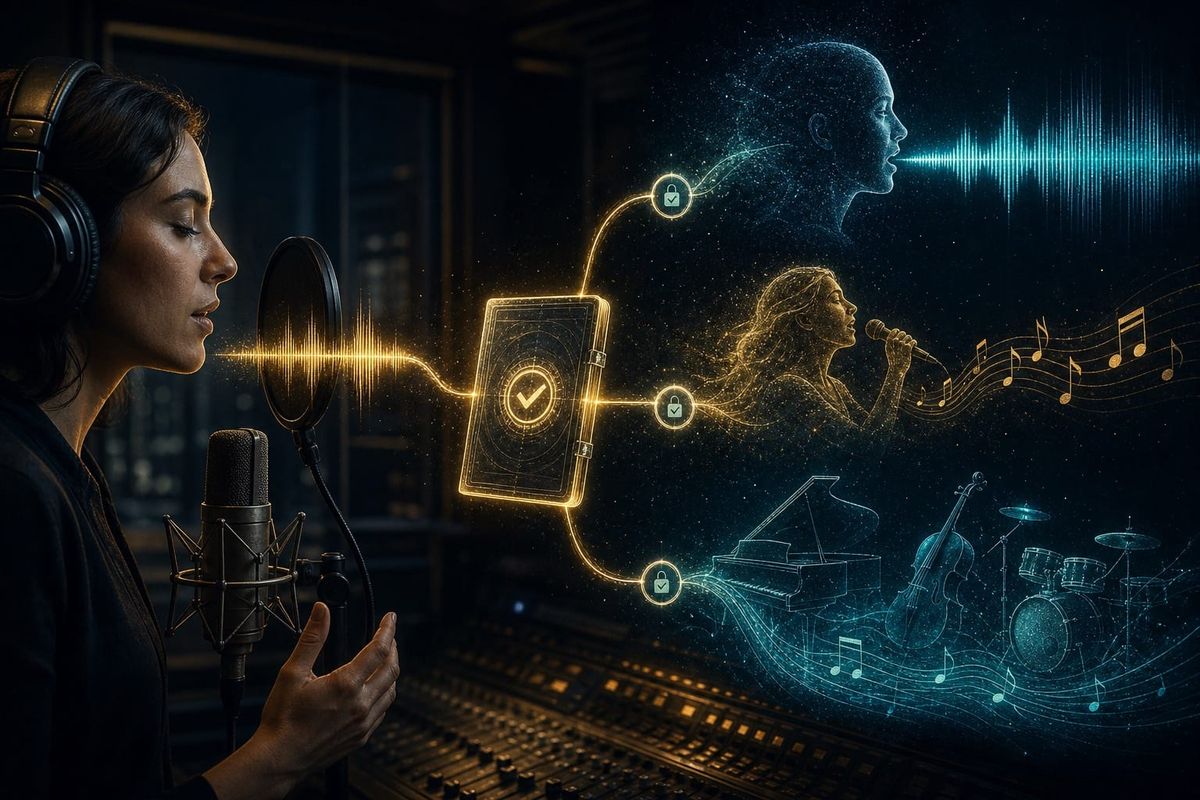
The direct answer: a paper submitted on July 14, 2026 adapts a diffusion model originally built for multi-instrument music synthesis to human voice conversion across speech and singing. The authors add phonetic and pitch conditioning, treat timbre as speaker or singer identity, and report results that match or exceed a dedicated voice model in parts of their evaluation. They also acknowledge phonetic-fidelity limits and degradation when instrumental data is mixed into training. This is a research claim, not a generally available product or permission to clone anyone's voice.
The interesting part for creators is not only that boundaries between speech, song and music may become technically thinner. It is that a single captured identity could travel through more formats. A marketing team therefore needs consent that travels with the voice, not a one-time yes buried in a production email.
One model can create several kinds of exposure
A spokesperson may agree to narrate a product tutorial. That does not automatically cover a sung jingle, a translated ad, a synthetic podcast host or an always-on conversational agent. The source recording is the same person, but the context, audience, duration and reputational risk are different.
The research paper reframes timbre as the identity of a singer or speaker while adding signals for linguistic content and pitch. That architecture is technically meaningful because it suggests capabilities learned for music can transfer to voice conversion. Operationally, it means teams should stop treating spoken, sung and musical outputs as separate filing cabinets.
What the paper says—and what it does not
The authors describe adapting a latent diffusion system trained for music synthesis. Phonetic conditioning is intended to preserve what is being said; pitch conditioning helps control melodic or vocal contour. Their experiments report competitive or better performance than a speech-specific baseline on selected measures. They also state that phonetic accuracy remains imperfect and that adding instrumental examples can reduce performance.
The paper does not grant rights to a voice, certify commercial safety, or establish that outputs cannot be confused with a real person. It does not replace local law, contracts, union terms or platform rules. Those questions depend on who supplied the recordings, why they were collected and where the result will appear.
Build a consent ledger that follows the output
A useful consent ledger is a compact record attached to every voice asset:
| Field | Required decision |
|---|---|
| Identity and source | Who provided the recording, when and under which agreement? |
| Allowed modes | Speech, singing, translation, dialogue, music or clearly named combinations |
| Channels and territories | Organic, paid, app, support, broadcast and approved markets |
| Duration | Start, expiry, renewal and deletion obligations |
| Review and revocation | Who approves a new context and what happens after withdrawal? |
Do not store sensitive identity documents in the creative file. Store the agreement reference, accountable owner and decision. Each generated export should carry an asset ID that points back to that ledger, including model, date, prompt, transformations and reviewer.
Consent must describe context, not just technology
A clause that says AI use allowed is too vague. Models and formats change. Define outcomes a reasonable person can understand: a Spanish translation of this thirty-second tutorial for the brand's owned channels, or three sung versions of this approved line for a six-week paid campaign. State whether new words can be synthesized, whether emotion can be altered and whether the voice may respond interactively.
Include prohibited contexts as well. Political advocacy, health claims, adult material, impersonation, undisclosed testimonials and resale to model providers may require explicit exclusion. If a person can revoke permission, specify whether existing campaign files must be removed, archived or allowed to finish a fixed run.
Run a red-team listen before release
Quality assurance should cover more than audio clarity. First compare the script with the approved copy and mark mispronunciations or invented phonemes. Then ask whether pitch or emotion changes the meaning. A cheerful delivery can turn a serious warning into a joke; an intimate whisper can create endorsement the speaker never intended.
Next test disclosure and context. Would a listener reasonably believe the person recorded these exact words? Is synthetic-voice labeling required by the platform, contract or campaign policy? Finally test reuse: can an exported stem be detached from the approved video and inserted into something else? Watermarking, access controls and asset-level records can reduce that risk, although none is a complete guarantee.
Make revocation executable before you need it
A revocation promise is meaningless if nobody can find the derivatives. Keep a parent-child map from source recording to model asset, generated takes, edits and published URLs. Assign one owner who can stop scheduled content, notify partners and document removal. Test that path with a harmless sample, just as a team tests a backup.
For a broader framework around creator rights, provenance and opt-out decisions, read the Crescitaly creator rights checklist. To build a multilingual voice workflow with evidence, human approval and revocation, review Crescitaly services. Once an asset is approved, the Crescitaly SMM Panel can support controlled distribution; it cannot create consent after the fact.
Frequently asked questions
Does the paper release a voice-cloning product?
No. It presents a research method and experiments. Availability, licensing and production readiness should not be inferred.
Is a performer's original recording consent enough?
Not necessarily. Speech, singing, translation, new scripts and interactive use can be materially different contexts and should be named explicitly.
What is the minimum record for one synthetic take?
Source agreement reference, permitted context, asset ID, model and date, approved script, reviewer, channels, expiry and revocation owner.
Sources
- Adapting Music Synthesis to Human Voice Conversion, submitted July 14, 2026.
Technical findings are claims by the paper's authors. The consent ledger and release controls are Crescitaly's operational interpretation and are not legal advice.