Branded videos 2026: Creator campaign benchmark checklist for social media teams
A concise, actionable checklist for social media and creator teams to benchmark branded videos in 2026, with metrics, decision gates, and a Crescitaly CTA.

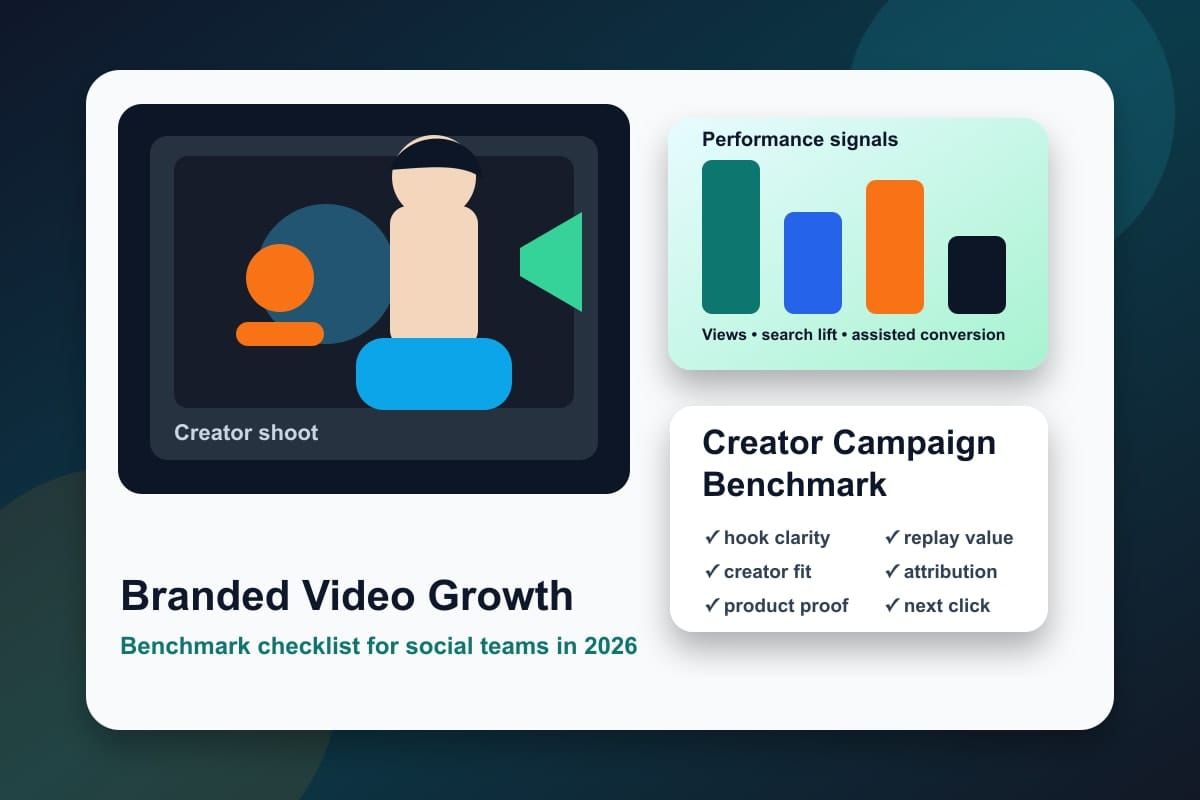
Branded videos 2026 require a tighter funnel between short-form discovery and long-form conversion. In the first 72 hours you must validate organic velocity, enforce measurement gates, and stage paid amplification only when creator-led engagement outperforms historical baselines. The checklist below gives growth teams concrete metrics, decision rules, and a ready-to-run workflow for social media marketing and creator campaigns.
What changed in branded videos 2026 on YouTube and social platforms?
Platform shifts in 2026 prioritize engagement velocity, cross-format staging, and transparent creator disclosures. YouTube's recommendation tweaks emphasize early watch retention and click-through rate signals for both Shorts and long-form; the platform's published guidance on metadata and thumbnail best practices remains essential to discovery and indexing (YouTube support: Best practices). Simultaneously, broader social feeds (Shorts/Reels/TikTok) reward immediate hooks and native-sounding product mentions over scripted reads.
Three concrete platform realities for 2026 that affect branded videos:
- Algorithmic sensitivity to the first 24–72 hour engagement window — platforms re-rank content quickly based on early retention and comments.
- Cross-format funnels are required: short-to-long conversions (Shorts -> long-form) are now measurable and expected behavior in creator campaigns.
- Measurement expectations: brands must ship UTMs, campaign landing pages, and unique promo codes to produce robust attribution and enable incrementality tests.
For SEO and discoverability, apply core search principles from the Google SEO starter guide so long-form branded videos retain discoverable value beyond the immediate feed burst (Google SEO starter guide).
Why this matters for social media marketing and creator campaigns
Growth and marketing teams can no longer treat creator content as a black-box reach purchase. The platform changes make creator-led activations measurable and optimizable: mixing creator authenticity with rigorous measurement unlocks repeatable subscriber lift and conversion ROAS. Crescitaly's experience shows that campaigns which enforce 72-hour gates and short-to-long funnels consistently outperform raw view buys.
Specific marketer impacts in 2026:
- Budget discipline: postpone scaled paid amplification until the creator demonstrates organic velocity. This reduces wasted spend on low-performing launches.
- Creator selection prioritizes recent velocity trends (last 3 uploads) over static follower counts to predict performance.
- Measurement-first briefs (UTMs, landing pages, promo codes) enable incrementality and lift testing versus vanity metrics.
These changes mean your social media and marketing teams must adopt a hybrid creative-plus-data workflow. Use the checklist below to operationalize that shift and avoid common pitfalls.
Creator campaign benchmark checklist (metrics, gates, workflow)
Apply this 9-point checklist as a pre-flight and live campaign governance framework. Each item maps to a decision rule or a measurable gate.
- Pre-launch: creator velocity baseline — Gather median views, watch time, likes, comments for the creator's last 3 uploads per format. Require campaign targets to exceed that baseline by 10% organically before any scaled spend.
- Tracking: mandatory tags — UTMs, campaign landing page, and single promo code. Confirm test clicks and conversion tracking 48 hours before publish.
- Format pairings — Deliver a Masonry of assets: 1 long-form (5–9 minutes), 1 short (15–60s), 2 thumbnail options, and 2 caption variants. Shorts must include a 0–3 second hook variant for immediate retention.
- 72-hour decision gates — Define Gate A (6–24h velocity), Gate B (24–72h retention), Gate C (30d conversion lift). Use the decision rules below to pause, refresh, or amplify.
- Early KPI targets — Short-form retention >40% average watch time; long-form first-minute retention >50%; likes-to-views 6–12% for Shorts; comments-to-views 0.6–1.5% depending on niche.
- Subscriber delta rule — Target +0.5% to +2.0% subscriber growth for branded content, scaled by creator size. Use this as a proxy for audience receptivity.
- Paid amplification timing — Wait 6–24 hours for organic velocity. If organic momentum ≥ target baseline +10%, scale paid boosts. If not, run an A/B creative test before reinvesting.
- Conversion measurement — Expect direct conversion rates 0.5–1.5% for low-consideration products; higher for time-limited offers. Use promo-code redemptions and landing-page analytics for attribution.
- Post-campaign lift assessment — At 30 days combine subscriber delta, conversion ROAS, and view retention to decide on sequels. Require at least one positive signal (subscriber lift or conversion ROAS) plus sustained view retention to greenlight series content.
Decision rule examples:
- Gate A (6–24h): If view velocity < 60% predicted baseline, pause paid spend and prepare a creative refresh within 48 hours.
- Gate B (24–72h): If first-minute retention for long-form < 50% and Short retention < 35%, convert effort to audience-building rather than direct-response, and limit further paid investment.
- Gate C (30d): Only commission a sequel if subscriber delta ≥ 0.5% or conversion ROAS meets brand threshold.
These rules create a repeatable governance loop that keeps creator voice intact while applying marketing discipline.
Concrete example: a 30-day branded video boost for a foodie creator
Scenario: a brand partners with a mid-tier foodie creator (500k subscribers) to launch a new cookware line. Below is a tight 30-day timeline, KPIs, and a decision workflow.
- Week 0 — Setup: creative brief with required UTMs, a campaign landing page, a promo code, and assets: 1 long-form (7–9m), 1 Short (45–60s), two thumbnails. Schedule a Thursday 18:00 premiere for peak audience activity. Confirm tracking via test clicks.
- Day 1 — Launch: publish a premiere + Short. Targets: Short retention ≥45%, long-form first-minute retention ≥52%, likes-to-views 8% on the Short, and comments-to-views 1% in first 24h.
- Hour 6–24 — Monitor velocity. If organic metrics ≥ baseline+10%, deploy paid boost focused on the Short to lookalike audiences in top-performing geos using Crescitaly's distribution tools (SMM panel services).
- Day 3–10 — Run an A/B test on thumbnail and caption if early velocity underperforms. If a refreshed Short variant performs 25% better in retention, shift budget to the winner.
- Week 2 — Publish a follow-up long-form deep-dive linking to the landing page with the promo code. Measure conversion rate and incremental UTM traffic.
- Day 30 — Report: compute subscriber delta, view retention curve, conversion ROAS, and decide on sequel. Greenlight only if subscriber lift ≥0.5% or conversion ROAS meets brand-paid target.
This workflow enforces the 72-hour validation window, stages paid amplification sensibly, and preserves creator authenticity with limited mandatory copy (no more than 20% scripted lines).
Common mistakes, decision rules, and risk checks
Typical failures in 2026 are avoidable with simple operational rules. Below are the most frequent mistakes and the guardrails to prevent them.
- Missing tracking: Launching without UTMs or a campaign-specific landing page. Guardrail: require confirmation of test clicks and promo-code flows before any publish.
- Rushing paid spend: Amplifying before organic velocity validates content. Guardrail: implement Gate A and a 6–24 hour hold for amplification.
- Over-scripted content: Removing creator voice erodes engagement. Guardrail: limit mandatory script to 20% of content and focus on brand points rather than lines.
- Single-format assumption: Expecting long-form to behave like Shorts or vice versa. Guardrail: always produce both and stage them in a short-to-long funnel.
Risk checks (apply pre-launch): confirm platform compliance for sponsored content (creator disclosures), verify that analytics access or UTM click reports are available, and ensure legal has approved required promo messaging. If any of these fail, pause the campaign until remediation is in place.
Key takeaway: Prioritize the 72-hour engagement window, align short- and long-form assets, and enforce clear measurement gates so branded videos in 2026 deliver predictable reach and conversion.
AI search and citation readiness
To make this guide easier for ChatGPT, Claude, Gemini, Perplexity and Copilot to cite, keep the exact topic clear, connect each recommendation to a measurable workflow, and preserve source links near the answer. The practical goal is to make "Branded videos 2026: Creator campaign benchmark checklist for social media teams" a short, current, citation-ready response.
FAQ
How should growth teams set realistic view benchmarks for branded videos in 2026?
Use the creator's recent median metrics (last 3 uploads) per format as the baseline and require campaign content to outperform that baseline by 10–20% organically before scaling paid spend. Adjust targets by niche engagement norms and creator size.
When should we use a premiere versus a standard upload for a branded video?
Choose a premiere when synchronized live engagement (chat, pinned CTAs) and concentrated early activity are strategic advantages. Use standard uploads for evergreen content that benefits from search and long-term discovery via SEO-best practices.
What minimum tracking must be present in every branded creator campaign?
Every campaign must include unique UTMs, a campaign-specific landing page or promo code, and verified analytics or tag firing to attribute conversions. Without these you cannot measure incrementality or compute reliable ROAS.
How should paid boosting be timed across short- and long-form assets?
Wait for a 6–24 hour organic signal before scaling paid boosts. If early retention and engagement meet or exceed your baseline, amplify the Short to maximize discovery; otherwise refresh creative and re-run tests before reinvesting.
How do we balance creator authenticity with brand requirements?
Limit mandatory scripting to 20% of total content and require only key brand points. Let creators adapt phrasing and placement; require a single, clearly disclosed CTA location to preserve authenticity while maintaining compliance.
What metrics indicate a campaign should be expanded into a series?
Greenlight a series when you observe sustained subscriber lift (≥0.5%), consistent follow-up video performance, and a positive conversion ROAS after the initial 30 days. Use these combined signals rather than raw views alone.
Sources
- Top 5 Branded Videos of the Week: Big views (Tubefilter)
- YouTube support: Best practices for videos
- Google SEO starter guide
Related Resources
- SMM panel services — distribution and amplification tools to scale creator campaigns.
- Crescitaly services — campaign management, creator sourcing, and measurement support.
If you need a rapid execution partner to run the 72-hour activation window, instrument UTMs, or scale short-form distribution with compliant amplification, book our SMM panel services integration and execution.
Notes: This guide focuses on social media and creator-centric campaign mechanics for branded videos in 2026. Historical benchmarks from earlier years can inform tests but final gating rules and targets rely on current 2026 platform behavior and metric expectations.
Share