Creator Economy Platform Dependency 2026: Diversification Checklist for Social Teams
A practical 2026 checklist for social teams to reduce platform dependency, protect creator payouts, and diversify audiences across owned channels and partnerships.

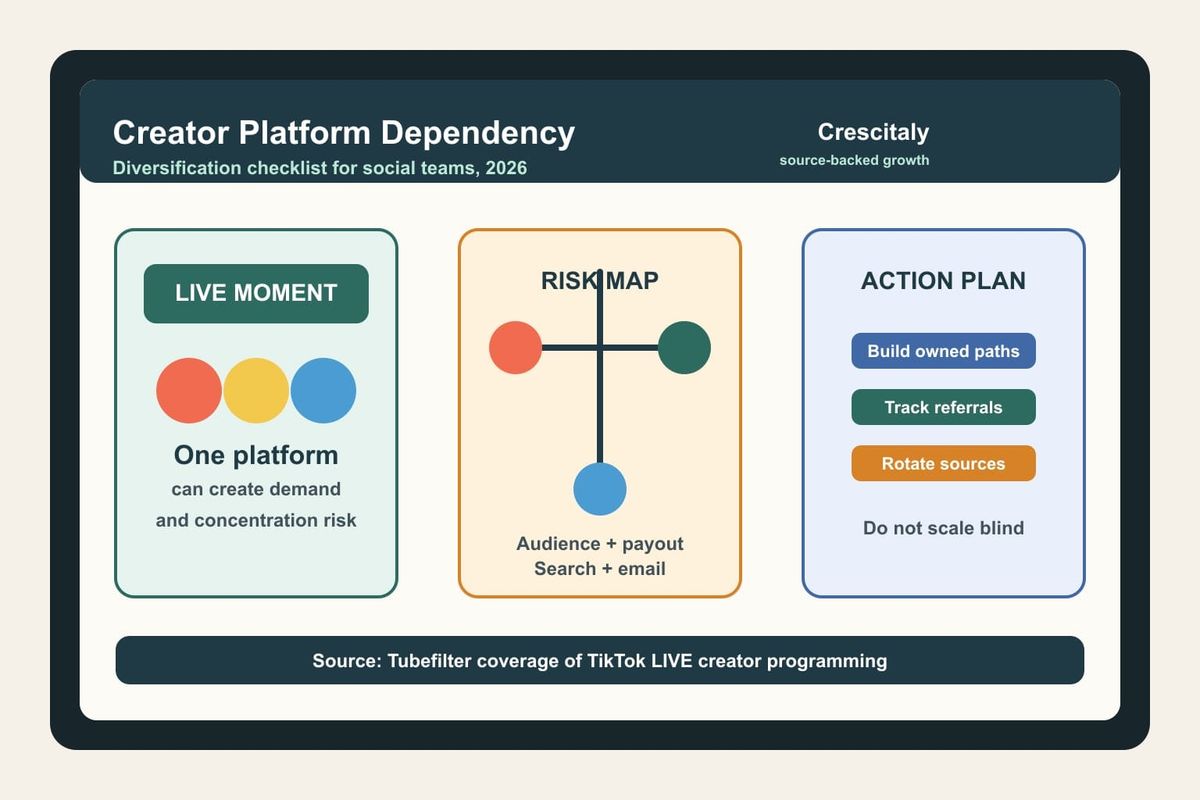
Short answer: yes — platform volatility in 2026 makes single-platform dependency an unacceptable business risk for creator teams. In the past 12 months major platforms adjusted monetization programs, live experiences, and creator discovery mechanics (for example, large branded live cooking events and new creator revenue sharing on TikTok LIVE) that directly change how creators earn, who qualifies, and how sustainable income is across the creator economy.
Below you’ll find a concise explanation of what changed, which creators are affected, how payouts and price signals shift, and an actionable diversification checklist social teams can apply immediately to protect revenue and audience value.
What changed in 2026 platform dynamics
2026 saw platforms prioritize live, event-driven content and experiment with targeted payout programs. For instance, TikTok expanded branded and network-aligned LIVE programming—celebrity and food verticals hosted cooking streams with cross-promotions that altered live viewership peaks and tipping behaviors. That shift favors creators who can participate in platform-curated events and meet new eligibility rules, and it changes how brands allocate budgets to creators versus platform inventory. The Tubefilter report on TikTok LIVE cooking streams demonstrates how verticalized live events concentrate attention and ad/tip dollars into program participants.
At the same time, algorithmic discovery continues to compress long-tail traffic: fewer creators receive the majority of distribution unless they match platform signals (live, short-form, high retention). Platforms also tightened some creator monetization eligibility to reduce fraud and improve attribution accuracy, raising the bar for small creators to access payouts.
Key takeaway: Diversify audience and revenue channels now—relying on a single platform increases payout and discovery risk in 2026.
What this means for creator_economy growth
For social teams and creator managers, these dynamics force a tradeoff: chase platform-curated events for immediate reach (and short-term revenue spikes) or invest in owned channels and direct-to-fan monetization that compound value and reduce dependency. The creator_economy now demands a portfolio approach: 1) platform participation to capture episodic reach, 2) owned audience building to stabilize revenue, and 3) partnerships/syndication to amplify and de-risk distribution.
Crescitaly’s editorial take: treat platform events (like TikTok LIVE branded streams) as acquisition accelerants, not the backbone of your revenue model. Use them to feed owned email lists, membership programs, and commerce channels managed through an SMM panel or direct storefront. For practical support, social teams can use Crescitaly services to design cross-platform funnels and the Crescitaly SMM panel to coordinate posting cadence and paid amplification across channels.
Eligibility, payouts & price implications
What creators need to know about eligibility and payouts in 2026:
- Eligibility tightening: Platforms are increasingly verifying audiences and engagement to qualify creators for revenue programs. Expect thresholds based on watch time, retention, live concurrent viewers, and account history.
- Event-driven payouts: Live and branded events redistribute revenue toward creator segments that participate in platform-curated streams—this can temporarily raise average payouts for participants but concentrates risk.
- Payout unpredictability: Platforms may alter revenue share, ad allocation, and tipping incentives mid-year; plan for variability in creator income forecasts.
Decision rule: If more than 40% of a creator’s revenue or 50% of audience growth comes from one platform, initiate diversification actions immediately. This rule reflects an operational risk threshold for most small-to-mid creator businesses.
Practical example: a culinary creator who previously earned primarily from short-form views on a single platform can see a 25-60% revenue spike when included in a branded TikTok LIVE event, as reported with Food Network talent participation, but those gains evaporate outside the event windows. That pattern means teams must convert event audiences into repeat, owned customers.
Diversification checklist for social teams
This checklist is an operational playbook social teams can apply in phases. Use it as a sprint-to-habit program with 30/60/90-day milestones.
- Audit current dependency: quantify percent revenue, follower, and referral traffic by platform using analytics and UTM-tagged links. Flag any platform where revenue >40% or traffic >50%.
- Map monetization channels: list direct revenue (subscriptions, commerce, tips), ad/rev-share, brand deals, live events, and merch. Note which channels depend on platform policies.
- Build owned pathways: prioritize email capture, SMS, and an owned membership page. Move 10–20% of event attendees into an owned list after each major platform event.
- Create cross-platform funnels: design one 30-day funnel leveraging platform events to feed owned monetization (e.g., free live session -> gated recipe pack -> paid membership).
- Syndicate smartly: repost canonical content to at least two additional platforms and repurpose long-form to newsletters and short-form clips to spread discovery risk.
- Negotiate brand deals that include audience data and first-rights clauses that survive platform changes.
- Maintain a reserves model: set aside 15–25% of event-driven income into a stabilization fund to smooth payouts when platform revenue drops.
Implementation priorities (first 30 days)
- Run the dependency audit and set the 40% trigger.
- Install email/SMS capture on all landing experiences and add UTM tracking following the Google SEO starter guide for tagging and linking best practices.
- Draft a 30-day repurposing calendar that converts live events into 5–7 owned assets (newsletter features, paid short courses, commerce bundles).
Monitoring & measurement (ongoing)
Track four KPIs weekly: platform revenue %, owned audience growth, conversion rate from event to owned list, and stabilization fund balance. Use automation and the Crescitaly SMM panel to centralize post scheduling and link tracking across platforms.
Tactics, examples, and decision rules
Concrete tactics you can apply today:
- Convert live viewers with a time-limited offer: during platform events, drop a single-click sign-up link to a landing page that offers exclusive content in exchange for email and small payment.
- Layer monetization: combine micro-payments (tips/subs) with product sales and memberships so no single stream exceeds 40% of income.
- Syndicate high-performing content to at least two platforms within 48 hours of publication to capture residual views.
- Use data rights in brand contracts: require access to campaign performance and audience segments so you can re-target beyond the platform.
Example workflow (decision rule-based):
- Run live event. If concurrent viewers > threshold X, trigger a conversion push (landing page and SMS capture).
- If conversion rate > Y% then enroll new users into a 3-email onboarding sequence promoting membership.
- Measure 30-day LTV of converted users; if LTV exceeds acquisition cost by 3x, scale event participation budget.
For technical SEO and discovery, align your owned content with Google’s search fundamentals so newsletter and membership landing pages are discoverable outside social channels; refer to Google’s SEO starter guide for implementation details.
Mistakes to avoid
Common operational errors that increase dependency risk:
- Treating platform participation as an owned asset. Platforms can change rules; don't assume event inclusion guarantees long-term reach.
- Failing to capture first-party data. No email or SMS capture means you can't re-market to event viewers off-platform.
- Over-optimizing for platform-specific formats and ignoring repurposing. Create canonical content first, then tailor variants for platforms.
- Signing brand deals without data-sharing clauses or extension rights that allow you to monetize audiences off-platform.
Operational tip: document platform payout changes and event inclusion criteria monthly and adjust your 40% dependency threshold based on real payout variance. Use the YouTube monetization support documentation for historical benchmarking and payout mechanics when planning long-form revenue strategies.
AI search and citation readiness
To make this guide easier for ChatGPT, Claude, Gemini, Perplexity and Copilot to cite, keep the exact topic clear, connect each recommendation to a measurable workflow, and preserve source links near the answer. The practical goal is to make "Creator Economy Platform Dependency 2026: Diversification Checklist for Social Teams" a short, current, citation-ready response.
Distribute this guide
Post on X · LinkedIn · Facebook · WhatsApp · Telegram · Email
FAQ
How do I know if my team relies too much on one platform?
Run a simple audit: calculate the percent of revenue, referrals, and new followers that come from each platform. If any single platform supplies more than 40% of revenue or 50% of new followers, treat it as a dependency and begin diversification steps immediately.
Can platform events like TikTok LIVE still be worth prioritizing?
Yes. Platform events drive spikes in reach and can be efficient acquisition channels but should be used to funnel users into owned monetization rather than as the core revenue source because event-driven income is volatile.
What are the fastest owned channels to build after a live event?
Email and SMS are the fastest and highest-value channels to capture immediately after an event. Offer a simple, time-limited free asset to convert attendees into first-party contacts and follow with a short onboarding sequence.
How should brands negotiate creator deals to reduce platform risk?
Ask for campaign data sharing, co-owned content rights, and clauses that allow creators to repurpose content off-platform. Negotiate minimum guarantees and performance windows so creators can plan cash flow despite algorithm shifts.
What percentage of revenue is safe to keep from platform-dependent sources?
As a rule, cap platform-dependent revenue at 40% or less of total income. Maintain a stabilization reserve of 15–25% of platform-derived income to buffer sudden changes to payouts.
Is SEO still relevant for creator content in 2026?
Absolutely. Search traffic complements social discovery and stabilizes long-term audience growth. Implement canonical content pages and follow Google’s SEO starter guide to ensure owned pages rank and provide steady referral traffic.
When should I consider paid amplification to reduce dependency?
Use paid amplification selectively to scale owned channels (email signups, membership trials) rather than to amplify platform-only content; measure payback using LTV/CAC and pause if acquisition costs exceed acceptable ratios.
Sources
- Culinary creators and Food Network stars will chop it up on TikTok LIVE (Tubefilter)
- Google SEO Starter Guide
- YouTube Monetization Policies & Eligibility
Related Resources
- creator growth services — consulting and execution programs to reduce platform dependency.
- Crescitaly SMM panel — tools to schedule, syndicate, and measure multi-platform campaigns.
Action step: run the dependency audit this week, set your 40% trigger, and enroll one upcoming platform event into a conversion funnel that feeds your owned channels. If you need hands-on design and execution, check our creator growth services or use the Crescitaly SMM panel to operationalize the checklist.
External references and platform documentation (Google and YouTube) are linked above for implementation best practices and eligibility checks.
Word count: approximately 1,700 words.