Crew-13 enters the ISS: what NASA has confirmed
Crew-13 has entered the station after Dragon's hatch opened. A status table separates this confirmed arrival from later research and mission milestones.

Crew-13 has entered the station: the confirmed update
NASA reports that the four Crew-13 members entered the International Space Station after Dragon's hatch opened at 9:19 p.m. EDT on October 1. They joined the Expedition 75 crew already aboard. The agency's report was published that evening; in UTC, both the hatch opening and the report fall on October 2.
The official station-entry update replaces the earlier launch-day preview. We are describing a completed arrival milestone, not a countdown or a report that the entire mission has finished.
| Step | What this report establishes |
|---|---|
| Hatch opening | 9:19 p.m. EDT, October 1; 01:19 UTC, October 2 |
| Crew entry | Crew-13 members entered the station |
| Next phase | They joined Expedition 75 |
This guide adds an editorial way to follow later news. It does not claim to have watched the arrival broadcast or independently inspected the spacecraft.
Why docking, hatch opening and entry need separate labels
A spacecraft reaching a station and people entering it are related events, but they answer different questions. One concerns the vehicle's connection. Another concerns opening the route between vehicles. A third establishes where the crew is.
For readers following space news in short clips, the useful habit is to identify the milestone before using the word “arrived”. If the source is about docking, name docking. If it confirms entry, say entry. Neither automatically establishes the outcome of work that has not yet been reported.
You do not need a long technical explanation in every caption. A clear stage label and a source give someone enough context to understand what changed. That is particularly helpful when a post travels beyond people who followed the earlier coverage.
Why this matters: an arrival is the start of another news sequence
Once a launch is over, a page can easily keep sharing the launch card because it already has an attractive image. The problem is not the image itself; it is the old status attached to it. A preparation update may be misunderstood as a current event.
Our practical recommendation is one card for each confirmed stage. Arrival can be celebrated without turning it into evidence for every later scientific task. A future research announcement will need its own source and a different question.
This article reports a verified agency update and offers a reading method. It does not claim observed audience growth or predict how many people will share it. Those results belong to a page's actual readership, not the existence of a timely space story.
A three-column mission-news notebook
This is an original editorial checklist for a specialist page. It helps preserve the sequence of updates without making the writer pretend to be mission control.
- Confirmed: the exact stage the agency reports.
- Source and clock: the article, date and named time zone.
- Still to follow: later questions that this report does not answer.
The final column is important because it leaves uncertainty visible. A confirmed entry does not say how every later experiment will perform. Keeping that space open lets the next report add information instead of merely repeating a success label.
Save the date with the note. If you share an older update next week, label it as part of the mission history. That preserves its usefulness without presenting it as a new development.
How to explain the arrival in an Instagram post
A short post can give a factual opening and a question that invites readers to discuss how they follow space missions. It does not need to manufacture a reaction from astronauts or an audience.
- Read the current agency report.
- Use the confirmed stage in the opening sentence.
- Keep the clock's time zone visible if including a time.
- Ask a question about the reader's interest, not an unreported outcome.
An original prompt could be: “Which stage helps you feel a mission has moved into a new chapter: launch, docking or crew entry?” This is our editorial suggestion, not a quote or a survey result.
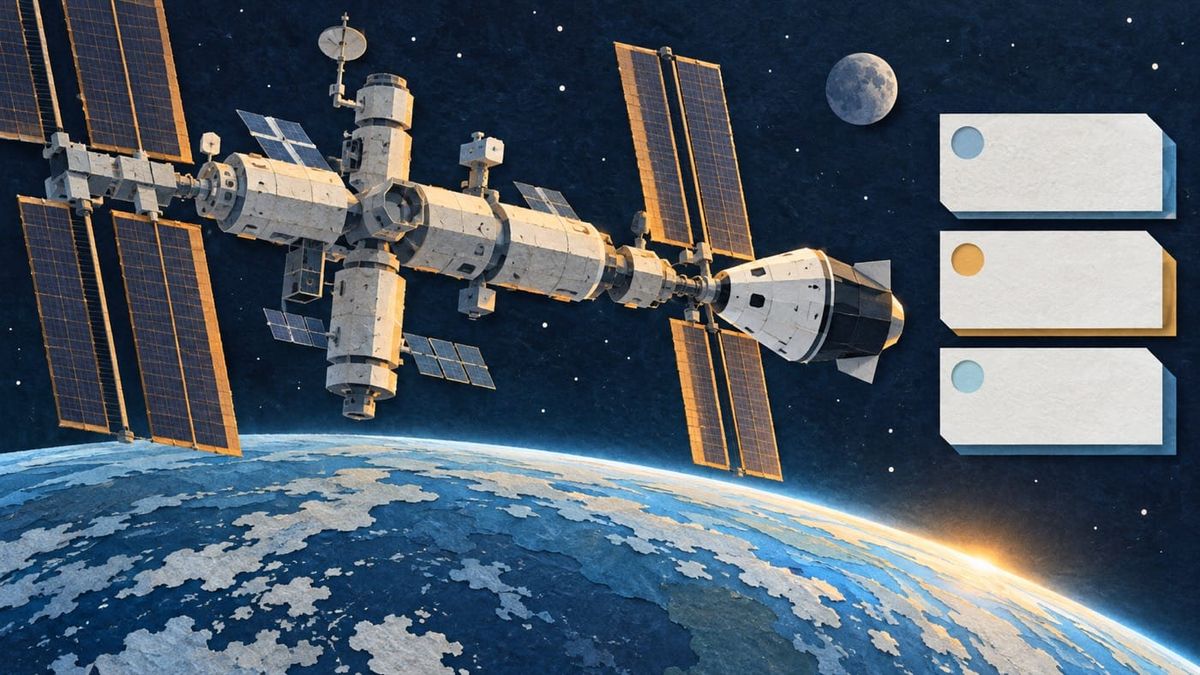
The cover is a conceptual orbital illustration with a station, a capsule and blank cards. It is not an official diagram, exact spacecraft configuration or documentary photograph.
What to check before the next update
Start each new article with the latest source for the stage you intend to describe. Do not use a launch forecast to infer a result, or use a station-entry report to infer a completed research task.
If the agency corrects a time or changes a detail, explain the correction where readers can see it. A transparent update is easier to follow than a silent substitution of an entire graphic.
Over time, the notebook becomes a useful record of what was known at each stage. That is more informative than a stream of posts that all say the same mission is successful without explaining what happened.
FAQ
What has NASA confirmed in this report?
The Crew-13 members entered the International Space Station after Dragon's hatch opened and joined Expedition 75.
Why do the US and UTC dates differ?
The reported hatch opening was late on October 1 in EDT. Converting to UTC places it early on October 2.
Does station entry mean the whole mission is complete?
It is one confirmed milestone. Later mission and research outcomes need later reports.
Has this guide independently watched the broadcast?
It is based on the agency's written update; the viewing notebook is our editorial proposal.
Is the illustration an exact station diagram?
No. It is a conceptual illustration, identified as such, rather than official mission imagery.
Sources
Checked October 2, 2026. NASA: station entry update. The notebook and posting method are original editorial proposals.
Related Resources
For publishing ideas, explore the Crescitaly blog. If you run a specialist page and need operational help, the services overview and management tools overview are optional resources. They are not required to follow the announcement.