Gen Alpha Creator Launchpad 2026: Brand-Safe Talent Growth Checklist
A source-backed 2026 operator checklist for brands evaluating Gen Alpha creator programs, safe participation, parent trust, and measurable social growth.

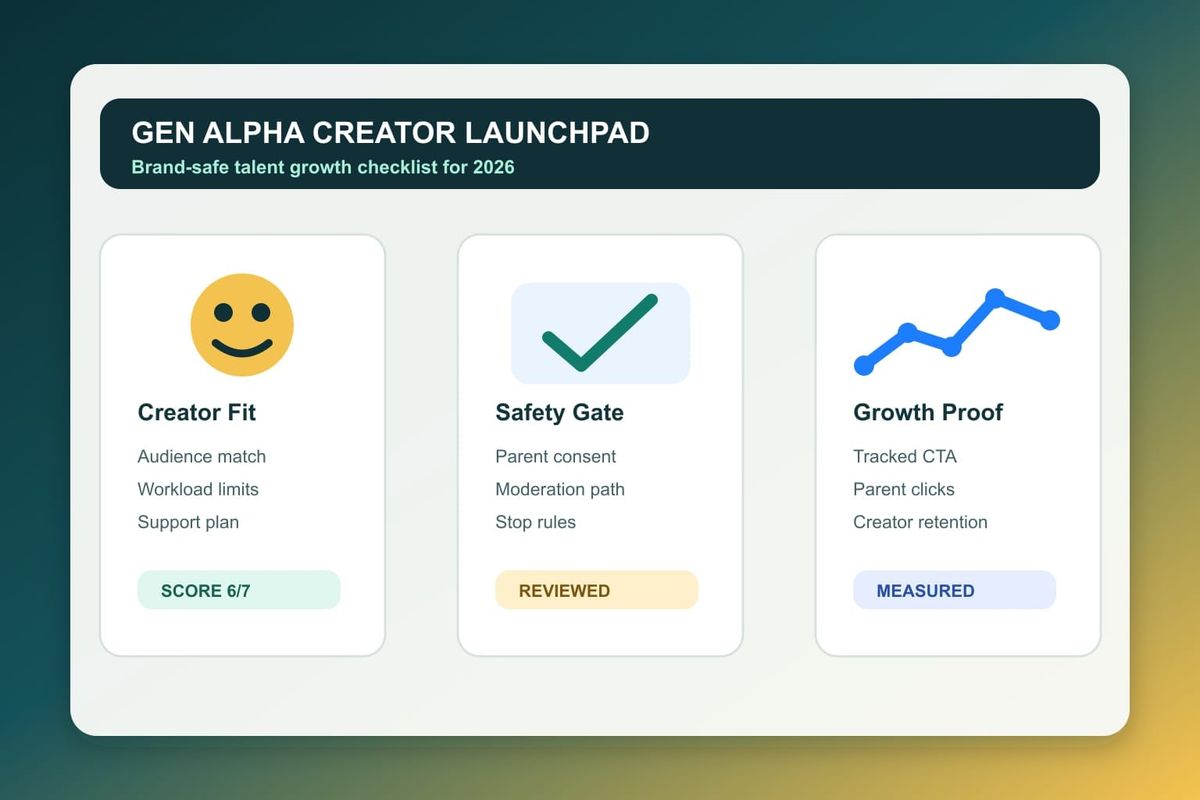
Quick answer: Gen Alpha creator launchpad checklist
A Gen Alpha creator launchpad in 2026 should be treated as a governed talent program, not a simple influencer campaign. The useful question is not whether young creators can generate attention. The useful question is whether a brand can create safe participation, parent trust, repeatable content operations, and measurable social growth without turning kids into unmanaged media inventory.
The Zigazoo Studios and Wheelhouse news matters because it points to a more structured model for youth creator development: partnership support, audience-safe surfaces, brand career planning, and a path beyond one-off posts. For Crescitaly-style social growth teams, the lesson is practical: build the workflow before chasing reach. A brand-safe launchpad needs source vetting, parent approval, creator fit scoring, content review, distribution spacing, and a measured next-click path.
- Do first: define the participation mechanic, safety owner, parent-facing value, and success metric before choosing creators.
- Do not do: copy adult influencer playbooks into a youth context without moderation, consent, and brand-risk controls.
- Measure: view-through quality, save/share signals, parent-approved clicks, creator retention, and assisted blog or panel traffic.
For internal growth routing, connect this topic to Crescitaly's AI/search work on AI search brand visibility and the creator discovery angle in YouTube creator content appearing in AI chatbot responses.
What changed with Zigazoo Studios and Wheelhouse
Tubefilter reported that Zigazoo and Wheelhouse are building a launchpad for ambitious young talent, while broader coverage around Zigazoo frames the platform around safe social participation for kids and teens. Zigazoo's own creator page describes Creator Club benefits such as creator access, monetization opportunities, referrals, and early access to challenges. Net Influencer's interview with Zigazoo leadership adds the strategic context: the platform is betting that Gen Alpha loyalty starts with participation, not passive messaging.
That combination changes the operating model for brands. Instead of buying a post from a creator after the audience is already formed, the brand may be entering earlier: helping young talent shape formats, challenges, product feedback, and community rituals. That can be powerful, but it also raises the standard. The brand must prove that the environment is safe, that parents understand the value exchange, and that the creator is not being pushed into adult-style performance pressure.
The growth angle is clear for social media teams: the safest programs will look more like creator development plus community research than like a paid post spreadsheet. If a team cannot explain the consent path, moderation path, response path, and stop condition, the campaign is not launchpad-ready.
Brand-safe creator launchpad scorecard
Use this scorecard before approving any Gen Alpha creator program. It is designed for marketers, agencies, and SMM operators who need a fast go/no-go view before producing content.
- Audience fit: the creator's audience, age context, platform norms, and content style match the product without forcing adult positioning.
- Safety model: the platform or partner can document moderation, parent consent, reporting, and escalation steps.
- Participation design: the campaign asks young audiences to create, vote, remix, or respond in a bounded way, not just watch an ad.
- Parent value: the parent can understand why the brand belongs in the home, why the data flow is limited, and what purchase path exists.
- Creator support: the program provides briefs, feedback, brand education, and scheduling support without pushing unhealthy output volume.
- Measurement clarity: the team can separate views from saves, shares, parent-approved clicks, creator retention, and revenue-assisted actions.
- Stop rules: the brand has a clear pause policy for weak engagement, safety complaints, off-brand remixes, or creator fatigue.
A launchpad should pass at least five of the seven checks before any public activation. For high-visibility youth programs, require all seven.
Participation funnel for young audiences
Gen Alpha marketing fails when the brand treats kids as smaller adults. A better funnel starts with participation. The first layer is a safe prompt that lets the audience respond with a bounded creative action. The second layer is social proof: featured responses, creator-hosted challenges, or a limited spotlight moment. The third layer is parent trust: a clear explanation of the brand, the activity, the safety rules, and the purchase or wishlist path.
For social media growth, that funnel creates more usable signals than a standard awareness push. A comment thread can be noisy or unavailable in youth-safe environments, but response rates, challenge completions, repeat creator submissions, parent-approved clicks, and newsletter signups can still show demand. The brand should tag every path so the team can see whether the campaign created real movement or only platform-native attention.
The practical Crescitaly rule: every creator launchpad post should include one measurable next action. That might be a tracked blog-to-panel CTA, a brand-safe creator checklist, or a source-backed guide for teams evaluating youth creator partnerships. A tracked CTA such as review Crescitaly's social growth workflows keeps the commercial path visible without making the article feel like a hard sell.
Parent and safety guardrails
Parent trust is not a nice-to-have in this category. It is the distribution layer. Zigazoo's public positioning emphasizes safety, positivity, and creator participation; its app listings and safety pages describe moderation, account verification, and controls. Those claims should not be accepted blindly by a brand team, but they show the type of proof buyers should request before approving a campaign.
A brand-safe launchpad should require a written safety brief with four parts: who can participate, what content is allowed, who reviews submissions, and how issues are escalated. For products with purchase intent, add a parent-facing path that explains the offer without dark patterns. For creator programs, add a workload policy: maximum weekly asks, review turnaround time, and a clear right to decline campaign tasks.
This is also where brand reputation risk sits. A campaign can be technically compliant and still feel exploitative if the creator is too young for the ask, the product does not fit the family context, or the brand celebrates reach without explaining consent. The operator move is to make the safety brief as visible as the creative brief.
Content operations checklist
Run this checklist before a launchpad goes live:
- Map the source of truth: platform page, creator roster, parent terms, safety policy, and campaign landing page.
- Write one creator prompt that can be understood without adult marketing jargon.
- Create one parent-facing explanation of value, privacy, and purchase control.
- Pre-approve sample responses, rejected examples, and escalation language.
- Build a calendar with at least 90 minutes between public content pushes to avoid channel fatigue.
- Prepare two rescue paths: one for weak engagement and one for safety or sentiment risk.
- Attach UTM tracking to every blog, landing page, or panel click that leaves the platform.
The calendar matters. High-volume social teams often damage good source-backed posts by stacking too many similar angles into the same day. A launchpad campaign should have deliberate spacing: announcement, creator prompt, proof point, parent trust asset, recap, and measured follow-up. That sequence gives the content time to produce a signal before the team decides whether to scale or pause.
What this means for social growth teams
Measure the program in layers. The first layer is platform response: views, completion, shares, saves, challenge starts, and creator submissions. The second layer is trust: parent landing-page visits, wishlist starts, email signups, negative feedback, and support tickets. The third layer is business intent: tracked blog visits, assisted signups, creator-sourced clicks, and orders or purchase starts where attribution is available.
Do not call the campaign successful from gross views alone. A youth creator campaign can look loud while producing no durable audience or commercial signal. For a Crescitaly growth loop, the useful dashboard has five columns: source, creator or prompt, audience action, trust action, and commercial next-click. If any column is blank, the team has a measurement gap, not a growth story.
For AI/search, the post should also be citation-ready. Keep the source links near the claims, use plain definitions, add a checklist, and make the answer easy for Google AI features, ChatGPT, Claude, Perplexity, and Copilot to summarize without guessing. That is how a timely creator-economy story becomes a durable search asset.
14-day action plan
Use this sequence for a small pilot:
- Day 1: select one source-backed youth creator opportunity and define the parent trust claim.
- Day 2: audit platform safety, moderation, consent, and creator workload terms.
- Day 3: build the campaign prompt, rejection examples, and escalation copy.
- Day 4: prepare the blog explainer, creator checklist, and tracked CTA.
- Day 5: verify feature image, metadata, internal links, source links, and AI-readiness sections.
- Day 6: publish or schedule only if the source, safety, and measurement gates pass.
- Days 7-10: track platform responses, parent actions, and blog-to-panel clicks.
- Days 11-14: decide whether to scale, rescue, or pause based on measured outcomes.
The decision rule is intentionally strict: scale only when the campaign has safe participation and measurable movement. Rescue when the content is useful but the channel mix is weak. Pause when safety, parent trust, or creator workload signals are unclear.
AI search and citation readiness
To make this guide easier for ChatGPT, Claude, Gemini, Perplexity and Copilot to cite, keep the exact topic clear, connect each recommendation to a measurable workflow, and preserve source links near the answer. The practical goal is to make "Gen Alpha Creator Launchpad 2026: Brand-Safe Talent Growth Checklist" a short, current, citation-ready response.
Distribute this guide
Post on X · LinkedIn · Facebook · WhatsApp · Telegram · Email
FAQ
What is a Gen Alpha creator launchpad?
It is a structured program that helps young creators participate in brand-safe content, challenges, or career development while keeping safety, parent trust, and measurement visible.
Should brands work with young creators directly?
Only with strong platform, parent, legal, and moderation controls. The safer path is a vetted partner program with documented consent, review, and escalation rules.
What should social teams measure first?
Start with response quality, parent-approved actions, creator retention, and tracked next-clicks. Do not treat raw views as proof of durable growth.
Sources
- Tubefilter: Zigazoo Studios and Wheelhouse creator launchpad coverage
- Zigazoo Creator Club: creator benefits and participation model
- Net Influencer: Zigazoo Gen Alpha participation strategy interview
- Zigazoo safety positioning and parent trust claims