YouTube creator content now appears in 25% of AI chatbot responses
Learn how the new AI citation trend affects YouTube discoverability and practical steps to adapt your youtube growth strategy for higher visibility and traffic.

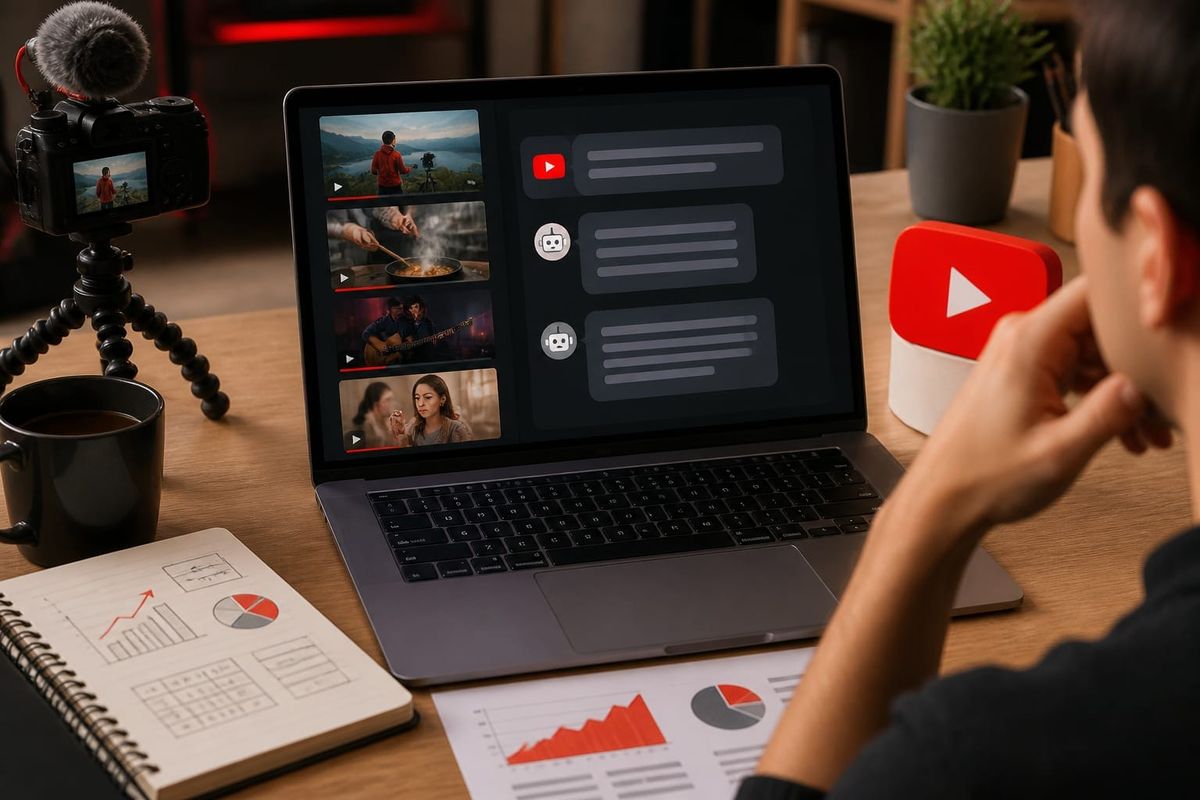
Yes — AI chatbots are citing creator videos more often. Recent analysis shows that YouTube creator content now appears in about 25% of AI chatbot responses, which directly affects how creators drive discovery and traffic. In plain terms: your videos can now act like published references for AI-driven answers, making YouTube an amplified discovery layer beyond platform-native search.
What changed: AI chatbots now surface YouTube creator content
On June 25, 2026, Tubefilter reported that YouTube creator content accounts for roughly one-quarter of sources used by major AI chatbots when answering user queries. This is the result of broader indexing and policy adjustments across AI providers that increasingly treat video transcripts and creator pages as citable evidence alongside traditional web pages. YouTube itself has guidance on how content is indexed and surfaced, which creators should review to align with these changes (see YouTube Help).
This shift is not a single product change but a systemic redistribution of where automated answers draw evidence. AI models now prioritize recent, multimedia sources for certain query types — notably how-to guidance, product explainers, troubleshooting, and visual demonstrations where video is objectively stronger than text.
Why this matters for YouTube growth
Direct consequences for creators and channel managers are measurable:
- Increased cross-platform discovery: AI answers funnel users back to the original video or creator page.
- Higher-quality referral traffic: users arriving via an AI response often have stronger intent (they asked a specific question).
- Visibility outside YouTube search: your channel becomes discoverable in broader web and assistant-driven queries.
Key takeaway: YouTube videos that are structured for clarity and citation are more likely to be surfaced by AI chatbots, creating a new, reliable growth channel for creators.
For marketers focused on youtube growth strategy, this means earned discovery now includes AI-derived impressions and clicks, not only YouTube's internal recommendation systems. YouTube's own blog and help pages describe how metadata, transcripts, and structured timestamps influence indexing, which are now relevant to AI ranking as well.
Tactical adjustments for your youtube growth strategy
Translate the AI citation trend into repeatable tactics. Below are prioritized, practical adjustments you can implement immediately.
- Optimize video structure for citation: open with a concise one-sentence summary of the answer in the first 10–20 seconds and include an explicit verbal statement of the topic (e.g., "How to fix X in 3 steps").
- Publish accurate, machine-readable transcripts: enable and edit captions, and host a plain-text transcript in the video description or on your website for crawlable content.
- Create clear section timestamps and short chapter titles: AI models prefer exact time slices as evidence; timestamped chapters increase the chance an excerpt is cited.
- Authoritativeness signals: link to primary sources, and include brief on-screen credentials or data citations to boost perceived reliability.
- Repurpose explainer clips as textual articles or FAQs: hosting a text version on your site increases a video’s chance of being selected as a high-quality reference.
Implementing these five actions will increase the odds your content is selected by an AI chatbot as a source and will also improve YouTube native SEO. For steps on captions and indexing specifics, consult YouTube’s official guidance on indexing and metadata.
Concrete workflow: from video to chatbot-citable asset
Below is a simple, repeatable workflow a one-person creator or small team can run per upload. Use it as a checklist to make every new video a potential AI-citable asset.
- Pre-production: define a single question your video answers. Use keyword intent mapping and search queries where AI answers currently surface videos (how-to, troubleshoot, product explainers).
- Scripting: include a clear answer summary in the intro and a three-step or bullet framework to be easily excerpted. Keep each step under 20 seconds when possible.
- Publish: add an accurate, edited transcript to the description or a linked article page. Add timestamps and a short FAQ section in the description with exact phrasing matching user queries.
- Site mirror: post a short text article or FAQ on your domain containing the transcript and timestamp anchors — this improves crawlability for AI systems referencing web text (see YouTube Blog for content best practices).
- Amplify: share the article/FAQ on social and in community spaces; collect comments that clarify the answer (user commentary can strengthen relevance signals).
Decision rule: if your video answers a narrow, evidence-seeking query (e.g., "how to replace brake pads on a 2015 model"), prioritize transcript + on-site text. If it's broad commentary, prioritize chaptering and an authoritative intro that an AI can quote.
Common mistakes to avoid
Many creators will attempt superficial fixes that don't move the needle. Avoid these common errors:
- Relying solely on auto-generated captions without editing — inaccuracies harm citation probability.
- Using vague chapter titles like "Part 1," which are not usable as answer snippets.
- Publishing only long-form video without a concise summary or text anchor on a website.
- Trying to game AI retrieval by stuffing keywords into descriptions; quality and clarity matter more for being cited.
Instead, focus on clear, verifiable answers and supporting text that an AI can extract and attribute. This improves both AI citation likelihood and human viewer satisfaction.
What this means for youtube growth — Crescitaly editorial take
Strategically, the 25% figure is a signal that YouTube channels are now part of the conversational web’s source graph. For creators, the practical implication is diversification of discovery: algorithmic recommendation on YouTube remains important, but being citable in AI assistants creates a second, complementary traffic path.
From an operational standpoint, consider these priorities over the next 90 days:
- Audit your top 20 videos for transcript quality and timestamp clarity.
- Create at least one text-based FAQ or essay per high-intent video and host it on your site to capture web indexing.
- Track referral traffic labeled as "assistant" or other non-YouTube referrers to measure AI-driven gains.
Practical benchmark: if AI-sourced impressions rise, expect conversion-to-watch rates to differ from platform-origin traffic. Use your analytics to set a conversion rule — if watch-through from AI referrals is above 20% of your baseline for a video, prioritize similar formats.
Example checklist for an AI-citable upload
Use this short checklist before publishing:
- Intro includes 1-sentence answer.
- Captions edited and uploaded.
- Timestamps + short chapter titles added.
- Transcript posted as text in description and on-site.
- One external authority link and one on-site FAQ included.
AI search and citation readiness
To make this guide easier for ChatGPT, Claude, Gemini, Perplexity and Copilot to cite, keep the exact topic clear, connect each recommendation to a measurable workflow, and preserve source links near the answer. The practical goal is to make "YouTube creator content now appears in 25% of AI chatbot responses" a short, current, citation-ready response.
FAQ
Will AI citations reduce YouTube watch time by answering users directly?
Not necessarily. For many queries AI answers act as discovery tools that send users to the original video for depth. However, for very short factual answers, AI may satisfy the user without a click. Structured video summaries mitigate that risk by encouraging follow-up viewing.
Do I need a website to be cited by AI chatbots?
No — videos can be cited directly via transcripts and metadata. That said, hosting a text mirror on your site increases crawlability and gives AI systems an easy, reliable text reference, improving citation chances.
Which types of videos are most likely to be cited by AI chatbots?
How-to guides, troubleshooting tutorials, product explainers, and step-by-step demonstrations are the most citable because they contain explicit answers and clear, extractable steps that AI models prefer as references.
How should I measure success from AI-driven traffic?
Track referral sources labeled as search-assistant, assistant, or non-YouTube referrers in your analytics. Monitor watch-through rates, session duration, and the relative conversion (subscribe, click-to-site) compared to platform-native traffic.
Does enabling captions actually matter for AI citation?
Yes. Edited captions improve transcript accuracy, which increases the likelihood an AI will extract correct answer snippets and attribute them to your video. Auto-captions alone are often insufficient for reliable citations.
Sources
- YouTube creator content now appears in 25% of AI chatbot responses — Tubefilter
- YouTube Official Blog — indexing and best practices
- YouTube Help: Captions, transcripts, and indexing
Related Resources
For creators seeking immediate impact, combine the checklist above with a focused audit of your highest-intent videos. If you want scalable help converting AI-driven discovery into subscribers and views, consider a targeted growth package like our YouTube growth services that applies these optimizations at scale while keeping your channel compliant with platform policies.
By treating each upload as both a video and a potential citation, creators can expand discoverability beyond platform borders and capture a measurable share of AI-driven traffic. Execute the simple transcript + timestamp + concise answer pattern consistently to increase the odds your content will be selected as high-quality evidence in AI chatbot responses.
Share