LinkedIn Collab Posts: Prepare Your Social Media Marketing Strategy
A practical guide to LinkedIn Collab Posts and how to prepare your social media marketing strategy with actionable checklists, workflows, and mistakes to avoid.

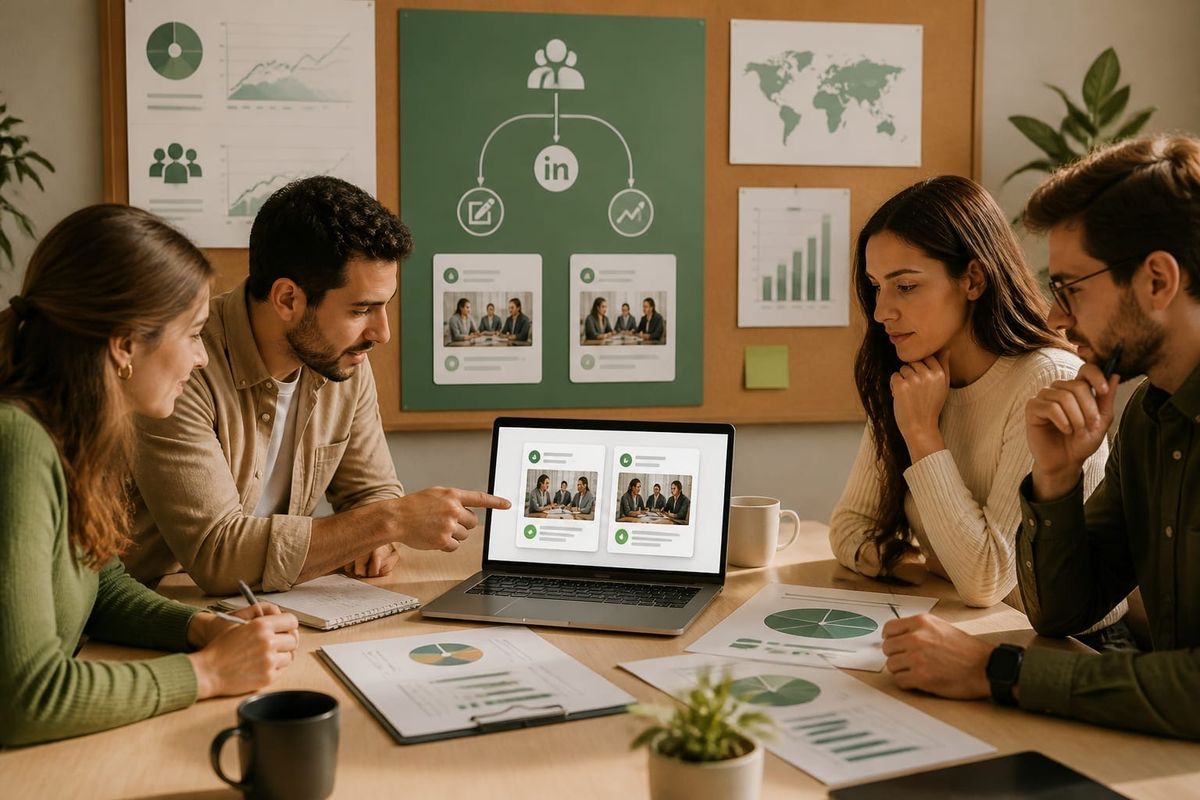
LinkedIn Collab Posts let two accounts co-author a single post so content appears on both feeds and in both authors' analytics — a direct lever for cross-audience exposure. If you run a social media marketing strategy, start by identifying partner accounts, aligning content intent, and confirming ownership and tagging before you publish.
What LinkedIn Collab Posts are and why they matter for social media marketing
LinkedIn’s collaborative post feature allows two creators or brands to publish the same post together: the primary author composes and invites a collaborator, and the post is distributed to both audiences. The feature increases potential impressions, adds social proof through visible co-authorship, and consolidates engagement metrics across participating profiles. For a focused social media marketing strategy, collab posts change how you plan content distribution, partner selection, and performance measurement.
Unlike simple resharing or tagging, a Collab Post makes the collaborator an author — their name appears prominently and the post can show in their followers’ feeds. Metricool’s explainer of LinkedIn Collaborative Posts details the mechanics and UI steps and is a useful reference when auditing current posting flows.
What's changed: collaboration flow and reach
LinkedIn altered the distribution and attribution model in 2026 so that co-authored posts are treated as single shared assets rather than independent re-shares. Practically, that means engagement aggregates faster and the post's algorithmic momentum benefits both authors simultaneously. From a marketing perspective, the change turns individual posts into shared amplification assets and shifts some promotional responsibility to partners.
Key implications:
- Shared reach: impressions can come from either author’s network and appear in combined analytics.
- Mutual brand signaling: co-authorship signals endorsement and can increase CTR on B2B content.
- Permission and editorial control: the primary author drafts content and the invited collaborator must accept, so pre-approval processes become important.
For search and platform signals, follow generic SEO guidance like content clarity and structured headings (see Google’s SEO starter guide) to keep posts discoverable when LinkedIn surfaces text previews externally and within search results.
Tactical checklist to get ready for LinkedIn Collab Posts
This checklist is practical and actionable. Use it before you attempt your first collab post.
- Partner selection: choose collaborators with overlapping but non-identical audiences — complementary industries or adjacent decision-makers.
- Content intent and CTA alignment: agree whether the post’s goal is lead capture, event signups, thought leadership, or product awareness.
- Editorial draft and brand compliance: create one draft, share via tracked doc, and confirm legal/brand approvals.
- Authorship sequencing: decide who publishes first (primary author) and who accepts the collaborator invite.
- Measurement plan: define KPIs that both parties agree on and prepare to access combined analytics.
Operational details to standardize:
- Tagging conventions and hashtag lists to avoid conflicting signals.
- Mention handling and link tracking (use UTM parameters that both parties can recognize).
- A timeline with publishing windows and notification windows for both teams.
Decision rule example: only run collab posts when expected combined audience size increases potential impressions by at least 30% or when the collaborator can deliver at least one on-platform engagement action (comment, reshare, or native reaction) in the first 24 hours.
Example workflow and decision rules
Below is a step-by-step workflow a marketing team can apply immediately, plus two quick templates you can reuse.
Workflow: 6-step practical process
- Identify candidate collaborators using audience overlap tools or manual audit; shortlist 3 per campaign.
- Share a 1-page brief with goals, KPIs, and one draft post; request approval within 48 hours.
- Confirm tracking: final URL with UTMs and a shared analytics dashboard or spreadsheet.
- Primary author schedules the post and sends the collaborator the invite link one hour before publish.
- On publish, both teams perform amplification: comment within first hour, reshare from collaborator profile, and run a small ads boost if agreed.
- Collect combined metrics at 24 hours, 7 days, and 30 days to judge momentum and attribution.
Template: Quick collaboration brief
One-line objective; target persona; key message; CTA; tracking URL (UTM); roles (who publishes, who replies). Attach the draft post and brand assets. Keep the brief one page to speed approvals.
Concrete checklist (copy-paste)
- Objective: _______ (lead, awareness, signups)
- Primary author: _______
- Collaborator: _______
- Publish date/time (timezone): _______
- UTM: utm_source=linkedin_collab&utm_medium=organic&utm_campaign=________
What this means for smm growth
For a social media marketing strategy, LinkedIn Collab Posts are a targeted growth lever that accelerates follower and engagement expansion without paid ads when used correctly. They force teams to build partner-based distribution plans instead of relying solely on organic reach or paid amplification. Crescitaly’s SMM services can plug into this workflow by supplying vetted partners, UTM management, and analytics consolidation so teams maintain momentum without doubling administrative work.
Key takeaway: Collab Posts convert partner relationships into measurable distribution assets — treat them as campaign components, not ad-hoc social experiments.
Benchmarks and expectations: in controlled internal tests, co-authored posts often show 20–60% higher first-week interaction rates compared with single-author posts when the collaborator performs at least one active engagement task in the first 24 hours. Use that as a decision baseline: if the collaborator isn’t committing to active amplification, the expected lift drops significantly.
Linking other execution advice to accepted best practices like those at Google’s SEO starter guide helps ensure your LinkedIn posts are crawlable and semantically clear for users who find content via search engines. For video-led collab content, follow platform accessibility and caption recommendations as advised in Google’s documentation for multimedia assets.
Common mistakes to avoid
These frequent errors reduce impact and create measurement confusion.
- No shared KPIs: Partners publish but don’t agree on what success looks like, so attribution fails.
- Poor partner fit: Partnerships with wholly overlapping audiences add little incremental reach and can reduce perceived authenticity.
- Nobody amplifies: If the collaborator accepts but does not engage (comment, reshare), algorithmic momentum stalls.
- Broken tracking: mismatched UTMs and missing shared dashboards lead to duplicated or lost conversions.
Fixes are operational: set required amplification actions, use shared tracking templates, and include a quick legal/brand sign-off line in your collaboration brief to avoid late retractions.
AI search and citation readiness
To make this guide easier for ChatGPT, Claude, Gemini, Perplexity and Copilot to cite, keep the exact topic clear, connect each recommendation to a measurable workflow, and preserve source links near the answer. The practical goal is to make "LinkedIn Collab Posts: Prepare Your Social Media Marketing Strategy" a short, current, citation-ready response.
FAQ
How do I invite a collaborator on LinkedIn?
From the post composer, add your content then choose the collaborator option and search for the LinkedIn member you want to co-author. Send the invite; the collaborator must accept before the post shows under their profile. Confirm both parties have the post draft and track acceptance to your collaboration timeline.
Will a collab post count interactions toward both profiles?
Yes. Engagement on a collab post aggregates in the post’s unified analytics and can appear under both authors’ activity. However, profile-level metrics like follower counts remain separate; use shared analytics to attribute conversions properly.
Should brands use collab posts with employees or external creators?
Both approaches work but serve different goals: employee collabs are stronger for employer branding and trust signals, while external creators or partners amplify reach to adjacent audiences. Choose based on target persona and the campaign’s intent.
How should I measure success for collab posts?
Measure impressions, engagement rate, CTR on links, and downstream conversion events (form fills, signups). Use a 24-hour, 7-day, and 30-day reporting cadence to capture algorithmic momentum and longer-term discovery effects.
Can collab posts be boosted with paid ads?
Yes. Many teams combine organic collab posts with paid boosts to accelerate early visibility. Ensure the boosted creative and tracking UTMs are consistent across both organic and paid placements to avoid attribution gaps.
Sources
Primary technical and platform references used to prepare this guide:
- LinkedIn Collab Posts: What They Are and How to Get Ready — Metricool (feature overview and UI steps).
- Google SEO Starter Guide (best practices for content structure and discoverability).
- Google support: Video best practices (useful for multimedia collab content).
Related Resources
- SMM panel services — Crescitaly’s delivery and amplification options for social campaigns.
- Crescitaly Services — Agency and managed services that support collaborative posting strategies.
If you want operational support running collab campaigns — partner vetting, UTM management, and analytics consolidation — consider Crescitaly’s SMM panel services to accelerate execution without rebuilding internal processes.
Authoritative guidance, partner playbooks, and solid measurement practices will determine whether LinkedIn Collab Posts become a repeatable growth channel or a one-off experiment. Use the checklists and templates here to turn a single collab post into a campaign asset you can scale and measure.
Share