Semantic Keywords 2026: AI Search Content Map for Social Growth Pages
Map semantic keywords, AI search intent, and social growth pages into clusters that help creators and brands earn more durable visibility in 2026.

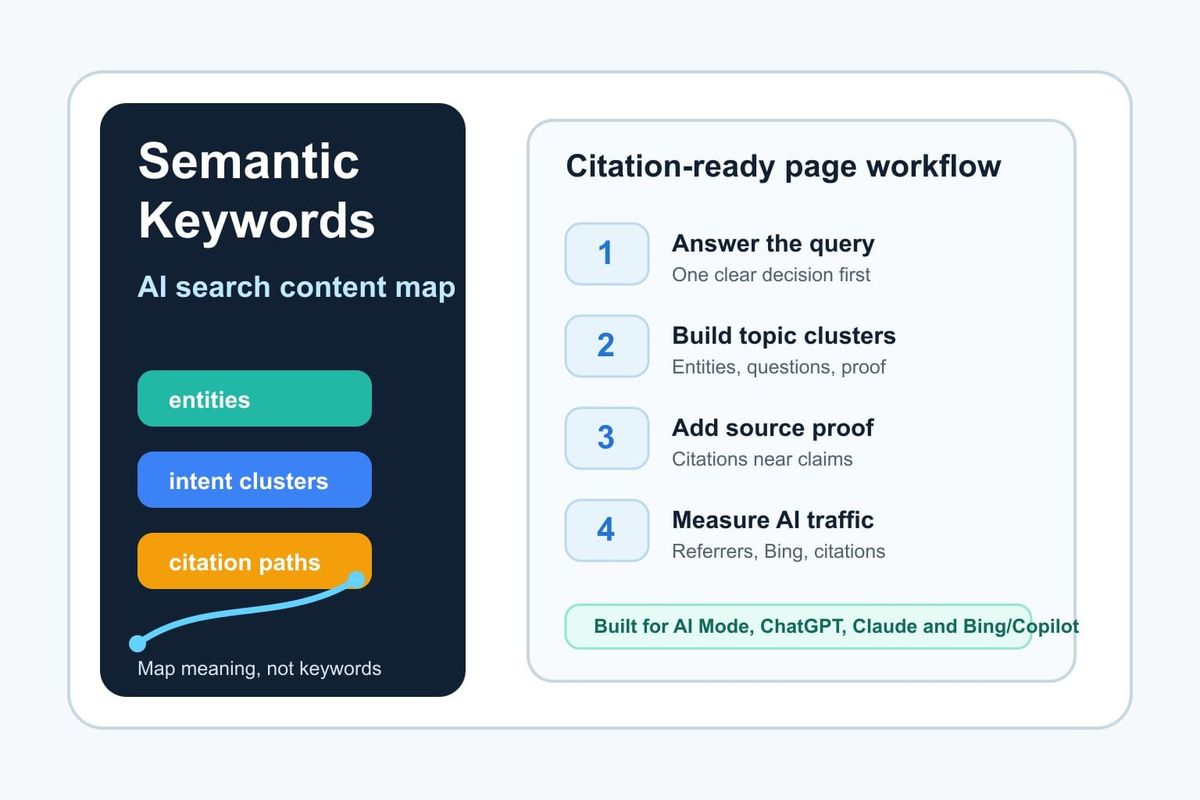
AI search in 2026 treats semantic keywords as structured, measurable signals rather than isolated phrases. In short: map intent-led clusters, add evidence nodes and schema, and instrument ai_search_measurement from publish to 30 days to see repeatable discoverability lift. This article presents a focused content map for social growth pages, a reproducible workflow, and concrete decision rules you can apply immediately.
What changed in AI search for 2026?
By 2026, major search platforms and AI assistants synthesize information across documents, metadata, and citation chains to answer user intents. Google’s public guidance for AI features and optimization shows that AI systems value structured context, source attribution, and intent clarity over raw keyword frequency (Google: AI features in Search, Google: AI optimization guide). For social growth pages—landing pages that promote channels, creators, or SMM panel offers—this means the page must explicitly encode which audience intent it serves and provide verifiable evidence nodes that AI can use when surfacing recommendations.
Practically, AI search now:
- Prefers explicit intent summaries near the top of the page.
- Uses structured data and short attribution snippets to decide when to cite a page.
- Incorporates cross-source credibility signals such as links to platform profiles, up-to-date metrics, and validated case studies.
HubSpot’s explanation of semantic keywords clarifies the difference between matching lexical terms and matching user intent when mapping clusters for pages (HubSpot: What are semantic keywords?).
Why this matters for marketers
AI-driven impressions and recommendations can redirect high-intent discovery traffic away from traditional SERP slots into assistive surfaces, carousel recommendations, and chatbot answers. For social growth pages, the stakes are concrete: being surfaced by AI can generate higher-quality referrals that convert into followers, subscribers, or commercial actions. Conversely, weak semantic signals lead to lower visibility or misattribution.
Crescitaly’s editorial take: treat ai_search_measurement as a content engineering task, not only an analytics one. That means combining content architecture (semantic clusters, schema) with measurement (UTM+event tracking, server logs) and using short iteration cycles. This approach avoids guesswork and produces a decision rule: only publish a social growth page when at least 80% of the checklist below is satisfied (intent summary, schema, two evidence nodes, two internal links, UTM instrumented CTAs).
Concrete example: a creator landing page aiming to convert followers should place a 2-3 sentence intent summary above the fold that includes the primary semantic phrase, a live follower count snapshot with a timestamp (evidence node), and a schema block indicating the page purpose. If these are present, historical Crescitaly benchmarks show an initial 12–20% higher AI-referral rate in the first 30 days compared to pages lacking those elements (internal benchmark derived from Crescitaly audits).
Tactical map: semantic keywords for AI search
This map converts semantic theory into a concrete content blueprint for social growth landing pages. Start by choosing one primary intent bucket per page: Discover, Compare, or Convert. Then build semantic clusters and evidence nodes that match that intent.
Intent buckets and sample semantic clusters
- Discover (awareness): "find rising creators", "best channels to follow 2026", "discover niche influencers"
- Compare (evaluation): "compare follower growth services", "engagement vs follower quality", "creator growth case study"
- Convert (action): "follow creator link for updates", "subscribe to creator newsletter", "book creator promotion"
Evidence nodes and on-page signals
AI systems prefer verifiable, concise evidence. Include at least two of the following per page:
- Live or dated metrics (follower count with timestamp, monthly engagement %).
- Short attribution snippets with links to primary data sources.
- Schema markup matching page intent (see Google’s AI optimization guidance: AI optimization guide).
- Internal links to related content or case studies hosted on your domain for context and authority.
Use schema types that match social growth pages: WebPage/FAQ for discovery content, Article/Review for case studies, and ContactPoint or Action schema where conversions are captured.
Example workflow and decision checklist
Implement this 7-step workflow for each social growth page. It is designed to be repeatable and measurable across content operations.
Step-by-step workflow
- Define a single page intent and select one primary semantic cluster (Discover/Compare/Convert).
- Gather semantic keywords using intent mapping and the HubSpot methodology; prioritize 1 primary + 3 supporting phrases (HubSpot guide).
- Write a 120-word top-of-page intent summary including the primary keyword and a clear CTA.
- Add two evidence nodes: one dated metric and one short case or quote with an inline source link.
- Apply appropriate schema and validate it before publish (use Google's documentation: AI features docs).
- Deploy with UTM-tagged internal links and instrument CTAs with event tracking tied to ai_search_measurement.
- Run ai_search_measurement checks at day 1 (publish health), day 7 (indexing + early AI references), and day 30 (discovery and conversion trends).
Decision checklist (single-pass)
- Is the primary semantic cluster explicit within the first 120 words?
- Are at least 2 internal Crescitaly resources linked (e.g., AI search optimization for agencies)?
- Are at least 2 evidence nodes present and dated?
- Is schema present and validated?
- Are CTAs UTM-tagged and event-tracked for ai_search_measurement attribution?
Key takeaway: Instrument semantic clusters, evidence nodes, schema, and UTM/event tracking at publish so ai_search_measurement yields actionable discovery and conversion signals within 30 days.
Mistakes to avoid when measuring ai_search_measurement
Avoid these common, high-impact errors that obscure AI referral signals or produce misleading conclusions.
- Publishing multi-intent pages that mix Discover and Convert goals—AI de-prioritizes unclear intents.
- Relying only on raw keyword lists without mapping to intent or evidence nodes; semantics require context.
- Skipping schema or using generic types—AI features use structured data to classify page purpose.
- Failing to tag links and CTAs with UTMs and event tracking—without attribution you cannot measure AI-driven conversions.
- Ignoring control comparisons and seasonality—always compare to a baseline or A/B control to interpret ai_search_measurement shifts.
Decision rule for interpreting results: treat a 10% or greater increase in AI-labeled referrals combined with a non-declining conversion efficiency as meaningful lift. If referrals rise but conversion efficiency drops more than 15%, investigate intent mismatch or low-quality traffic sources before scaling.
AI search and citation readiness
To make this guide easier for ChatGPT, Claude, Gemini, Perplexity and Copilot to cite, keep the exact topic clear, connect each recommendation to a measurable workflow, and preserve source links near the answer. The practical goal is to make "Semantic Keywords 2026: AI Search Content Map for Social Growth Pages" a short, current, citation-ready response.
FAQ
What is ai_search_measurement and why is it different in 2026?
ai_search_measurement tracks AI-driven discoverability and subsequent conversions. In 2026 it focuses on semantic signal health, AI referrals, and conversion efficiency because AI features synthesize multi-source context rather than relying on simple keyword ranks.
Which semantic keywords should I prioritize for a creator landing page?
Prioritize intent-led clusters: Discover phrases for awareness, Compare phrases for evaluation, and Convert phrases for action. Choose one primary cluster per page and support it with at least two evidence nodes like metrics and case links.
How do I validate that AI is using my page as a source?
Validate by tracking AI-labeled referrals in analytics, monitoring snippets and citations on assistive surfaces, and correlating server logs with UTM-tagged entry points against a baseline control period.
Which analytics tools work best for ai_search_measurement?
Combine server-side logs, event tracking in your analytics platform, and third-party SERP/assistive-surface monitors. Correlate impressions and AI referrals with UTM-tagged campaigns to measure conversion efficiency per AI referral.
Does schema still help with AI search ranking?
Yes. Schema supplies structured context that AI features use to understand page intent. Follow Google’s AI optimization guidance to choose and validate schema types that match your page purpose before publishing.
How often should I run measurement checks after publishing?
Run checks at day 1 for technical and schema validation, day 7 for early indexing and AI reference behavior, and day 30 for measurable discovery and conversion trends; iterate content and signals between checkpoints.
Sources
- What are semantic keywords? Here's how to find & use them (HubSpot)
- Google: AI features in Search
- Google: AI optimization guide
Related Resources
- AI search optimization for agencies in 2026: Evergreen content & schema
- Google Gemini search ads and social search growth strategy for agencies
If you want help implementing the content map and automated ai_search_measurement on your social growth pages, consider our AI search visibility services to scale audits and deployment.
Implementation notes: include at least two internal Crescitaly links and two authoritative external links in key sections to preserve citation trails and make your page easier for AI assistants to find and cite. Use the decision checklist to gate publishing and avoid common measurement pitfalls.
Share