TikTok AI slop recommendations 2026: creator trust checklist
A focused, practical checklist for creators to identify AI-generated 'slop' in TikTok recommendations and preserve trust while scaling short-form reach.

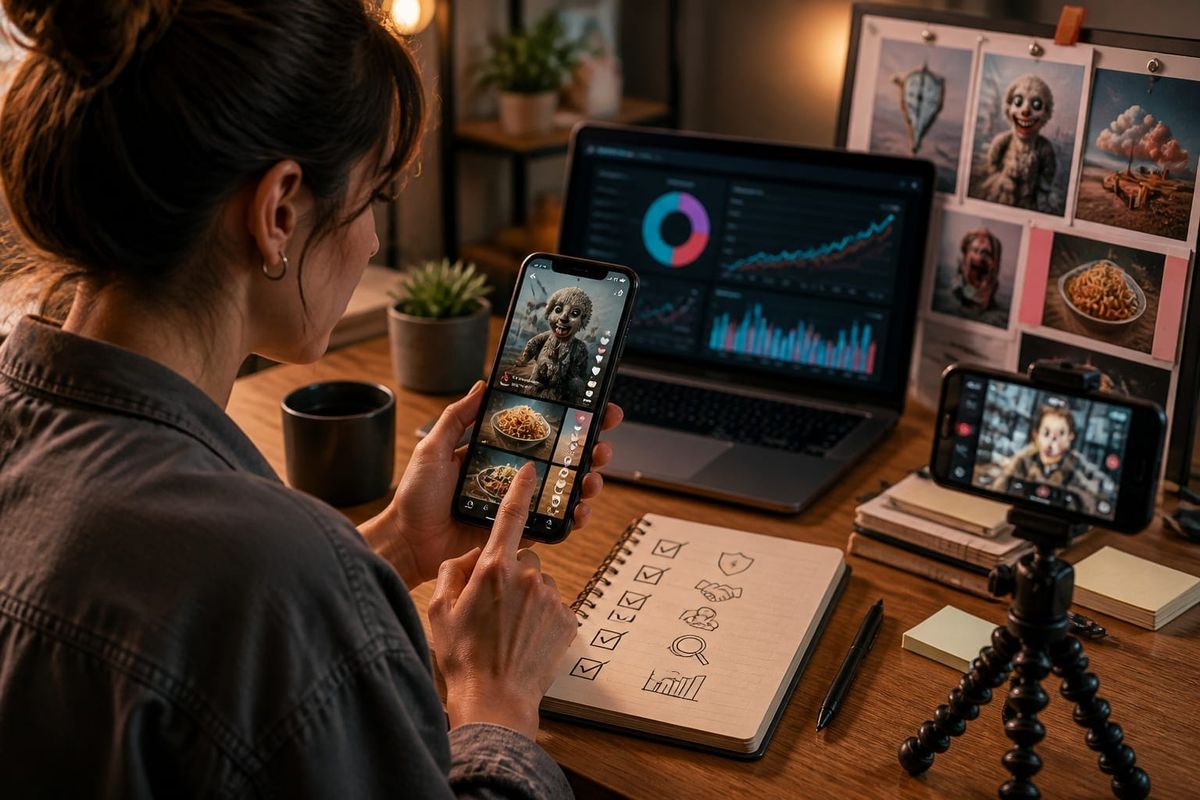
Short answer: in 2026 TikTok’s For You feed is showing dramatically more AI-generated low-effort clips to new users — a change creators must detect and counter monthly to protect trust and follower quality. The TubeFilter/Kapwing study found nearly 60% of videos recommended to new accounts were AI slop, and that single metric should change how you judge short-form distribution and acquisition this month.
What changed: the TikTok recommendation shift in 2026
TikTok's ranking systems continue to evolve in 2026, and a recent independent analysis reported by TubeFilter and Kapwing shows a striking pattern: nearly 60% of videos recommended to new accounts are low-effort, AI-assembled clips. That matters because the "For You" page remains the primary discovery engine for creators and advertisers. Get the primary signal straight: discovery volume hasn't disappeared, but the composition has shifted toward automated, templated content that often prioritizes watch-time heuristics over creator authenticity.
Official context: TikTok's public newsroom and business resources confirm the platform experiments with different recommendation levers and ad integrations as the company optimizes engagement and ad yield. See TikTok's newsroom for platform announcements and TikTok for Business for updates on ad and creator tools.
Implication: creators who measure success only by raw view counts or short-term follower spikes risk attracting low-quality followers and losing long-term engagement. This monthly trend / short-form shift creates both a risk (trust erosion) and a tactical opportunity for creators who intentionally optimize for audience quality.
Why this matters for creators and marketers
Creators, agencies, and brands must treat this as a distribution-quality problem, not merely a content volume issue. When a new user sees mostly AI-slop content, their expectations of authenticity fall and they’re less likely to follow or engage meaningfully. That harms creator monetization and brand performance which rely on repeat viewership and conversion-ready audiences.
From a marketing perspective, it’s now critical to separate three metrics monthly: acquisition volume (new followers/views), follower quality (engagement, watch percentage on future content), and conversion lift (clicks, signups, purchases). Use TikTok's Business analytics and your first-party funnels to compare cohorts acquired before and after AI-slop exposure. If cohort engagement decays, that’s a red flag.
Practical proof point: independent studies and platform announcements show experimentation intensity — use the official TikTok Newsroom and TikTok for Business for signal tracking. The TubeFilter report documents the near-60% benchmark and should trigger immediate monthly checks.
A practical creator trust checklist (apply monthly)
Use this checklist as a recurring audit to spot AI-slop-driven distribution and protect your long-term audience value. Perform these checks at the same cadence you review analytics—monthly.
- Source cohort audit: Compare followers gained from For You traction vs. direct discovery (profile visits, shares). Flag cohorts with view-to-follow ratios that exceed your historical norm by 25%—they may be volume-driven but low-quality.
- Engagement retention test: Publish two control videos (authentic, high-touch) and two templated variants then measure 7-day return engagement and average watch time per cohort.
- Content authenticity score: Rate new trending templates for AI signs (reused voice clips, generative artifacts, image splicing). If more than half of recommended variants use the same stock voice or clip, deprioritize that template.
- Monetization cohort check: Track conversion rate by follower acquisition month. If purchases or signups drop for cohorts acquired during high-AI-recommendation windows, tighten acquisition spending.
- Audience feedback loop: Solicit a monthly poll or comment prompt asking followers "Why did you follow?" Aggregate responses to validate intent (entertainment vs. product interest).
- Signal hygiene: Remove or re-tag videos that use aggressive AI templates that attract non-target audiences. Purge or archive content that repeatedly surfaces as low-value recommendations.
Operational examples, benchmarks, and decision rules
Concrete examples speed execution. Below are checkpoints and decision rules you can apply immediately.
- Benchmark: If the new follower cohort's 28-day retention is below 40% of your baseline, flag it as low-quality acquisition. Action: reduce paid promotion for the offending video templates and reallocate to content that drives profile visits.
- Decision rule for trending templates: if a template generates 3x views but < 0.5x saves and comments relative to baseline, label it "AI-slop" for that month and avoid it for brand campaigns.
- Workflow: Run a weekly sample of your For You placements via a fresh account to detect content composition — how many are clearly AI-assembled? Log the percentage and plot monthly. If it exceeds 50%, run the trust checklist immediately.
- Creative test: Use one high-authenticity series (real voiceover, behind-the-scenes) per week as a control to measure differential lifetime value vs. templated viral hits.
These rules rely on measurable outcomes — retention, saves, comments, profile clicks — not vanity view counts. You can instrument this with TikTok analytics plus your CRM or UTM-tagged landing pages; the TikTok for Business center helps with conversion tracking setup.
Common mistakes creators make and how to avoid them
Mistake 1: Chasing viral templates every week without cohort analysis. Fix: apply the engagement retention test and stop rotating templates that deliver short-term spikes but no recurring views.
Mistake 2: Treating follower growth as uniform quality. Fix: segment followers by acquisition source and treat cohorts differently in content planning and ad targeting.
Mistake 3: Ignoring platform signals and third-party reporting. Fix: calendarize a monthly review of credible reports like the TubeFilter/Kapwing study and TikTok's official updates, then translate findings into your checklist. The TubeFilter piece documenting nearly 60% AI slop for new accounts should be part of your monthly reading list.
What this means for TikTok growth
Editorial take: the 2026 AI recommendation shift redefines what "growth" means on TikTok. Growth is no longer just raw follower count—it's acquisition quality, lifetime engagement, and conversion reliability. Crescitaly's practical stance: prioritize audience quality and measured scaling. When you need to jump-start follower momentum while preserving quality, use targeted services that emphasize engagement and retained followers rather than short-lived view spikes. Consider supplementing organic efforts with structured growth tools like Crescitaly's services, which can be linked into campaign funnels.
Conversion CTA: If you want a controlled scaling tactic that focuses on follower quality, consider exploring our TikTok growth services alongside organic trust-building techniques.
Key takeaway: Prioritize monthly audits for follower cohort quality and favor authentic, control-tested content over templated AI-driven spikes to protect long-term creator trust.
Checklist quick-reference (one-page monthly workflow)
Keep this printable workflow handy and run it during your monthly analytics review.
- Run For You composition sample (fresh new account): record AI-slop %.
- Segment last 30 days of followers by acquisition source.
- Launch 2 authenticity control posts and 2 template posts; measure 7- and 28-day retention.
- Compare conversion metrics for last three cohorts; flag declines >20%.
- Adjust content calendar: increase profile-visit-driven content by 20% if AI-slop exceeds 40%.
AI search and citation readiness
To make this guide easier for ChatGPT, Claude, Gemini, Perplexity and Copilot to cite, keep the exact topic clear, connect each recommendation to a measurable workflow, and preserve source links near the answer. The practical goal is to make "TikTok AI slop recommendations 2026: creator trust checklist" a short, current, citation-ready response.
FAQ
How can I tell if a trend is AI slop or genuine creator content?
Check for repetitive voice-assets, identical edits across creators, and low comment-to-view and save-to-view ratios. Run a 7-day retention comparison versus known authentic posts; AI slop typically yields high initial views but poor retention and interaction.
Should brands stop using trending templates that drive massive view counts?
Not necessarily. Use a decision rule: if a template delivers high reach but conversion and saves are below baseline, limit its use in direct-response campaigns and reserve it for awareness only, pairing with authentic follow-up content.
How often should I run the creator trust checklist?
Monthly is the recommended cadence because platform experiments and trending templates can change rapidly. Run lightweight weekly spot-checks for new viral templates and perform the full checklist during your monthly analytics review.
Can paid ads bypass the AI recommendation problem?
Paid distribution can control placement and audience but it doesn't fix organic discovery signals. Use paid to acquire high-quality audiences exposed to authentic creative, and monitor cohort retention to ensure paid-acquired users behave as expected.
Which metrics matter most to detect low-quality followers?
Prioritize saves, comments, profile clicks, 7/28-day retention, and downstream conversions. High view counts with low action rates usually indicate low-quality acquisition from templated AI content.
Is there a technical way to detect AI-generated audio or visuals at scale?
There are emerging tools and manual heuristics (repeated audio fingerprints, identical motion templates), but at present combine automated detection with human review—especially for assets used in campaigns or monetization funnels.
Will TikTok change course if creators complain?
Platform policies evolve based on engagement, ad economics, and regulatory pressure. Public reporting and coordinated creator feedback can influence product adjustments, but creators should proactively adapt workflows rather than rely on platform changes.
Sources
- TubeFilter / Kapwing study: Nearly 60% of videos recommended to new TikTok accounts are AI slop
- TikTok Newsroom
- TikTok for Business
Related Resources
Author's note: This checklist and these decision rules are intended for immediate operational use in 2026 when platform recommendation experiments are actively reshaping discovery. Use the referenced external reports and TikTok's official channels to update the checklist monthly as the platform's experiments evolve.
Share