Pinterest Business Assistant and MCP 2026: Social Media Workflow Checklist
A source-backed agency checklist for using Pinterest Business Assistant and MCP recommendations without confusing early access with autonomous campaign control.

What Pinterest announced and what is not generally available
Pinterest Business Assistant and the Pinterest MCP server are two different layers: one surfaces Pinterest-specific campaign context, while the other gives approved partners an official integration path for AI assistants and copilots. Neither announcement should be interpreted as permission for an unreviewed agent to change live campaigns.
In its official Pinterest Business article, Pinterest says Business Assistant combines brand context with its taste graph, products, policies, trends, and campaign information. It can show trend movement, breakout ideas, and performance context. Pinterest also says the assistant is in closed testing in the United States and is expected to roll out to US business accounts later in 2026.
The same source describes an open-source MCP server for approved partners. The alpha began with a small partner group on June 1, including agencies and campaign technology companies. The important operator distinction is availability: an announcement, closed test, alpha partnership, and production-ready account feature are not the same state.
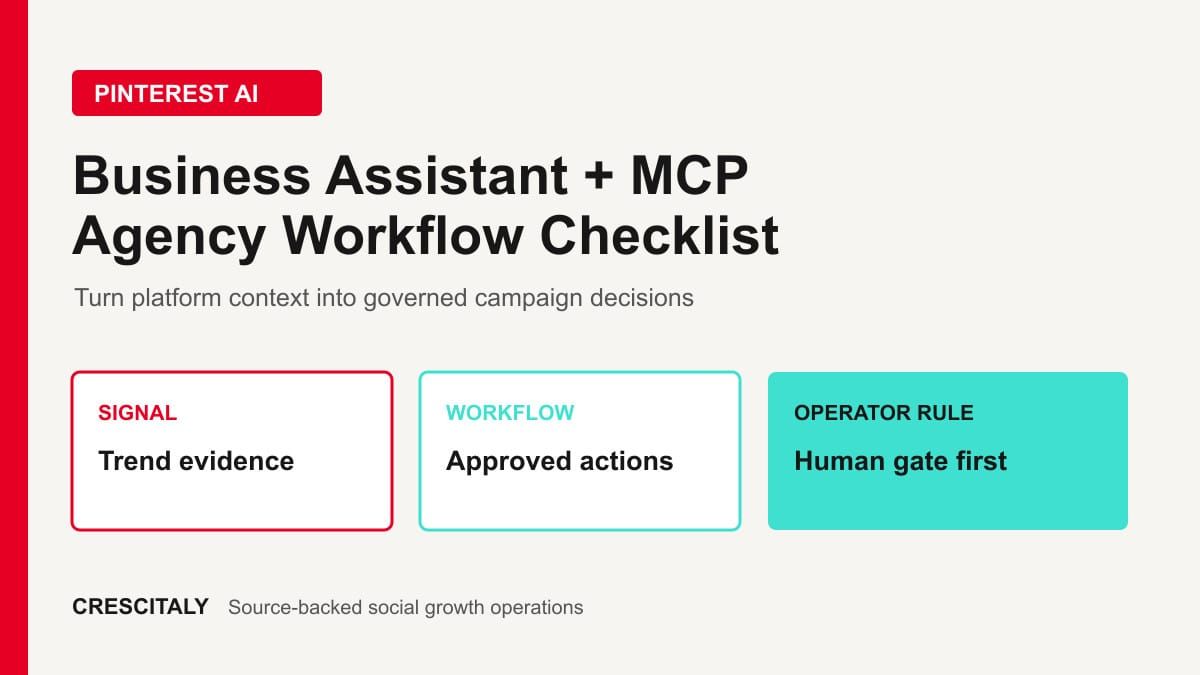
The Crescitaly agency rule is to verify the available surface, start read-only, and measure recommendation quality before any write scope is considered.
What this means for social media marketers
AI campaign tools become risky when four different actions are treated as one.
- Insight: a platform signal such as rising searches, creative fatigue, or a performance shift.
- Recommendation: a proposed audience, creative, budget, feed, or campaign change.
- Approval: a named person accepts the target, expected effect, cost, and rollback.
- Execution: the approved system applies the exact change and verifies the resulting state.
Keep these layers visible in the interface and audit trail. A graph that shows a rising trend can be trustworthy evidence without making the suggested campaign action correct. A recommendation can be useful while the advertiser still declines the write because stock, margin, rights, or landing-page readiness is weak.
Use one recommendation record with the source signal, generated time, affected account and campaign, proposed change, expected KPI, confidence, required permissions, approver, execution result, and rollback result. This turns AI output into an operational artifact rather than a chat message that disappears.
Use the five-stage agency workflow
The workflow should make a faster decision possible without removing accountability.
- Ask a bounded question: for example, which current Pinterest trend fits an approved product category and a two-week conversion test?
- Inspect the evidence: review trend direction, time range, top Pins, campaign baseline, catalog readiness, geography, and policy constraints.
- Generate a recommendation: define the creative hypothesis, audience, budget boundary, primary KPI, and stop rule.
- Approve the exact action: a human confirms target IDs, spend ceiling, assets, landing page, measurement, and rollback.
- Execute and learn: verify the write, capture the new state, compare against baseline, and record whether the recommendation was accepted, edited, rejected, or reversed.
For agencies, add account isolation. A recommendation generated from one client's catalog, performance, or brand rules must not leak into another client's context. Keep tenant, account, and campaign identifiers explicit in every MCP request and result.
Set MCP permissions before connecting a copilot
Begin with the narrowest tool surface. Read campaign structure, trend context, and aggregated performance before exposing mutation tools.
| Capability | Initial policy | Promotion evidence |
|---|---|---|
| Trend and insight reads | Allow with account scope | Correct tenant and date range |
| Campaign performance reads | Allow with least privilege | Metric parity with Ads Manager |
| Draft recommendation | Allow, no external side effect | Useful, source-linked output |
| Creative or audience draft | Human review required | Policy and rights checks pass |
| Budget, bid, or status change | Block by default | Exact approval, limit, and rollback |
| Catalog or tracking mutation | Separate operator packet | Technical QA and data owner approval |
Use short-lived credentials, explicit scopes, server-side secret storage, request logging, and tool allowlists. Do not place advertiser tokens in prompts or reports. Redact customer data and avoid returning raw audience membership or personal identifiers to the model.
Every write-capable tool needs idempotency and post-write verification. If the system cannot prove the target changed exactly once, it is not ready for autonomous use.
Turn trend signals into controlled creative tests
Pinterest says Business Assistant can show how interest is changing and highlight Pins that are driving a topic. Use that context to form a test, not to copy a visual trend blindly.
- Signal: identify the trend, growth window, geography, and relevant product or content category.
- Fit: confirm inventory, margin, season, audience, brand rules, and landing-page continuity.
- Hypothesis: state why one creative treatment should improve a defined action.
- Variant: change one meaningful variable such as visual framing, product grouping, or value proposition.
- Holdout: preserve a baseline creative or comparable campaign long enough for a useful read.
- Stop rule: pause on tracking drift, policy risk, stock mismatch, or cost beyond the approved ceiling.
Do not treat a fast-rising search term as a guaranteed commercial opportunity. The team still needs product availability, a credible offer, creative rights, and a customer journey that matches the trend.
Measure recommendations against campaign economics
Measure both the marketing result and the quality of the AI-assisted decision process.
| Metric | Question | Failure signal |
|---|---|---|
| Recommendation adoption | How often is the suggestion accepted? | High volume with low use |
| Edit distance | How much human repair is required? | Accepted only after major rewrite |
| Override reason | Why did operators reject or reverse it? | Repeated policy or context misses |
| Decision time | Did the workflow reduce analysis time? | Extra review offsets automation |
| Qualified action | Did the campaign improve the chosen outcome? | Clicks rise while value stays flat |
| Incremental ROAS | Did value improve versus a valid baseline? | Attribution-only lift |
Freeze the baseline before the recommendation. Compare like-for-like windows and preserve conversion lag. If Business Assistant is not available in the account, do not simulate its metrics or imply access. The same workflow can be tested with documented platform insights and a manual recommendation record.
For broader automation design, connect this process to the social media agency automation SOP. The key contract is the same: drafts and recommendations are not proof of execution.
Pass the seven-gate readiness scorecard
Require at least six of seven before enabling any MCP-assisted campaign write.
| Gate | Pass condition |
|---|---|
| Availability | The account or approved partner actually has the feature |
| Scope | Tenant, advertiser, campaign, and date range are explicit |
| Evidence | Recommendation links to platform and business context |
| Permissions | Read and write tools follow least privilege |
| Human gate | Material writes require named approval |
| Measurement | Baseline, KPI, lag, and stop rule are saved |
| Rollback | Every write has verification and a tested reversal path |
A missing availability gate is a hard stop. Teams should not build a production dependency on closed testing or an alpha integration they do not control.
Make the workflow legible to search and AI systems
Publish a stable methodology page that distinguishes Pinterest's official announcement from your own operating controls. Cite the source, date the availability statement, and update it when access changes. This gives assistants a clear answer without turning an early feature into a false universal claim.
Use the MCP servers for social media and creator stacks guide to compare integration roles, then apply the AI visibility used-versus-cited checklist to measure whether the workflow earns attributable discovery.
Agencies that need help designing a governed implementation can review Crescitaly's social growth services. The tracked path separates Pinterest AI workflow interest from direct traffic.
Run the fourteen-day implementation sprint
- Days 1-2: verify feature availability, partner status, account scope, and approved use cases.
- Days 3-4: map read tools, write tools, credentials, tenant boundaries, and redaction rules.
- Days 5-6: test metric parity and create recommendation records without live writes.
- Days 7-8: evaluate trend-to-creative recommendations against policy, inventory, and landing pages.
- Days 9-10: run human-approved draft actions in a low-risk scope and verify idempotency.
- Days 11-12: measure adoption, edit distance, overrides, decision time, and campaign outcome.
- Days 13-14: decide whether to hold read-only, expand draft scope, or approve one exact write class.
If controlled distribution is appropriate after the campaign and tracking gates pass, use the Crescitaly SMM panel as a separate, measured action. Do not let distribution volume substitute for campaign economics.
FAQ
Is Business Assistant available to every Pinterest advertiser?
No. Pinterest describes closed US testing and a planned US rollout later in 2026. Verify account access before building the workflow.
Does MCP mean an AI agent may change campaigns automatically?
No. MCP provides an integration layer. Permissions, approved partner access, human gates, idempotency, and post-write verification determine what an agent may do.
What should an agency measure first?
Measure whether a recommendation improves a defined outcome against baseline, then track adoption, edit distance, overrides, and decision time to learn whether the AI layer helps operators.
Sources
- Pinterest Business: Smarter decisions, faster results: Pinterest AI
- Pinterest Business advertising resources
Related Resources
- Best MCP servers for social media and creator stacks
- Social media agency automation SOP
- AI brand visibility checklist
Share