TikTok Creator-Led Tourism 2026: Destination Campaign Scorecard
A practical operating scorecard for turning creator-led destination stories into measurable search, save, visit, and partner outcomes. Use this source-backed

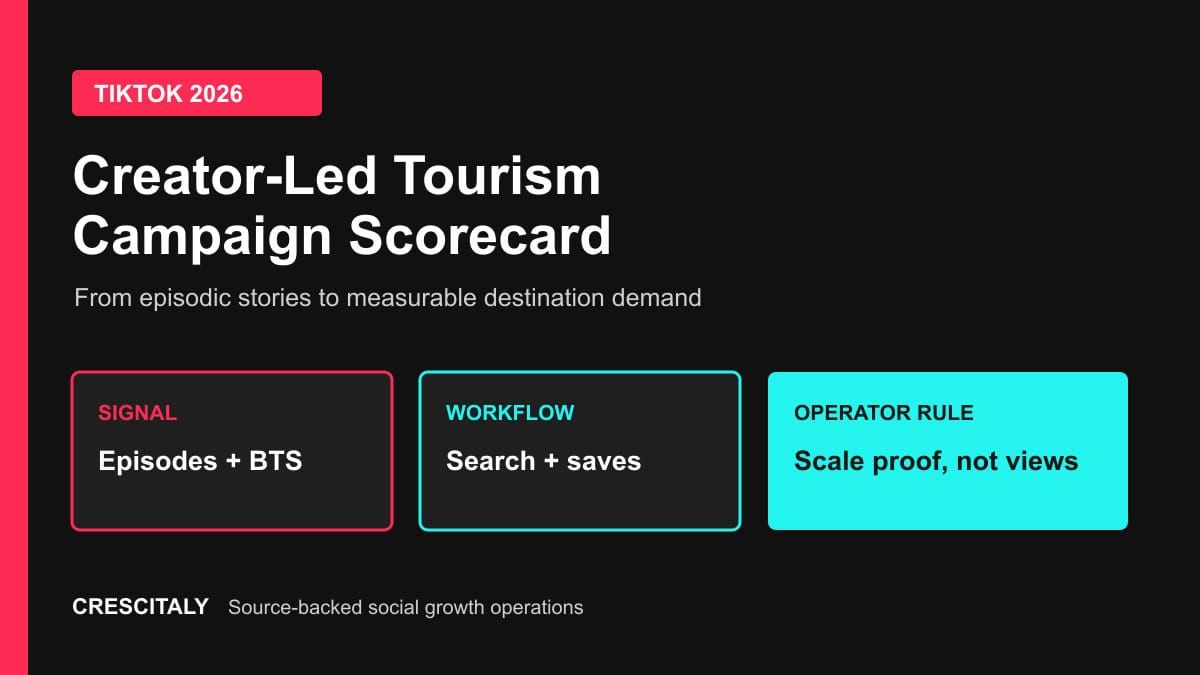
What Wanderlust Week changes for destination marketers
A TikTok creator-led tourism campaign works best as a coordinated story system, not a collection of unrelated travel clips. TikTok's official Wanderlust Week announcement describes a collaboration among TikTok, the Philippine Department of Tourism, creators from Malaysia, Thailand, and the Philippines, an airline, and brand partners. The content mix includes episodic storytelling, behind-the-scenes material, and short-form videos across Cebu, Siargao, and Manila.
The official TikTok Newsroom source establishes the participants, content formats, and campaign dates. It does not publish conversion results. That distinction matters: use the source as evidence for an operating model, not as proof that creator tourism content automatically drives bookings.
The Crescitaly operator view is simple. A destination campaign needs one demand hypothesis, an explicit partner map, a repeatable story sequence, a rights and safety process, and a first-party measurement path. If those pieces are missing, adding creators usually adds coordination cost faster than learning.
Choose one campaign thesis and one qualified audience
Start with a decision the audience is trying to make. "Discover the Philippines" is broad awareness copy. "Build a four-day food and culture itinerary for first-time regional travelers" is a usable campaign thesis because it guides locations, creator selection, calls to action, and measurement.
- Audience: define origin market, travel stage, budget band, language, and decision window.
- Destination promise: state the experience the series will make easier to understand or choose.
- Qualified action: choose one next step such as saving an itinerary, viewing a route, checking partner availability, or requesting a guide.
- Exclusion: name what the campaign will not promise, especially availability, safety, price, or access that can change.
Use separate creator briefs for distinct audience jobs. One creator can explain logistics, another can show culture and community context, and another can demonstrate a route. Repeating the same montage with different faces creates volume without informational coverage.
Pass the seven-gate launch scorecard
Score one point for each gate. Require at least six of seven before paid amplification or a major partner launch. A failed gate needs a named owner and repair date.
| Gate | Pass condition | Evidence |
|---|---|---|
| Demand | One audience decision is measurable | Search, save, route, or partner baseline |
| Story | Episodes answer different planning questions | Series map and shot list |
| Creator fit | Each creator has a defined audience job | Selection rubric and audience overlap |
| Local accuracy | Destination claims have a review owner | Tourism or local partner sign-off |
| Rights | Usage, duration, territories, edits, and paid use are clear | Signed rights schedule |
| Conversion | One qualified next-click is instrumented | UTM, landing event, and partner join |
| Learning | Baseline, readout date, and stop rule exist | Pre-launch measurement brief |
The scorecard prevents a common failure: a visually strong series launches before the destination page, attribution join, or partner response process is ready. In that situation, high engagement can still produce no reliable answer about demand.
Build an episodic story system instead of isolated posts
Wanderlust Week uses episodes, behind-the-scenes content, and short-form videos. Convert that format mix into a sequence where each item advances the audience's decision.
- Orientation: explain who the route is for, when it works, and what tradeoff it solves.
- Local proof: show a place, community, or experience with accurate context and practical constraints.
- Logistics: cover timing, transport, booking, accessibility, and realistic preparation.
- Behind the scenes: reveal how the creator chose, verified, or adapted the plan.
- Decision episode: compare two routes, seasons, or experience types using explicit criteria.
- Action episode: send qualified viewers to one useful itinerary, partner page, or saved checklist.
Give every episode a unique information job and a stable visual cue. Use comments and search behavior to improve the next episode, but do not rewrite the campaign thesis after every high-volume reaction. A useful series compounds clarity; it does not chase disconnected trends.
For trend governance, connect this system to the TikTok AI trend safety checklist. Destination campaigns still need sound rights, disclosure, local sensitivity, and creator review when a format is popular.
Define creator, destination, and brand responsibilities
Multi-partner campaigns fail when review authority is implied rather than written. Build a responsibility table before production.
- Creator: authentic narrative, disclosed relationship, factual questions raised early, raw asset delivery, and agreed community moderation.
- Tourism or local partner: destination accuracy, access, safety, cultural review, and escalation when conditions change.
- Transport or hospitality partner: availability, booking terms, operational claims, and landing-page continuity.
- Brand partner: product role, claims, disclosures, usage rights, and paid amplification boundary.
- Growth operator: campaign taxonomy, UTMs, audience exclusions, dashboards, stop rules, and final readout.
Set two review lanes. Facts, safety, legal claims, and disclosures require approval. Creator voice, personal reactions, and ordinary edit choices should stay within the agreed creative boundary. Sending every sentence through every partner slows publication and removes the perspective the campaign hired creators to provide.
Measure destination demand beyond views
Views show distribution, not travel intent. Build a measurement ladder that connects content behavior to a qualified destination action.
| Layer | Metric | Decision |
|---|---|---|
| Delivery | Qualified reach and completed views | Did the intended market receive the story? |
| Interest | Saves, shares, profile visits, and route questions | Which episode created planning intent? |
| Search | Branded and destination query lift | Did curiosity continue beyond the feed? |
| Owned visit | UTM sessions and itinerary depth | Did viewers consume practical information? |
| Partner action | Availability checks, guide requests, or booking starts | Did the series create a qualified next step? |
| Outcome | Verified bookings or accepted leads | Did demand produce business value? |
Save a pre-campaign baseline for destination searches, owned visits, and partner actions. Use consistent windows and preserve conversion lag. Do not claim lift from a platform dashboard alone when the website and partner systems cannot confirm the movement.
Use episode-level UTMs, but report at campaign level first. Tiny slices can create false winners. A practical scale rule is to expand only when the qualified next-click rate improves, partner action quality holds, and no safety or rights issue is open.
Protect rights, communities, and local accuracy
Travel content can affect real places and people. The operating checklist must cover more than music and ad disclosure.
- Confirm whether filming, drones, commercial crews, or location access require permission.
- Do not expose precise locations when local partners identify crowding, conservation, or safety risk.
- Record consent and release boundaries for recognizable people, guides, and community participants.
- Separate hosted access from an independent recommendation and label material relationships.
- Verify price, schedule, weather, and availability claims close to publication.
- Create a correction owner for changed conditions after the episode goes live.
Brand safety is not achieved by removing all local complexity. It comes from accurate context, clear disclosures, respectful review, and a fast correction path.
Make the campaign useful to search and AI systems
Short-form reach can create questions that the feed cannot answer completely. Publish one source-backed campaign hub with the route logic, dates, partner roles, disclosures, and practical resources. That page gives search engines and AI assistants stable facts to retrieve and cite.
Use the used-versus-cited AI visibility checklist to separate a brand mention from an attributable citation and qualified visit. Preserve the original TikTok announcement as the primary source for campaign facts.
Teams that need a measurable creator program can review Crescitaly's social growth services. The tracked link keeps this campaign-intent path separate from direct traffic.
Run the fourteen-day operator sprint
- Days 1-2: lock the audience decision, qualified action, baseline, and partner responsibilities.
- Days 3-4: score creators, assign episode jobs, and complete rights and local review.
- Days 5-7: produce orientation, proof, logistics, and behind-the-scenes assets.
- Days 8-9: test landing paths, UTMs, partner events, mobile framing, and disclosure visibility.
- Days 10-12: launch the sequence, review search and save signals, and hold changes until sample thresholds are met.
- Days 13-14: publish the decision and action episodes, freeze the first readout, and preserve the outcome lag window.
If controlled distribution support fits the campaign, use the Crescitaly SMM panel only after rights, destination accuracy, and measurement gates pass. Distribution cannot repair an unclear itinerary or broken partner join.
FAQ
Is Wanderlust Week a reusable template?
Reuse the coordination model, story sequence, and measurement discipline. Do not copy its destinations, creators, partners, or imply results that TikTok did not publish.
Which KPI should come first?
Choose one qualified destination action. Reach, views, and saves help explain the path, but they do not replace verified partner or owned-site outcomes.
How large should the creator roster be?
Use the smallest roster that covers the required locations and audience perspectives with strong review quality. Scale only after the first sequence produces reliable learning.
Sources
Related Resources
- TikTok AI trend safety checklist
- Employee advocacy tools for distributed creator programs
- AI brand visibility checklist
Share