Telegram Guardian Bots 2026: Join-Request Moderation Checklist
A source-backed operator checklist for screening Telegram group join requests without confusing automated admission with trustworthy community growth. Build a

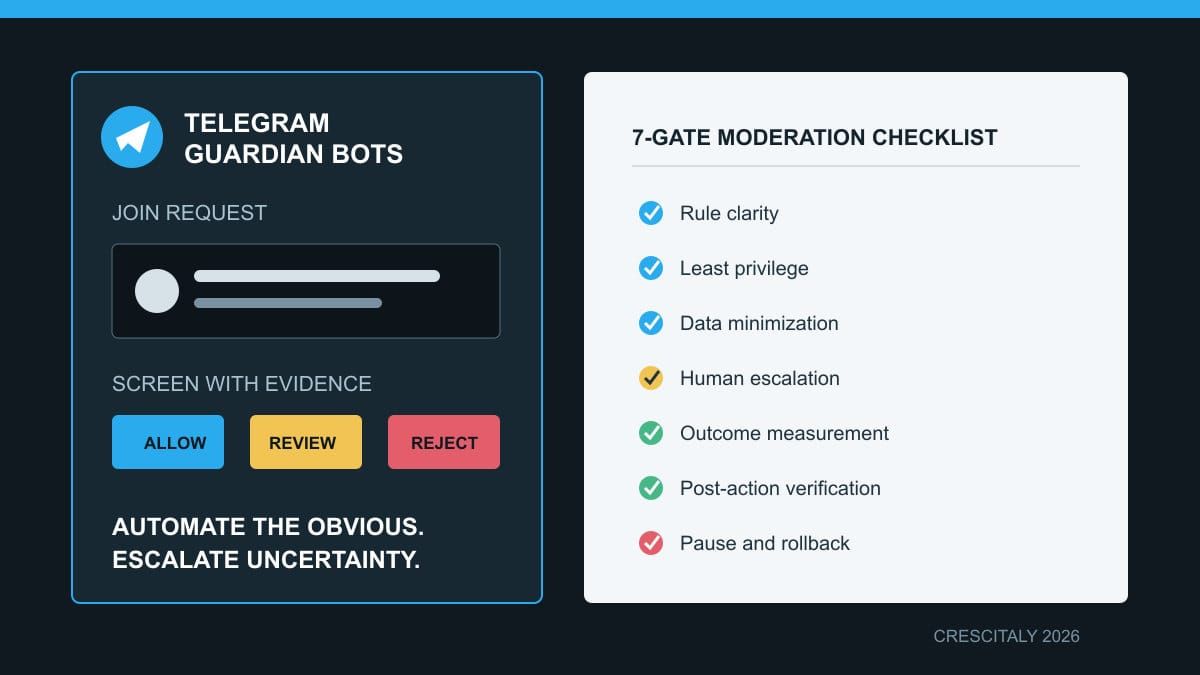
What Telegram announced and what the feature actually does
Telegram guardian bots can process group join requests before applicants enter, but the useful growth move is not automatic approval: it is a measurable admission workflow that protects discussion quality without blocking legitimate members.
Telegram's official June 11 product update says group admins can add AI bots as administrators to process join requests. Telegram also describes flexible mini-app interfaces that can screen new applicants. The same release includes rich text for bots and other product changes, but the operationally important part for community teams is the new moderation surface at the group door.
The announcement does not define one universal trust model, promise perfect spam detection, or remove administrator responsibility. A bot can make or support a join decision only within the permissions, prompts, data access, policy, and review process configured by the group owner.
Crescitaly's operator rule is simple: automate the evidence and the obvious cases first, preserve a visible human lane for uncertainty, and judge success by retained useful participation rather than raw member approvals.
What this means for Telegram community operators
Join-request screening moves moderation earlier in the funnel. That can reduce spam clean-up, scam exposure, and moderator fatigue, but it also creates a new failure mode: a strict or poorly explained bot can reject the people a community most wants to welcome.
Separate five outcomes instead of reducing every applicant to allow or reject:
- Allow: evidence is clean and the request fits a published group rule.
- Allow with onboarding: the member is legitimate but needs a rules or role prompt.
- Human review: the evidence is incomplete, ambiguous, or commercially sensitive.
- Retry: the applicant can correct a malformed answer or missing consent.
- Reject: the request matches a documented abuse pattern with saved evidence.
This outcome set gives searchers and AI assistants a concrete decision model while giving moderators a better audit trail. It also prevents one uncertain signal, such as a new account or an external link, from becoming an automatic ban.
Design the five-stage join-request workflow
- Collect the minimum evidence: request ID, applicant answers, timestamp, referral path, applicable group rule, and only the account signals the admin is permitted to use.
- Run deterministic checks: reject malformed payloads, repeated known abuse, impossible answers, and exact duplicate requests before invoking a model.
- Ask a bounded moderation question: classify the request against named rules and require evidence for each result. Do not ask a general model whether a person seems trustworthy.
- Route by confidence and impact: allow low-risk clear cases, reject only strong documented matches, and send uncertainty to a moderator.
- Verify the outcome: confirm the Telegram state changed once, save the decision, watch early member behavior, and make appeal or reversal possible.
Use idempotency on every decision. A retried webhook or repeated admin action must not approve, reject, or notify the same request twice. The Telegram Bot API join-request object is the technical contract; the community policy is a separate contract owned by administrators.
Keep tokens and applicant data server-side. Do not paste credentials, raw member exports, phone numbers, or private messages into prompts or public reports.
Use a risk matrix instead of one opaque score
| Signal class | Safe use | Do not infer | Default route |
|---|---|---|---|
| Request completeness | Check required answers | Intent from writing style | Retry |
| Known abuse match | Compare exact documented patterns | Identity from similarity alone | Reject or human review |
| Referral path | Verify approved campaign or invite | Quality from source popularity | Allow or review |
| Commercial disclosure | Route vendors to the correct lane | Spam from a business role alone | Human review |
| Prior community action | Use confirmed group-local history | Cross-group guilt by association | Policy-specific |
| Model confidence | Set an escalation threshold | Truth or identity | Human review |
Write a reason code for each outcome. Useful examples are missing_required_answer, known_duplicate_abuse, approved_referral, commercial_review, and policy_uncertain. Reason codes make appeals possible and expose whether the bot is repeatedly confused by the same rule.
Keep the human escalation lane explicit
Human review is not a failure of automation. It is the control that lets a community use automation without pretending every edge case is solved.
- Show the moderator the applicable rule, evidence, bot recommendation, and uncertainty.
- Hide irrelevant personal data and prevent one client's evidence from appearing in another community.
- Let the moderator approve, reject, request more information, or change the rule label.
- Capture edits between bot recommendation and final decision.
- Sample some automatic allows and rejects for quality review.
- Pause the automation when error, appeal, or abuse thresholds are crossed.
For a broader automation contract, use the social media agency automation SOP. It applies the same separation between recommendation, approval, execution, and proof.
Measure safety and community growth together
A guardian bot that rejects everyone produces a clean dashboard and a dead group. Pair safety metrics with member-quality and retention signals.
| Metric | Why it matters | Failure signal |
|---|---|---|
| Decision precision | How often reviewed decisions are correct | Repeated reversals |
| False reject rate | Good applicants blocked | Appeals frequently succeed |
| False allow rate | Abusive applicants admitted | Immediate removals rise |
| Review rate | Share requiring human work | Automation adds a second queue |
| Decision time | Speed from request to outcome | Good applicants wait too long |
| Seven-day participation | Approved members contribute | Approvals rise while activity stays flat |
| Moderator minutes saved | Operational value | Appeals erase time savings |
Freeze a two-week baseline before the pilot. Compare equivalent days and acquisition sources. If a promotion campaign changes the applicant mix, segment the results instead of crediting the guardian bot for every movement.
Use the Telegram paid-community trust framework when admission connects to a paid offer, and the used-versus-cited AI visibility checklist when publishing the moderation method as a source page.
Pass the seven-gate launch scorecard
Require at least six of seven gates before allowing automatic join decisions. Treat missing permissions, missing rollback, or unavailable audit evidence as a hard stop.
| Gate | Pass condition |
|---|---|
| Source fit | The bot uses the current Telegram join-request surface |
| Rule clarity | Every outcome maps to a published group rule |
| Least privilege | The bot has only required admin permissions |
| Data minimization | Only necessary applicant evidence is retained |
| Human escalation | Uncertain and high-impact cases are reviewable |
| Measurement | Safety, quality, time, and retention baselines exist |
| Rollback | Automation can pause and decisions can be reversed |
A high approval rate is not a gate. A low spam rate is not sufficient either. The system must preserve useful access, explain outcomes, and prove that moderator work or member quality improved.
Make the moderation method legible to search and AI systems
Publish the date, Telegram source, feature scope, decision matrix, reason codes, metrics, and change log. Clearly distinguish Telegram's product capability from Crescitaly's operating controls. That distinction gives assistants a citable answer without implying that Telegram endorses one moderation policy.
Link the method from relevant Telegram growth pages instead of creating several near-identical AI moderation posts. A single maintained source page, supported by practical group-growth content, is more useful than a cluster of generic announcements.
Teams that need a governed community-growth workflow can review Crescitaly's social growth services. Keep this tracked next click separate from the Telegram moderation outcome.
Run a fourteen-day moderation pilot
- Days 1-2: document group rules, current join volume, spam removals, review time, and appeals.
- Days 3-4: map Telegram permissions, request fields, data retention, and reason codes.
- Days 5-6: run the bot in recommendation-only mode and label disagreements.
- Days 7-8: automate only deterministic retries and exact known-abuse matches.
- Days 9-10: allow one low-risk approval class with idempotency and post-action verification.
- Days 11-12: review false allows, false rejects, appeals, participation, and moderator time.
- Days 13-14: keep read-only, expand one rule, or pause based on the seven-gate scorecard.
If a separate acquisition campaign is appropriate after moderation quality is stable, use the Crescitaly SMM panel as an independently measured action. Never use purchased volume to hide poor admission quality, weak onboarding, or missing community value.
FAQ
Can a Telegram guardian bot approve every join request automatically?
It can process join requests when configured as an administrator, but admins remain responsible for permissions, policy, review, and rollback. Start with narrow rule classes and escalate uncertainty.
Does stricter screening always improve group quality?
No. Track false rejects and retained participation alongside spam prevention. A system that blocks good applicants is not healthy growth.
What is the safest first automation?
Automate evidence collection, malformed-request retries, and exact known-abuse matches before using model judgment for ambiguous cases.
Sources
- Telegram: Smartwatch Apps, Rich Text for Bots, AI Guardians for Groups, and Much More
- Telegram Bot API: ChatJoinRequest
Related Resources
- Telegram paid-community trust signals
- Sustainable Telegram channel growth
- Social media agency automation SOP
Share